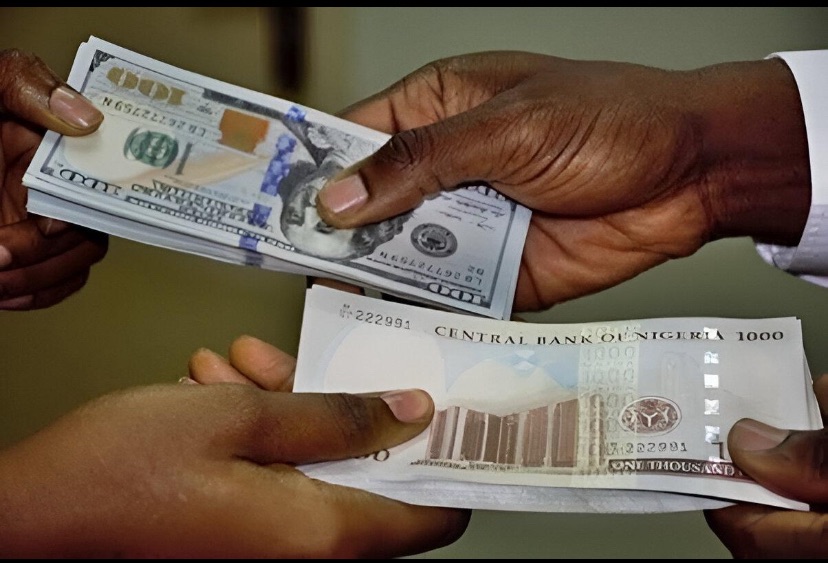

Demand for foreign exchange in Nigeria dropped sharply in April 2026, giving the naira some breathing space and helping to reduce pressure on the country’s currency market.
According to data from the Central Bank of Nigeria (CBN), end-users demanded $3.42 billion in foreign exchange during the month, representing a 35.23 per cent decline from the previous period.
The fall in demand came as the naira recorded modest gains at the official foreign exchange market.
The average exchange rate improved by 1.38 per cent to N1,361.22 per dollar in April, compared with N1,379.98 in March. By the end of April, the naira stood at N1,374.94 per dollar, stronger than the N1,386.72 recorded at the end of March.
The figures suggest that reduced demand for dollars played a role in easing pressure on the naira during the month.
Foreign exchange was used across several areas of the economy. Visible imports accounted for 41.92 per cent of total FX utilisation, while invisible imports made up the remaining 58.08 per cent.
Industrial activities were the biggest users of foreign exchange among visible imports, accounting for 37.44 per cent. Manufactured products followed with 21.85 per cent, while oil imports represented 20.11 per cent.
Food products accounted for 14.47 per cent of visible import-related FX usage. Transport-related imports made up 3.54 per cent, while minerals and agricultural products accounted for 1.47 per cent and 1.12 per cent respectively.
For invisible imports, financial services dominated demand, taking up 91.51 per cent of total utilisation. Business services accounted for 4.37 per cent, while transport services represented 2.58 per cent. Communication services accounted for 0.84 per cent.
Trading activity in the official FX market also weakened during the month. Average foreign exchange turnover fell by 26.97 per cent to $442.54 million in April, from $605.93 million in March.
However, Nigeria’s overall foreign exchange position improved despite the lower market activity.
Net FX inflows increased to $5.85 billion in April, compared with $4.16 billion in March. The improvement was mainly driven by a significant reduction in foreign exchange outflows.
Total inflows stood at $8.71 billion, down from $9.70 billion in March. However, outflows fell much more sharply, dropping to $2.86 billion from $5.54 billion.
The banking system recorded a net outflow of $180 million, a major improvement from the $1.66 billion recorded in March. Autonomous sources, meanwhile, recorded a net inflow of $6.02 billion.
Nigeria’s external reserves remained almost unchanged at $48.32 billion at the end of April, compared with $48.35 billion in March.
The reserves were enough to cover about 10 months of imports, well above the commonly referenced international minimum of three months.
The combination of lower dollar demand, reduced outflows and stronger net FX inflows provided some relief for Nigeria’s currency market.
The April figures indicate that pressure on the naira was beginning to ease, although continued stability will depend on sustained dollar supply, investor confidence and the overall performance of the Nigerian economy.