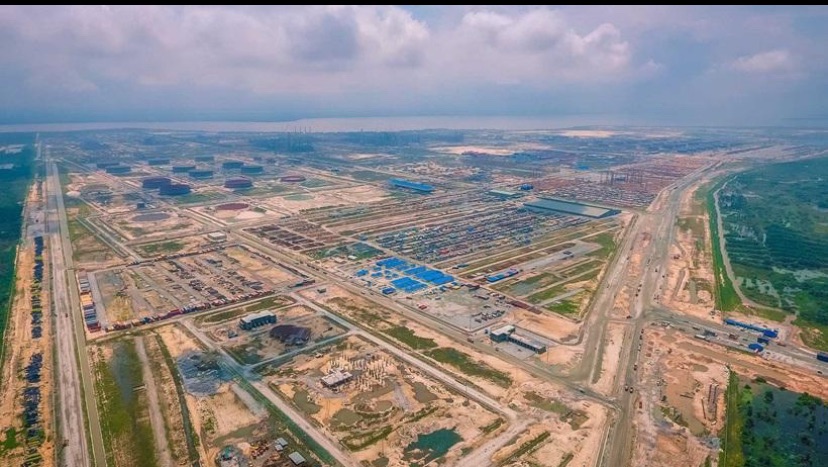

Nigeria imported crude oil worth $1.39 billion during the first quarter of 2026, marking a significant increase as local refineries, particularly the Dangote Petroleum Refinery, sourced more feedstock from international markets.
According to data from the Central Bank of Nigeria (CBN), crude oil imports surged from $340 million in the last quarter of 2025 to $1.39 billion between January and March 2026. This represents a sharp increase of more than 300 percent within three months.
The development highlights a major shift in Nigeria’s petroleum trade pattern. Although the country remains Africa’s largest crude oil producer, its biggest refinery is increasingly relying on imported crude to support growing production activities.
CBN figures showed that crude oil imports accounted for about 82 percent of the total $1.70 billion spent on importing crude oil, gas, and refined petroleum products during the quarter.
The rise in crude imports comes as the Dangote refinery continues to ramp up production and expand exports of refined petroleum products. Industry experts say imported crude grades often better suit the refinery’s operational requirements and are sometimes more competitively priced than locally supplied crude.
While crude oil imports increased significantly, imports of refined petroleum products dropped sharply. The country spent only $310 million on fuel imports during the first quarter, compared to $2.48 billion in the previous quarter. This represents an 87.5 percent decline.
The reduction suggests that locally refined fuel is increasingly replacing imported products, helping Nigeria reduce its dependence on foreign fuel supplies.
At the same time, exports of refined petroleum products grew strongly. Earnings from refined product exports rose by over 20 percent to $2.37 billion, up from $1.97 billion in the previous quarter.
This trend indicates that Nigeria is gradually moving away from being a major importer of refined fuel and is becoming an important exporter of petroleum products. The expansion of local refining capacity, led by the Dangote refinery and supported by other facilities, is playing a key role in this transformation.
The country’s overall trade performance also improved during the period. The CBN reported that Nigeria’s goods account surplus increased significantly to $5.95 billion in the first quarter of 2026, compared to $1.77 billion in the previous quarter.
Crude oil export earnings rose by nearly 20 percent to $8.11 billion, while gas exports increased to $2.53 billion. Total exports climbed to $15.49 billion, while imports fell to $9.54 billion.
As a result, Nigeria’s current account surplus rose to $4.98 billion, representing a major improvement over previous quarters. The stronger external position also contributed to an increase in the nation’s foreign reserves, which reached $48.35 billion at the end of March 2026.
Despite these gains, concerns remain about the availability of crude oil for local refiners. Data from the Nigerian Upstream Petroleum Regulatory Commission showed that local refineries received only 28.5 million barrels of crude during the quarter, despite more than 61 million barrels being allocated to them.
Industry stakeholders say pricing remains one of the biggest challenges. The Crude Oil Refiners Association of Nigeria explained that many domestic producers sell crude at premium prices linked to Brent crude benchmarks, while imported grades such as West Texas Intermediate (WTI) can sometimes offer better value and compatibility for refinery operations.
Experts believe that adjusting local pricing structures and improving domestic supply arrangements could help reduce dependence on imported crude while strengthening Nigeria’s refining sector and long-term energy security ambitions.