


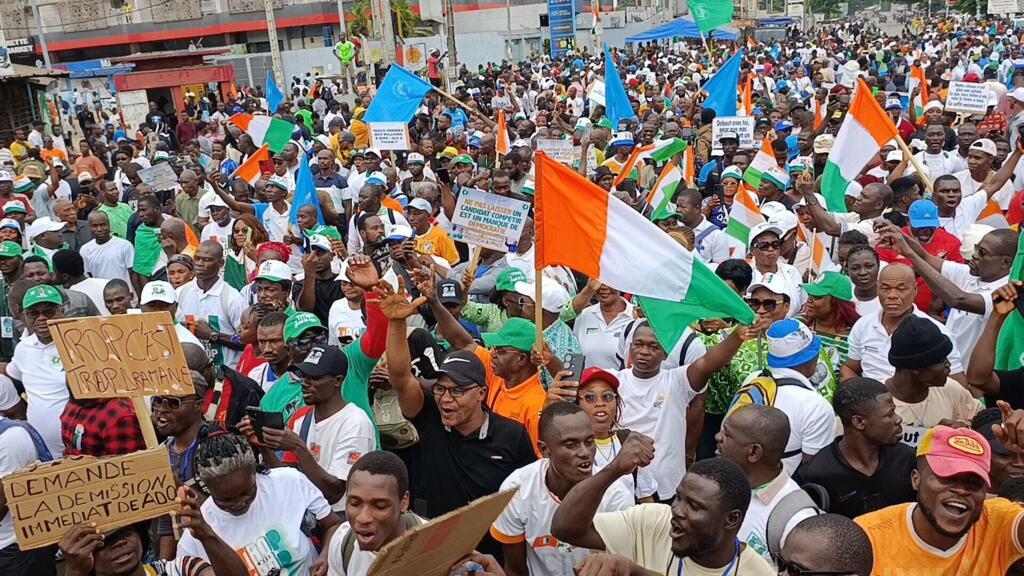

An Ivory Coast court has sentenced 32 people to three years in prison for participating in a banned demonstration earlier this month, just days before the country’s presidential election. The ruling, delivered on Tuesday, marks a further escalation in political tensions ahead of the 25 October vote, which has already been marred by protests, arrests, and sporadic violence.
The convicted protesters were found guilty of “disturbing public order” and “assembling on public roadways,” the same charges used against around 30 others who were sentenced last week for participating in similar demonstrations. The latest verdict underscores the government’s hard-line stance on unauthorised gatherings amid mounting unrest over the disqualification of key opposition figures from the upcoming election.
Opposition groups have been calling on their supporters to rally against the exclusion of former president Laurent Gbagbo and former prime minister Tidjane Thiam, both of whom were barred from contesting by the Constitutional Council. Their exclusion has deepened grievances among opposition supporters, who accuse the ruling administration of attempting to manipulate the electoral process in favour of President Alassane Ouattara’s preferred candidate.
Authorities have imposed a nationwide ban on demonstrations, citing the risk of violence and disruption to public order. Government officials claim that more than 700 people have been arrested across the country in recent weeks in connection with what they describe as illegal protests. Public prosecutor Oumar Braman Koné defended the crackdown, stating that some of the demonstrations had “amounted to acts of terrorism” due to the level of destruction and confrontation involved.
However, opposition lawyers have strongly rejected these allegations and vowed to appeal the convictions. They argue that the government’s actions are politically motivated and designed to suppress dissent ahead of the polls. “These are citizens exercising their constitutional right to peaceful assembly,” one defence lawyer said. “Labelling them as terrorists is an attempt to silence legitimate political opposition.”
The sentencing comes amid a wave of unrest that has left at least three people dead in recent days. Clashes between protesters and security forces have been reported in several cities, including Abidjan, Bouaké, and Yamoussoukro. In Yamoussoukro, an office of the Independent Electoral Commission (CEI) was set ablaze on Monday night, further heightening concerns over election security.
Tensions have been running high since the Constitutional Council published the final list of approved presidential candidates earlier this month. While the government has appealed for calm, opposition leaders have urged supporters to continue demonstrating peacefully against what they see as an increasingly authoritarian political environment.
Analysts warn that the government’s crackdown on protests could fuel further discontent and undermine confidence in the electoral process. Ivory Coast, once one of West Africa’s most stable economies, has a recent history of post-election violence. The disputed 2010 presidential election, which pitted Gbagbo against Ouattara, descended into a civil conflict that killed more than 3,000 people and displaced hundreds of thousands.
Although the country has made significant economic progress since then, political reconciliation has remained fragile. The exclusion of high-profile candidates and the use of restrictive measures against opposition activities risk reopening old wounds. Human rights organisations, including Amnesty International and Human Rights Watch, have repeatedly called on Ivorian authorities to respect citizens’ rights to freedom of expression and assembly.
In response to the growing international concern, government spokespersons have maintained that the restrictions are necessary to prevent a descent into chaos. They argue that while the government recognises the right to protest, public safety must remain the top priority in the run-up to the polls.
With only four days left before voting begins, the atmosphere in Ivory Coast remains tense. Opposition leaders have not indicated whether they will boycott the election, but they continue to denounce what they describe as a “climate of fear and repression.” As the country approaches election day, observers say the coming days will be crucial in determining whether Ivory Coast can avoid a repeat of its violent past or whether renewed political polarisation will again plunge the nation into instability.


