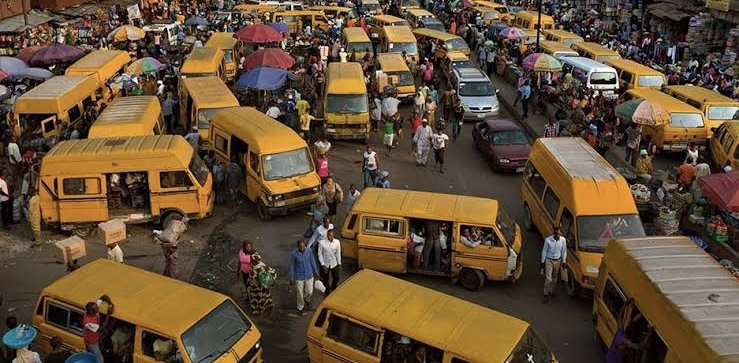

The average fare paid by commuters for bus journeys within Nigerian cities surged by 26.71 per cent year on year to N1,195.75 in February 2026, driven by rising fuel costs and ongoing global oil market tensions, according to the National Bureau of Statistics transport fare watch report. The increase from N943.68 recorded in February 2025 reflects the cascading impact of higher energy prices on household transportation budgets, with monthly fares also rising 0.74 per cent from N1,186.98 in January 2026.
The transport fare watch report, which covers bus journeys within cities, intercity bus routes, air travel, motorcycle transport (Okada), and waterway passenger transport, paints a picture of broad-based fare increases across all modes of mobility. The data captures the effects of the ongoing Middle East conflict involving the United States, Israel and Iran, which has disrupted global oil markets and contributed to domestic pricing adjustments that have made movement more expensive for millions of Nigerians.
For the average Nigerian household, rising transport costs represent a direct hit to disposable income. Unlike discretionary spending categories that can be reduced or eliminated, transportation is often a non-negotiable expense tied to employment, education, healthcare access, and commerce. The 26.71 per cent increase in intracity bus fares means that commuters who previously spent N943.68 on monthly bus transport now spend nearly N1,200 for the same journeys, squeezing budgets that are already under pressure from elevated food prices and other living costs.
The intercity bus segment showed a more moderate but still significant increase, with average fares rising 6.13 per cent year on year to N8,108.81 from N7,640.34 in February 2025. However, monthly fares dropped by 4.65 per cent from N8,504.39 in January 2026, suggesting some seasonal or market-driven moderation. Air travel recorded the steepest year-on-year increase among formal transport modes, with single-journey fares rising 21.38 per cent to N153,647.95 from N126,586.38 in February 2025.
Motorcycle transport, widely known as Okada and a critical last-mile mobility solution in many Nigerian cities, recorded the most dramatic increase among all modes. The average fare rose by 53.26 per cent year on year to N920.95 from N600.93 in February 2025, reflecting the vulnerability of two-wheeled transport to fuel price volatility and the limited alternatives available to commuters in areas with poor road infrastructure. On a monthly basis, Okada fares increased by 4.82 per cent from N878.60 in January 2026.
Waterway passenger transport, essential for communities in coastal and riverine areas, saw average fares rise 31.66 per cent year on year to N2,097.30 from N1,593.02 in February 2025, with a modest monthly increase of 0.55 per cent.
The state-level breakdown reveals significant geographic disparities in transport costs. For intracity bus journeys, Lagos recorded the highest fare at N1,537.09, followed by Taraba at N1,405.36, reflecting the commercial capital’s higher operating costs and demand pressures. Abia recorded the lowest at N699.17, followed by Adamawa at N700. For intercity bus travel, Abia again topped the list with N9,490.95, followed by Ogun at N9,402.26, while Kwara recorded the lowest at N6,190.50.
Air travel costs showed remarkable variation, with Kano recording the highest single-journey fare at N187,742.40, followed by Ogun at N175,500.00, while Gombe recorded the lowest at N131,290.00. For motorcycle transport, Kaduna recorded the highest fare at N1,500, followed by Lagos at N1,416.67, while Adamawa and Akwa Ibom recorded the lowest at N650. Water transport was most expensive in Rivers at N6,560, followed by Bayelsa at N5,338.49, while Borno recorded the lowest at N880.
From an economic perspective, rising transport costs act as an inflationary multiplier, increasing the cost of moving goods from production centres to markets, raising input costs for businesses, and reducing the real incomes of workers who must spend more to reach their places of employment. The NBS data suggests that the fuel price shocks of recent months have fully transmitted into consumer transport prices, with limited evidence of absorption by transport operators who face their own margin pressures.
For policymakers, the data underscores the challenge of managing inflation in an environment where external shocks and domestic fuel pricing adjustments feed directly into household expenses. While the government’s removal of fuel subsidies was framed as a necessary fiscal reform, the NBS figures quantify the tangible impact on commuters who have no alternative to expensive public transport. The 53 per cent increase in Okada fares is particularly concerning, as it affects lower-income Nigerians who rely on motorcycle transport for short-distance travel in areas underserved by formal bus networks.