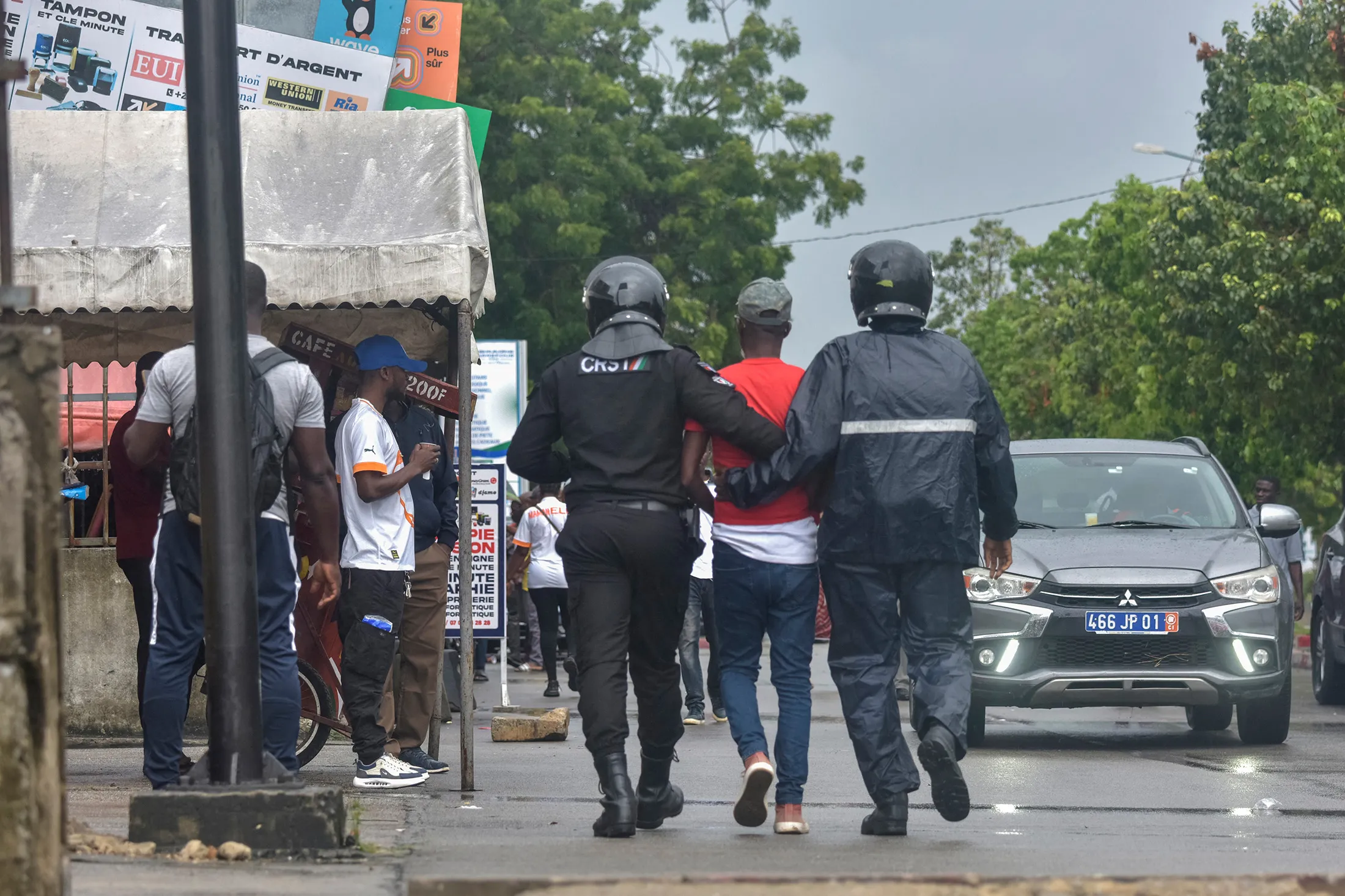

At least 237 people were arrested in Ivory Coast last Saturday during a banned protest in Abidjan, as political tensions escalate ahead of the country’s 25 October presidential election. The demonstration, which security forces dispersed with tear gas, was organised by opposition groups challenging President Alassane Ouattara’s bid for a controversial fourth term.
General Vagondo Diomandé, the Minister of the Interior and Security, confirmed the arrests in a televised statement, calling the protest “illegal” and insisting that all those detained would “be held accountable for their actions.” Activists, however, denounced the government’s heavy-handed response as a sign of deepening authoritarianism and democratic backsliding.
The rally had been called by the Common Front, a coalition uniting Ivory Coast’s two largest opposition parties, after authorities banned all public marches in the capital. Protesters had gathered to demand political dialogue and the reinstatement of barred opposition candidates, including former President Laurent Gbagbo and ex-Credit Suisse chief Tidjane Thiam. Both men, who remain influential figures, were excluded from the ballot by the Constitutional Council earlier this year.
A Contested Fourth Term
President Ouattara, 83, has ruled Ivory Coast since 2010, overseeing a decade of strong economic growth following years of civil conflict. However, his decision to run again has reignited fierce debate about the country’s constitutional order. A 2016 constitutional revision, introduced under his government, removed the two-term limit, which he argues allows him to seek re-election under a new framework. Critics, however, say the move subverts the democratic gains made after the post-election violence of 2010–2011, when more than 3,000 people were killed following a disputed vote between Ouattara and Gbagbo.
Ouattara’s supporters argue that continuity is vital at a time when Ivory Coast faces regional instability, inflationary pressures, and threats from Sahel-based militant groups expanding into coastal West Africa. “The country needs stability and experienced leadership,” a government spokesman said in a recent statement, citing security challenges in the north and the need to safeguard economic progress.
Opposition groups, however, accuse Ouattara of entrenching power through the courts and the electoral commission, both of which they claim are aligned with the ruling party. The exclusion of several prominent challengers has left a fragmented field of candidates, including former ministers Jean-Louis Billon and Ahoua Don Mello, as well as former First Lady Simone Ehivet Gbagbo and veteran politician Henriette Lagou.
Repression and Resistance
Saturday’s protest followed a decree from the prefect of Abidjan declaring all public gatherings illegal during the election period “in the interest of public order.” Despite this, hundreds of demonstrators took to the streets, waving placards demanding “Justice, Democracy, and Dialogue.” Videos shared on social media showed security forces firing tear gas to disperse crowds and arresting protesters near the central business district.
Opposition leaders say dozens were injured. “We will not be intimidated or silenced,” said a spokesperson for Gbagbo’s party, the Ivorian Popular Front. “The regime’s repression only strengthens our determination to restore democracy.”
The Common Front announced plans to hold daily protests nationwide until its demands for a fair electoral process are met. Analysts warn that unless dialogue resumes, tensions could escalate in the coming days, risking a repeat of the violence that has marred previous elections.
Regional and Economic Stakes
Ivory Coast, with a population of 32 million, is the largest economy in Francophone West Africa and the world’s top cocoa producer. Political instability has ripple effects across the region and global commodity markets. During the 2010–2011 crisis, cocoa exports were severely disrupted, driving global prices upward and undermining investor confidence.
Since then, the country has achieved robust growth averaging 6–7% annually, supported by infrastructure investment and agricultural expansion. However, mounting political uncertainty threatens to derail these gains. “Ivory Coast has been a pillar of stability in an increasingly volatile region,” said a regional analyst at the Institute for Security Studies. “But the re-emergence of polarised politics, coupled with economic grievances and youth unemployment, poses serious risks.”
International actors, including the African Union, ECOWAS, and the European Union, have called for restraint and renewed dialogue between the government and opposition. Diplomats are reportedly engaging both sides to avoid escalation. Human rights organisations have also urged the authorities to lift restrictions on peaceful assembly and ensure a transparent electoral process.
Echoes of the Past
For many Ivorians, the current crisis revives painful memories of the country’s violent past. The post-election conflict of 2010–2011 left deep divisions that have yet to fully heal, despite Ouattara’s economic reforms and partial reconciliation efforts. The return of Laurent Gbagbo from exile in 2021 raised hopes of a new era of inclusiveness, but his exclusion from the race has rekindled old political rivalries.
As campaigning intensifies, citizens and observers alike are watching closely to see whether Ivory Coast can hold a peaceful, credible election — or whether history will repeat itself. The outcome, many say, will determine not only the country’s democratic trajectory but also the stability of West Africa’s fragile coastal region.