
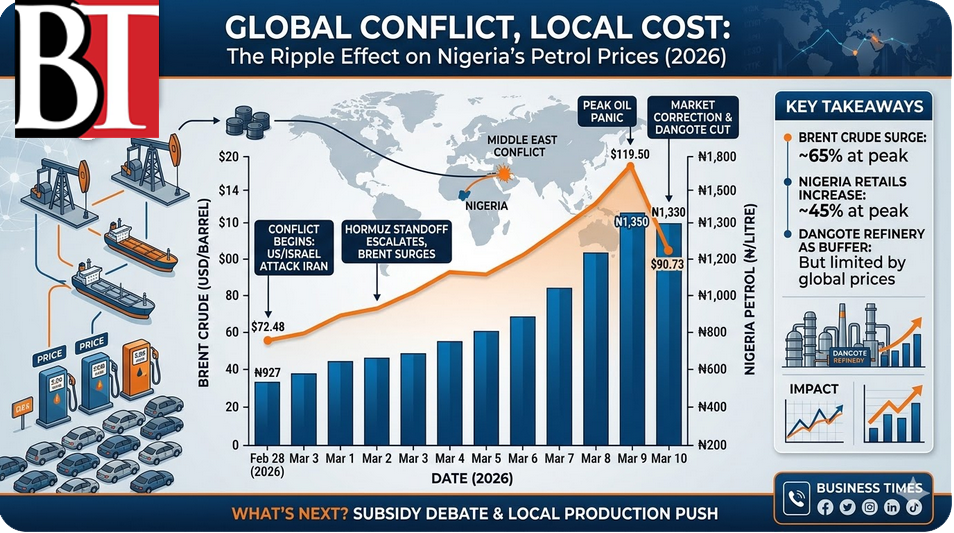
On February 28, 2026, joint US-Israeli strikes under Operation Epic Fury killed Iran’s Supreme Leader and obliterated its nuclear infrastructure. Within 72 hours, the conflict triggered the largest energy crisis since the 1973 oil embargo. Ten days later, the consequences continue to accelerate across the globe, but nowhere are they felt more acutely than in Nigeria, where a war fought thousands of kilometres away has become an intimate economic disaster for millions of citizens.
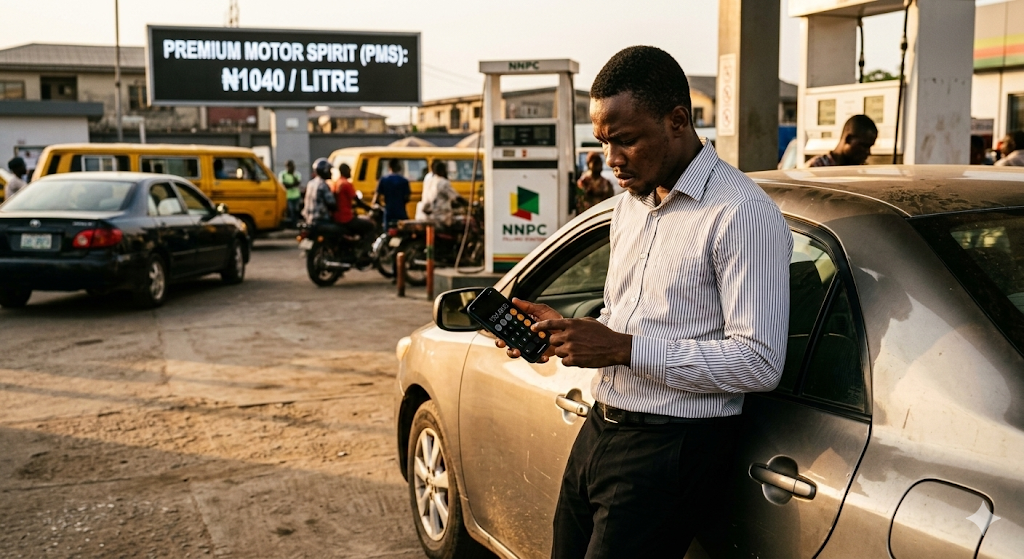
The closure of the Strait of Hormuz, through which approximately 20 percent of the world’s oil passes, removed millions of barrels from daily supply. Brent crude surged past $110 per barrel. And in Nigeria, the transmission was immediate. Dangote Refinery adjusted its ex-depot price four times in a week, from N774 before the war to N1,175 by early March. Retail pump prices followed, reaching N1,300 per litre in Lagos, N1,350 in Kaduna, and surpassing N1,400 in parts of Abuja. For the average Nigerian, this is not an abstraction. It is a daily assault on survival.
Voices from the Ground
Across social media, news interviews, and community forums, Nigerians are articulating how a distant geopolitical struggle has rewritten their personal economics.
In Lagos, a commuter identified as Grace O. told Facebook followers that “the school bus fee just doubled again. The principal says it’s ‘international oil politics.’ I just know my children might have to start taking the public bus which isn’t safe.” Her sentiment echoes survey data showing transport fares on some Lagos routes doubling, with trips from Egbeda to Oshodi rising from N700 to N1,200.
Bello A. in Kano voiced bewilderment on X: “How did a war in the Middle East become my personal problem in Kano? I used to spend ₦15k to fill my tank; now ₦40k isn’t enough. My small delivery business is dying.” His frustration captures the paradox of a major oil producer suffering from global price spikes.
In Ibadan, Tunde W. asked a pointed question: “We produce oil but we are the ones suffering the most when the price goes up. Why is our refinery not cushioning this? This is 2026 and we are still at the mercy of US-Iran tensions.” The query reflects widespread confusion about why the much-vaunted Dangote Refinery has not insulated Nigerians from global volatility.
Emeka N. , a printing press owner in Onitsha, described the operational reality: “I run a printing press on a generator because the grid is down. My diesel and petrol costs are now 60% of my overhead. I’ve had to lay off two staff this morning.” His experience is consistent with diesel prices reaching N1,620 per litre ex-depot and N1,750 at some pumps.
In Abuja, Musa K. has adapted dramatically: “I’ve switched to a bicycle for short distances. I can’t justify ₦1,500/litre just to go to the market. This war needs to end before we all go broke.” His adjustment reflects a broader trend of reduced car usage, with some high-end areas of Lagos described as “ghost towns” as residents park their vehicles.
Dr. Chidi in Enugu noted a public health dimension: “As a medical doctor, I’m seeing patients miss appointments because they can’t afford the transport fare. The ‘Iran-US’ factor is becoming a public health crisis here.” His observation gains weight from expert warnings that the conflict could worsen health funding and drug import costs.
Aisha Y. in Kaduna connected fuel prices to food costs: “Food prices are through the roof. The traders say the cost of trucking yam from the north has tripled because of fuel. We are literally eating the Israel-Iran war.” Her insight reflects the pass-through economics that translate fuel hikes into food inflation.
A user identified as @NaijaPatriot in Jos offered a stark summary: “Every time a missile is fired in the Middle East, a Nigerian family skips a meal. That is the reality of our ‘globalized’ suffering in 2026.”
The Macroeconomic Reckoning
Beyond individual hardship, the war carries systemic economic risks. SBM Intelligence, the Lagos-based geopolitical research firm, has warned that Nigeria’s historical approach of reactive diplomacy leaves the country exposed to external shocks. In a report on the confrontation, SBM analysts noted that “the Iran-Israel confrontation is likely to trigger volatility in global oil prices. While higher crude prices could temporarily increase Nigeria’s export earnings, the broader implications include reduced foreign investment, capital flight, and higher borrowing costs”.
The firm specifically highlighted risks to Nigeria’s access to debt markets. Increased risk perception among international investors may lead to higher yields on Nigerian government bonds and more expensive credit for businesses. This is particularly critical given Nigeria’s ongoing reliance on debt to finance fiscal deficits. “Periods of geopolitical instability often trigger investor risk aversion. Nigeria could face rising borrowing costs, reduced capital inflows, and weaker financial market performance if the Middle East crisis intensifies,” SBM analysts concluded.
The Petroleum Products Retail Outlets Owners Association of Nigeria (PETROAN) has warned that if the conflict persists, petrol could approach N2,000 per litre and diesel N3,000, with devastating consequences for inflation, jobs, and manufacturing.
Health experts are also sounding alarms. Professor Tanimola Akande of the University of Ilorin warned that the war will reduce external health funding to low and middle income countries, further straining HIV, tuberculosis, and malaria programmes in Nigeria. Dr. Dan Onwujekwe added that with the Middle East effectively closed, drug importation from China and India will become difficult and expensive.
A Double-Edged Shock
For Nigeria, the war presents a classic contradiction. Higher crude prices should boost federation revenues, with Brent trading well above the 2026 budget benchmark of $64.85 per barrel. But structural constraints limit the benefit. Nigeria’s oil production hovers around 1.5 million barrels per day, below its OPEC quota, and the country remains dependent on imported refined products. The windfall is thus partially offset by increased landing costs for petrol and diesel.
As energy expert David Okon explained, when Dangote Refinery previously sold petrol at N774 per litre, crude was landing at about $68 per barrel. With crude now arriving at roughly $95 per barrel, the cost difference of about $27 per barrel translates to nearly N40,000 per barrel when converted to Naira.
The crisis has renewed calls for policy reform. CPPE Director Muda Yusuf urged the government to ensure reliable crude supply to local refineries, strengthen distribution infrastructure, and encourage additional refining investments. Without such measures, Nigeria remains perpetually vulnerable to geopolitical tremors originating far from its shores.
Ten days after Operation Epic Fury, the war’s most enduring legacy for Nigeria may be this painful demonstration of globalised vulnerability. A missile fired at Iran reverberates in the transport fare paid by a Lagos commuter. A drone strike on a refinery shapes the meal skipped by a family in Kaduna. The connection is inescapable, and for millions of Nigerians, the cost is counted not in geopolitical terms, but in the most basic currency of survival.