
President Bola Tinubu has reaffirmed his commitment to reviving Nigeria’s state-owned refineries, setting his administration on a collision course with former President Olusegun Obasanjo, who argues that private-sector participation offers a better chance of making the facilities commercially viable.
Tinubu said the Port Harcourt, Warri and Kaduna refineries would return to operation but stressed that a physical restart would not constitute success unless the plants could operate profitably.
“The refineries you mentioned are going to come back to work,” Tinubu said after receiving leaders of the Nigeria Union of Petroleum and Natural Gas Workers at the Presidential Villa in Abuja. He added that “flame and smoke” from a refinery did not mean it was working unless it generated profit and value for Nigerians.
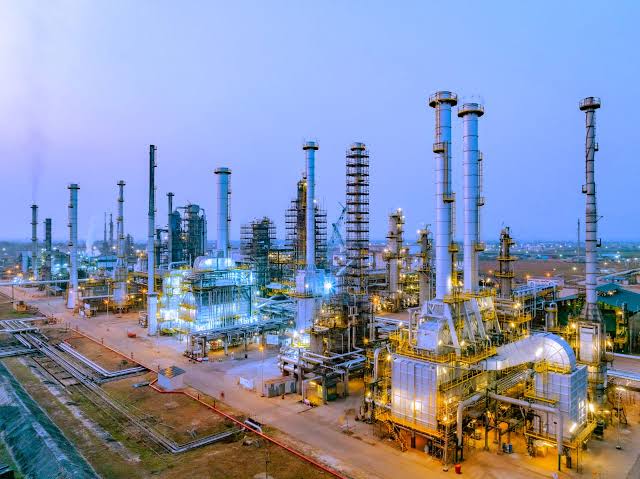
The pledge comes after years of rehabilitation efforts and repeated operational setbacks. The Port Harcourt complex, with combined capacity of 210,000 barrels per day, resumed limited operations in November 2024 following a rehabilitation programme estimated at $1.5 billion, but NNPC shut the facility in May 2025 for planned maintenance and a sustainability assessment.
NNPC is now pursuing a potential technical-equity partnership with Chinese companies to support the restart and expansion of the Port Harcourt and Warri facilities. The agreement is at the memorandum-of-understanding stage, rather than a completed privatisation or equity sale.
Obasanjo remains deeply sceptical of government ownership and management. He recently recalled that his administration approached Shell to take a 10 percent equity stake and operate the refineries. After Shell declined the equity proposal, he said the company was also asked to manage the plants without taking a stake, but rejected that option as well.
Obasanjo attributed Shell’s reluctance partly to the refineries’ relatively small scale, poor maintenance record and corruption risks. He has used the experience to argue that public-private partnerships are more suitable for complex industrial assets.
He also recalled a separate proposal involving Aliko Dangote. According to Obasanjo, Dangote assembled a team and committed $750 million in a proposed public-private partnership to operate the refineries. Contemporary reporting has described the proposal as an attempt to manage the facilities rather than simply an outright purchase of them.
The financial burden remains central to the debate. The federal government approved about $1.5 billion for the Port Harcourt rehabilitation in 2021, while separate rehabilitation allocations were approved for the Warri and Kaduna plants.
Energy expert Dan Kunle has opposed further public spending on the old refineries, arguing that government should privatise the facilities and redirect scarce capital towards other productive sectors. Some oil-sector stakeholders, however, continue to support the revival effort, particularly because functioning domestic refineries could strengthen supply security and create economic activity around the plants.
The real test for Tinubu is therefore no longer whether the refineries can be restarted. It is whether they can operate reliably, compete with private refiners and generate enough returns to justify continued investment.
That distinction could determine whether the latest revival programme becomes a durable energy reform, or another expensive attempt to resurrect assets that have repeatedly failed to deliver commercially.