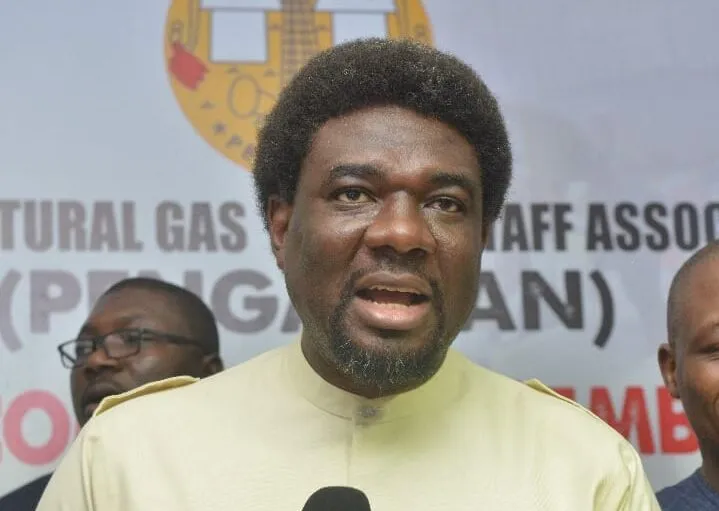

The Petroleum and Natural Gas Senior Staff Association of Nigeria (PENGASSAN) has warned that the Federal Government’s Executive Order No. 9 of 2026 could destabilise Nigeria’s oil and gas industry, arguing that the directive undermines provisions of the Petroleum Industry Act (PIA).
Speaking at the union’s National Executive Council meeting in Abuja, PENGASSAN President Festus Osifo criticised the order’s provision directing that 30 percent of profit oil from Production Sharing Contracts (PSCs) be paid into the Federation Account.
“From our own assessment, the provisions of this order is a direct attack on the PIA. If government wants to amend laws, send those laws to the National Assembly. Let stakeholders debate it. The way this executive order has been done has the ability to impact the stability we currently enjoy in the oil and gas industry,” Osifo said.
He argued that transferring the allocation to the Federation Account Allocation Committee without clarifying how statutory management fees would be refunded to Nigerian National Petroleum Company Limited (NNPC Ltd.) could disrupt operations and threaten workers’ salaries.
“That 30 per cent of profit oil amounts to between 1.5 and 2.5 per cent of total revenue. It is the management fee used to pay salaries of those administering the PSCs. There are comrades interfacing daily with Shell, TotalEnergies, ExxonMobil and other operators, ensuring that Nigeria is not cheated. How will their salaries be paid?” he queried.
Osifo said the union had begun engagements with government officials and expressed hope that concerns would be addressed.
“For us, there is no hidden agenda. We don’t politicise issues. We look at how these issues will affect our members first, the industry next, and Nigerians at large..From the engagements so far, there are green lights and we believe we will be able to close the gap.”
Beyond the executive order, the labour leader criticised prevailing economic conditions, questioning official claims of easing inflation.
“When they say inflation is reducing, it is year-on-year comparison… Nigerians are still feeling the heat in their pockets. How has rising foreign reserves translated to food on the table? How has exchange rate stability improved disposable income of the average worker?”
On security, Osifo described the situation as dire. “We are in a state of emergency in terms of insecurity,” he declared. “Reduce plenty talk and focus on solutions. Devote more funds to security. Nigerian lives must count.”
He also urged sustained investment in infrastructure and electricity, describing power supply as critical to economic growth.
Addressing sector-specific issues, Osifo said labour concerns remain unresolved at the Dangote Refinery, calling for intervention by the Ministry of Labour and security agencies.
While welcoming improvements in pipeline security and rising rig counts, he cautioned against complacency.
“When you remove your eyes from the ball, things can go wrong immediately. Government must sustain pipeline security because beyond revenue, it secures our members’ jobs,” he said.
The union reiterated its call for adopting the Nigeria LNG Limited ownership model for state refineries, advocating 51 percent private ownership and 49 percent government stake to ensure efficiency and protect energy security.