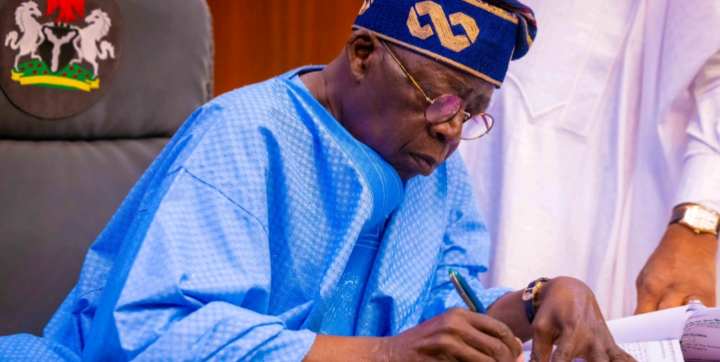

President Bola Tinubu has signed a landmark executive order mandating the Nigerian National Petroleum Company (NNPC) Limited to remit all oil and gas revenues directly to the Federation Account. The directive, gazetted on February 13, 2026, effectively strips the national oil firm of billions of naira in “deductions” that the administration claims have historically starved federal, state, and local governments of their constitutional funds. By bypassing NNPC as a financial intermediary, the presidency is moving to close the significant gap between gross crude production and the actual income reaching government coffers.
The economic consequence of this order is a massive redirection of liquidity toward the country’s three tiers of government. Under the previous Petroleum Industry Act (PIA) framework, NNPC reportedly diverted more than two-thirds of potential remittances through various fees. Data from the Federation Account Allocation Committee (FAAC) suggests that the redirection of the management fee and Frontier Exploration Fund alone will return approximately N1.42 trillion to the public coffers in 2025. This surge in available revenue is intended to fund urgent national priorities in security, healthcare, and infrastructure.
Analytically, the executive order dismantles several specific financial mechanisms that the State House described as exceeding “global norms.” NNPC loses its 30% management fee on profit oil and gas from Production Sharing Contracts (PSCs), as the government argued the firm already retains 20% of its profits for working capital. The 30% Frontier Exploration Fund often criticized as a source of “wasteful spending” and idle cash has been halted. Additionally, all operators under PSCs are now required to pay royalties and taxes directly to the Federation Account, and fines for gas flaring will no longer be diverted to internal infrastructure funds.
The impact on “Corporate Governance and Market Competition” is a vital dimension of this reform. The presidency expressed deep concerns over NNPC’s dual role as both a commercial operator and a concessionaire, noting that this structure creates “competitive distortions.” By stripping these regulatory-style powers, the government is forcing NNPC to complete its transition into a fully commercial enterprise as originally intended by the PIA. The order is constitutionally anchored in Section 44(3), which vests ownership of all mineral oils and gas in the Federal Government.
To ensure a seamless transition, an implementation committee has been established, chaired by the Minister of Finance and Coordinating Minister of the Economy. This high-level team, which includes the Attorney-General and the Special Adviser on Energy, is tasked with ensuring that integrated petroleum operations continue without interruption while the new fiscal rules take effect. President Tinubu has also signaled that this executive order is a precursor to a comprehensive legislative review of the PIA to address remaining “fiscal and structural anomalies.”
The long-term economic outlook for Nigeria’s oil sector depends on whether these reforms can successfully eliminate the “opaque deductions” and underperformance that have plagued successive administrations. As the largest oil producer in Africa, Nigeria is betting that fiscal transparency will attract higher-quality investment and stabilize the national budget. For now, the era of the “NNPC intermediary” is officially ending, as the Federal Government reasserts direct control over the nation’s most valuable resource revenues.