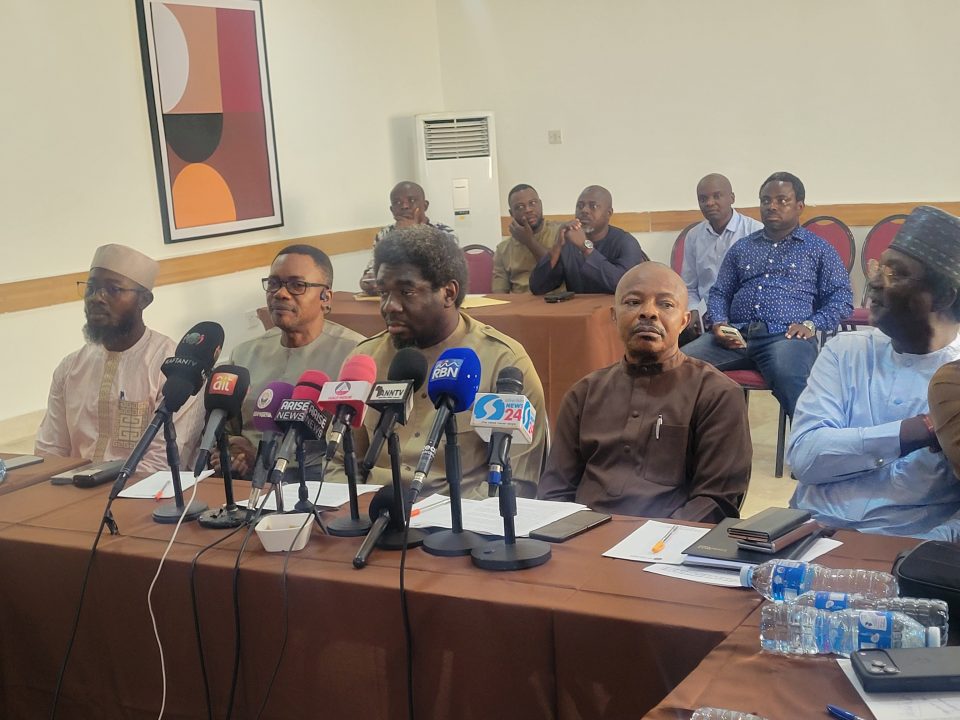

The Nigeria Labour Congress (NLC) and the Trade Union Congress of Nigeria (TUC) have resolved their disagreement over the Federal Government’s N70,000 transport allowance for public sector workers, ending days of public exchanges between the leadership of both labour organisations.
The two unions announced the resolution on Wednesday, November 18, 2026, during a joint press conference in Abuja, where they reaffirmed their commitment to protecting workers’ interests and maintaining unity within the labour movement. In a joint statement signed by Joe Ajaero, NLC president, and Festus Osifo, TUC president general, the organisations described their disagreement as a family misunderstanding that had been settled through the intervention of former leaders of both unions.
“We wish to place it on record that the unity of the Nigerian working class is far greater than any disagreement between its leadership,” the statement read.
The disagreement followed the Federal Government’s announcement on October 28, 2026, of a N70,000 monthly transport allowance for public servants for six months, following negotiations with the NLC and other labour representatives. While the NLC accepted the arrangement, the TUC rejected it, arguing that it was not properly represented during the negotiations. The organisation also maintained that workers needed a salary increase rather than a temporary transport allowance.
Speaking on Channels Television’s The Morning Brief, Ajaero defended the NLC’s decision to negotiate with the government, citing the International Labour Organisation’s (ILO) principle of the most representative workers’ organisation. He argued that the NLC had the authority to negotiate independently based on its membership strength and representation within the public service negotiating structure.
However, Osifo disagreed with this position, describing the arrangement as an aberration. He challenged Ajaero to identify the ILO regulations that allowed one labour centre to negotiate on behalf of another without consultation. The TUC president general also questioned the legitimacy of the meeting where the allowance was agreed upon, arguing that it was not a properly constituted meeting of the Joint National Public Service Negotiating Council (JNC).
He maintained that the TUC, with about 40 affiliate unions, had the right to represent its members independently, regardless of the NLC’s larger membership. Ajaero, in response, referred to the Trade Union Amendment Act 2005 and Section 40 of the 1999 Constitution, which guarantees workers the freedom to belong to unions of their choice. He also argued that seven of the eight union bodies represented in the JNC were affiliated with the NLC, while only one belonged to the TUC.
The resolution comes shortly after the Federal Government approved a committee to examine concerns raised by the TUC over workers’ welfare and the transport allowance arrangement. The committee followed a meeting between government officials and TUC representatives led by Osifo, who maintained that the organisation preferred a salary increase rather than the six month transport intervention.
The government said the committee would review the outstanding demands, assess actions already taken and make recommendations. It is expected to begin work immediately and submit its report to the Secretary to the Government of the Federation within two weeks.
The reconciliation between the two labour centres is expected to strengthen cooperation in addressing workers’ welfare, particularly amid concerns over the rising cost of living and the implementation of minimum wage adjustments across the country.