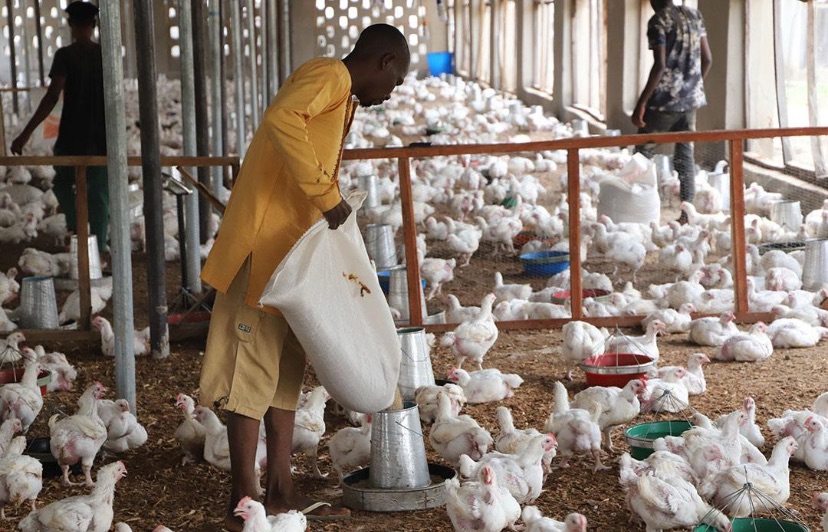

Nigeria’s Poultry Sector Pushes Ahead With Billion-Dollar Projects Despite Soaring Feed Prices
Nigeria’s poultry industry is expanding through new mega-investments and government-backed projects even as producers battle some of the steepest feed cost increases in the sector’s history, according to industry data and recent project announcements.
Feed remains the dominant cost driver for Nigerian poultry farms, accounting for roughly 60 to 70 percent of total production expenses, according to the Federal Ministry of Livestock Development. The pressure has been building for years: a market survey by the Centre for Journalism and Innovation Development found the average price of a 25-kilogram bag of poultry feed rose 168 percent between 2019 and mid-2022, climbing from ₦3,600 to as much as ₦10,000.
That trend has continued. The Poultry Association of Nigeria (PAN) reported that the cost of a bag of chicken feed rose from roughly $16.65 in December 2023 to $18.49 more recently, while maize — a core feed ingredient — increased 79.23 percent year-on-year by December 2023, according to National Bureau of Statistics data. PAN’s national chairman, Mojeed Iyiola, has said the rising cost of raw materials is making feed unaffordable for many farmers, and the association has previously estimated that up to 50 percent of poultry farms nationwide have shut down under the strain.
To cope, many farmers are now producing feed themselves. PAN president Sunday Ezeobiora said farmers can save at least 5 percent by mixing their own feed rather than buying commercially produced batches, even though maize and soybean prices have fallen more than 60 percent from their peaks — a decline that has not been fully passed on by feed manufacturers, who have cut prices by only about 10 percent.
Despite those cost pressures, capital is flowing into the sector. Nigeria launched a $1 billion National Integrated Poultry Project in early 2026, with a pilot phase now running across Enugu, Kaduna, and Oyo states and nationwide expansion planned for 2027. The project combines poultry rearing with large-scale maize and soybean cultivation — including plans to farm 60,000 hectares of feed crops — specifically to address the feed shortages driving up costs, and includes subsidized feed for smallholder farmers.
Other projects have followed. Ogun State commissioned a poultry processing plant capable of handling 5,000 birds per day under a World Bank-backed initiative, and Kaduna State has announced plans for a $200 million poultry megaproject aimed at creating jobs and boosting exports. Singaporean agribusiness firm Olam Agri, which operates in Nigeria’s animal feed industry, projects that targeted investment in feed systems could raise farm productivity by as much as 40 percent and cut livestock mortality by 65 percent through improved vaccination coverage.
Nigeria’s broader livestock sector — anchored by an estimated 250 million poultry birds supporting roughly 75 million households — contributes about 5 percent of GDP, valued near $32 billion, according to the Federal Ministry of Livestock Development. Stakeholders are now pursuing a $3 billion private-sector investment drive over the next three to five years to expand capacity further, even as officials acknowledge feed costs continue to consume 60 to 70 percent of production expenses industry-wide.
Nigeria’s Strategic Grain Reserves has also released stored corn directly to PAN to ease feed input costs, while the Ministry of Agriculture has said it is reinforcing vaccine production at the National Institute for Veterinary Research in Vom to help farmers manage disease risk alongside the cost squeeze. Analysts note the industry is also fighting an estimated $150–200 million in smuggled poultry meat entering Nigeria each year, a factor authorities say new domestic processing capacity is partly designed to counter.
Industry watchers describe a sector under real financial strain at the farm level, but with institutional and government confidence growing that structural investment in feed production, processing, and genetics can offset input cost volatility over time. Nigeria’s poultry sector remains Africa’s largest egg producer and second-largest poultry meat producer, and stakeholders at a recent Poultry Association of Nigeria summit in Lagos called for continued investment in precision feed milling, breeding, and cold-chain logistics to sustain the current wave of expansion.