
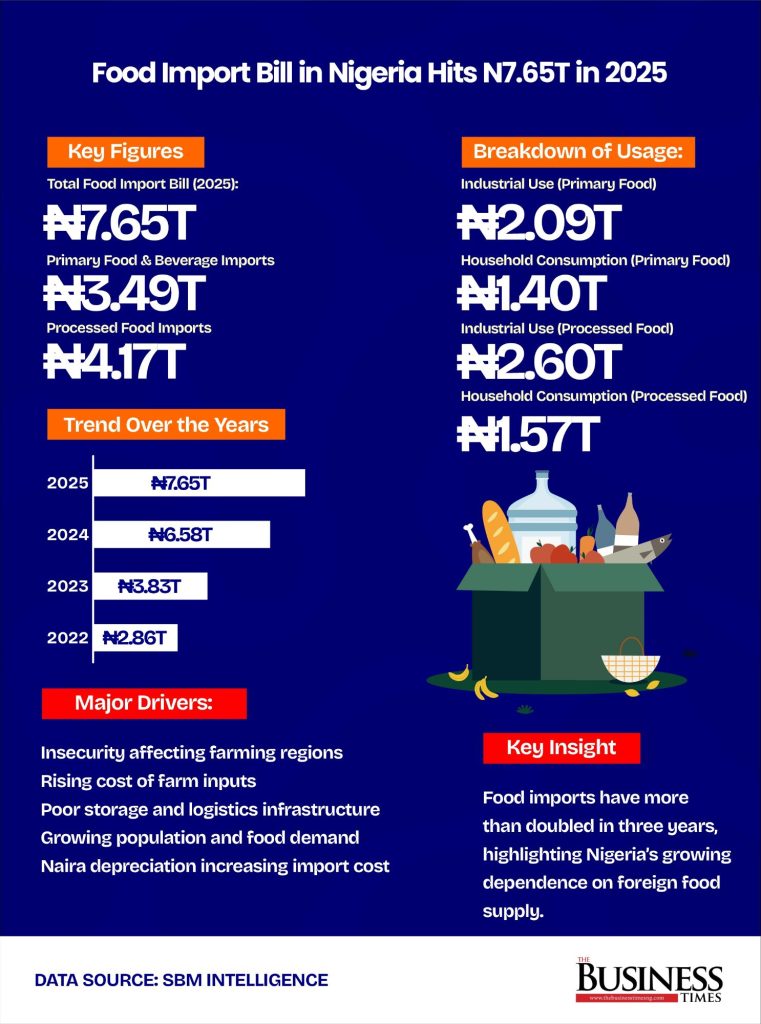
Nigeria spent N7.65 trillion on food imports in 2025, marking a sharp rise in the country’s reliance on foreign supplies despite its vast agricultural potential. The increase underscores a persistent gap between domestic production and consumption, raising concerns about food security, household welfare, and pressure on foreign exchange reserves. Primary commodities and processed foods together form the bulk of imports, with significant portions used as raw materials for industrial food processing.
Primary food and beverage imports accounted for N3.49 trillion of the total, of which N2.09 trillion was directed to food manufacturers and N1.40 trillion went to household consumption. Processed food imports were even higher at N4.17 trillion, with N2.60 trillion for industrial use and N1.57 trillion for households. The data highlights that Nigeria’s food processing sector depends heavily on imports because domestic supply cannot consistently meet quality or volume requirements.
After a series of interviews conducted by Business Times, Nigerians shared their insights on the underlying causes of this dependence.
“Mills and factories cannot rely on local farmers because the supply is uneven and often low quality,” said Grace Adebayo. “Imported raw materials are simply more reliable for production.”
Michael Okafor added, “Our agricultural supply chains are fragmented. Seasonal production and poor logistics make it difficult for processors to source consistently from local farms.”
Zainab Aliyu highlighted the role of post-harvest losses: “Crops often spoil before reaching processors because storage and transportation systems are weak. Imports fill the gap.”
Structural weaknesses in agriculture were also a recurring theme. Musa Abdullahi said, “Most farmers operate small plots with outdated methods. Mechanisation is minimal, productivity is low, and population growth keeps food demand rising faster than supply.”
Chioma Okeke noted, “Farmers struggle to access quality seeds, fertilisers, irrigation, and reliable markets. Without coordinated value chains from farm to factory, efficiency suffers and imports become unavoidable.”
Adewale Balogun added, “Land fragmentation and lack of credit prevent farmers from investing in machinery or improved seeds, limiting yields.”
Fatima Sadiq pointed to knowledge gaps: “Extension services are weak. Many farmers lack access to modern farming techniques, while countries that boosted productivity invested heavily in training their farmers.”
Tunde Olanrewaju observed, “Frequent policy changes create uncertainty. Investors need predictable programmes to commit to long-term projects.”
The rising import bill also has macroeconomic consequences. Ibrahim Lawal explained, “Buying food from abroad consumes huge amounts of foreign currency, mainly dollars. This strains reserves and weakens the naira.”
Ngozi Eze added, “Rising imports widen the trade deficit and expose the economy to global price shocks. Households feel the impact immediately when prices rise.”
Sadiq Bello highlighted the broader implications: “A large portion of national income flows out through food imports, reducing domestic wealth creation and limiting opportunities within agriculture.”
Security, rising input costs, and poor infrastructure compound the problem. Yusuf Mohammed said, “Farmers in northern regions abandon land due to armed conflict and banditry. Agricultural activity is declining in key areas.”
Blessing Nwankwo added, “Fertiliser, seeds, diesel, and labour are expensive. Many farmers cannot cultivate at scale, so domestic production falls short.”
Abdullahi Sani noted, “Poor rural roads increase transport costs and delay produce reaching markets. Losses rise before food even reaches consumers.”
Oluwaseun Adeyemi said, “Irregular rainfall and flooding disrupt planting seasons and reduce crop yields, further widening the supply gap.”
Rising import costs have direct consequences for households. Ifeoma Okoye explained, “Higher import costs pass directly into retail prices. Since food accounts for most household spending, welfare is immediately affected.”
Kabiru Adamu added, “Food inflation hits low-income families hardest. Rising prices reduce purchasing power and worsen food insecurity.”
Tosin Adebola said, “Families often cut back on quantity and quality of meals, which can increase poverty and stress household budgets.”
Ahmed Lawan noted, “Persistent food inflation pushes governments to increase subsidies and social support programs, which strains public finances.”
Experts highlighted potential solutions. Ibrahim Bello recommended mechanisation: “Farmers need access to modern machinery through leasing schemes or subsidies to boost production.”
Ngozi Chukwu emphasised irrigation: “Reliable irrigation enables year-round farming and reduces dependence on seasonal rainfall.”
Suleiman Adamu added, “Improving rural roads, storage, and market networks would reduce post-harvest losses and strengthen local production.”
Titi Ogunleye concluded, “Expanding access to affordable credit allows farmers and agribusinesses to invest in technologies that raise productivity.”
The surge in Nigeria’s food import bill underscores structural gaps in agriculture. Until domestic production rises significantly, imports will continue to feed Africa’s most populous nation. For policymakers and citizens alike, the message is clear: without coordinated investment in farming, infrastructure, financing, and security, Nigeria’s reliance on foreign food is unlikely to ease.