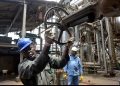
Nigeria has taken another step toward industrialising its solid minerals sector following a major investment agreement between the Federal Government and the Africa Finance Corporation (AFC) to develop an alumina refinery and related mining initiatives.
The partnership, valued at $1.3 billion, focuses on building a large scale alumina processing facility alongside complementary projects designed to deepen mineral exploration and attract long term private capital into the sector. The agreement was announced through a statement issued by the Minister of Solid Minerals Development, Dele Alake, in Abuja.
Under the arrangement, both parties will jointly finance the construction of a refinery expected to process about one million tonnes of bauxite annually. Alumina, derived from bauxite, is a key industrial input used in aluminium production, making the project central to Nigeria’s ambition of moving from raw mineral exports toward value added processing.
Beyond the refinery itself, the pact also includes a nationwide geoscience mapping programme intended to generate reliable mineral data and reduce exploration risks for investors. In addition, a joint strategic investment vehicle will be created to accelerate exploration and production across identified mining assets.
Officials described the agreement as a turning point for the industry. According to the government, “The Africa Finance Corporation and the Federal Government through the Solid Minerals Development Fund (SMDF) have signed a Memorandum of Understanding to jointly fund three projects: a $1.3 billion alumina project, a comprehensive geoscience mapping exercise, and an investment vehicle to realise the goals.”
The refinery is designed to operate for roughly two decades at high utilisation levels, with projected total alumina output estimated at about 19 million tonnes over its lifespan. Feasibility assessments conducted before the signing confirmed the project’s commercial viability and competitiveness within the global minerals market.
Minister Dele Alake characterised the investment as a structural reform milestone aimed at repositioning mining as a meaningful contributor to national output. He stated, “This is a landmark deal, poised to transform the mining sector and increase its contribution to the nation’s GDP.”
Economic projections linked to the project indicate potential annual contributions of about $1.2 billion to Nigeria’s Gross Domestic Product, alongside broader economic value estimated at over $25 billion during the project lifecycle. The initiative is also expected to generate significant foreign exchange earnings and expand employment opportunities within mining and industrial processing.
For policymakers, the agreement reflects a broader strategy to diversify the economy away from oil dependence by strengthening downstream mineral processing capacity. By encouraging domestic beneficiation rather than exporting raw resources, authorities aim to improve industrial competitiveness and deepen investor confidence in Nigeria’s mining reforms.
The signing also signals growing collaboration between public institutions and development finance partners in funding large scale industrial infrastructure. Government officials indicated that regulatory approvals have already been granted to fast track implementation, with agencies directed to ensure timely processing of permits and operational clearances.
Overall, the alumina refinery pact represents both an industrial investment and a policy signal. It underscores Nigeria’s attempt to reposition its solid minerals sector as a viable growth engine capable of attracting capital, expanding exports, and supporting long term economic diversification.