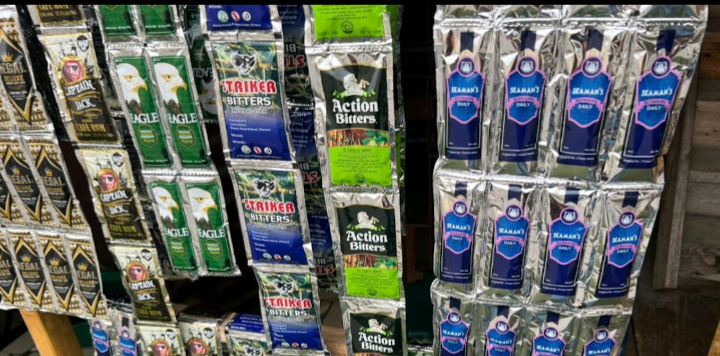

Nigeria’s National Agency for Food and Drug Administration and Control (NAFDAC) has officially begun enforcing a ban on the production and sale of alcoholic beverages packaged in sachets and small PET bottles under 200 ml, a regulatory move aimed at protecting public health that has reignited economic concerns across the country.
At a media briefing in Lagos on Wednesday, NAFDAC Director-General Prof. Mojisola Adeyeye confirmed that enforcement activities have commenced following a directive from the Senate instructing the agency to resume restrictions on these products, which were initially subject to an extended phase-out period.
“We already started the enforcement to ban alcohol production in sachet and bottles below 200ml…” Prof. Adeyeye said, reinforcing the agency’s commitment to curbing the distribution of inexpensive, high-alcohol beverages that critics say are easily accessible to youths and other vulnerable groups.
NAFDAC’s action comes after a temporary pause last year, when the Federal Government called for consultations on the controversial policy. Those consultations have now concluded, and the regulatory agency says it has the authority to proceed with enforcement.
Health and Safety Focus
NAFDAC officials emphasised that the ban targets packaging formats that make potent alcohol cheap and easy to conceal, rather than alcohol consumption itself. According to Adeyeye, sachet products previously contained extremely high alcohol content, in some cases as much as 50 %–90 %, raising concerns about misuse and underage access.
The ban aligns with repeated legislative pushes by the Senate, which in late 2025 ordered no further extensions of the phase-out period for sachet-based alcohol sales. Lawmakers argued that the widespread availability of such products constitutes a public health risk, especially for children and adolescents, and linked cheap packaging to increased social harms.
Public health advocacy groups have broadly supported the policy, maintaining that restricting access to sachet alcohol is a necessary step to reduce alcohol misuse, improve community safety and address rising concerns about addiction among young Nigerians.
However, the ban has drawn sharp warnings from industry players and economic stakeholders who fear significant fallout from the sudden regulatory shift. Business groups have cautioned that prohibiting sachet and small-bottle alcohol production could jeopardise substantial investment in the local manufacturing sector and disrupt employment across the value chain.
Economic analysts point to estimates suggesting that the policy could affect as much as N1.9 trillion in industry investments and millions of jobs, both directly within drinks manufacturing and indirectly across distribution, logistics, retail, and informal markets.
Economically, the ban introduces a critical trade-off: while aiming to curb health and social costs associated with alcohol abuse, it also risks weakening a segment of the consumer goods industry that contributes to employment and tax revenue, at a time when Nigeria’s broader economic recovery remains fragile. (Estimated impact underscores pressure on local investors and workers.)
The Manufacturers Association of Nigeria (MAN) and other industry groups have called on regulators to reconsider the ban in favour of alternative approaches, such as stronger policy frameworks that balance public health objectives with economic sustainability, arguing that outright prohibition could drive consumers toward unregulated, illicit products.
As enforcement intensifies across markets and retail points nationwide, the long-term impact of the ban will be closely watched by public health experts, business leaders, and policymakers alike. The phased policy shift reflects enduring tensions between safeguarding community wellbeing and supporting economic activity in a key sector.