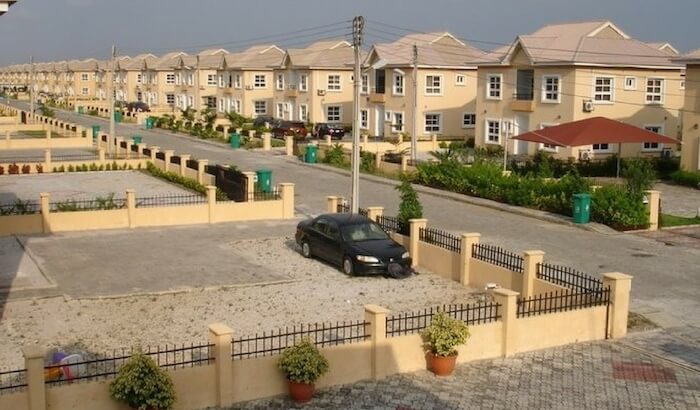

Nigeria’s housing market is expanding, but much of the new supply remains beyond the reach of ordinary households. The mismatch is particularly clear in Lagos, where demand is concentrated in cheaper homes while a large share of new developments targets the premium market.
The Federal Government’s National Housing Data Technical Committee put Nigeria’s housing deficit at 14.925 million units for 2025. The figure was presented in January 2026 by committee chairman Dr Taofeek Olatinwo during the 14th National Council on Lands, Housing and Urban Development in Ilorin. The Federal Ministry of Housing and Urban Development said the assessment was based on a more systematic methodology than earlier estimates.
The new figure should not simply be treated as a replacement for every previous estimate. Some higher estimates have included both the shortage of housing units and existing homes considered structurally inadequate. The distinction is important when comparing figures from different studies.
Lagos illustrates the affordability problem. The Punch reported on 4 February 2026, citing Estate Intel’s 2025/2026 Lagos Real Estate Development Pipeline Report, that more than 34,800 residential units were in the development pipeline. Yet Estate Intel estimated the state’s housing deficit at more than 2.7 million units, with the biggest shortages in affordable and middle-income housing.
The problem is therefore not simply the number of houses being built, but the prices of those houses. Research by Global Transaction Initiative (GTI), reported in Nigerian housing publications in 2026, found that properties below ₦15 million accounted for less than 5% of analysed supply but about 55% of estimated demand. At the other end, homes above ₦200 million represented about 55% of supply but only around 5% of demand.
High construction costs help explain why developers struggle to deliver cheaper homes. Cement prices remained elevated during 2025, the price rose from ~₦7,500 in late 2025 to ₦9,000–10,000 in early 2026, and even ₦10,500–15,000 by mid‑2026 in some areas, while the Federal Competition and Consumer Protection Commission opened a preliminary investigation into possible price manipulation in the cement market in August 2026. The FCCPC’s finding was preliminary and did not establish wrongdoing.
Financing is another barrier. BusinessDay reported in 2026 that mortgage lending remains below 1% of Nigeria’s GDP, limiting access to long-term financing for prospective homeowners. For renters, the pressure is already severe. A BusinessDay survey reported in March 2026 that 72% of respondents spent the equivalent of four to six months’ salary on annual rent, or about 40% of income.
Meanwhile, the wider property market continues to grow. Next Move Strategy Consulting estimates Nigeria’s real estate market was worth $32.2 billion in 2025 and could reach $40 billion by 2030.
The challenge is ensuring that this growth reaches the mass market. In May 2026, The Punch reported that built-environment stakeholders said Nigeria needs at least 550,000 new homes annually for the next decade to address its housing challenges.
Without cheaper land, lower construction costs, wider mortgage access and stronger incentives for affordable housing, Nigeria could continue to see a growing real estate industry while millions of households remain unable to afford the homes being built.