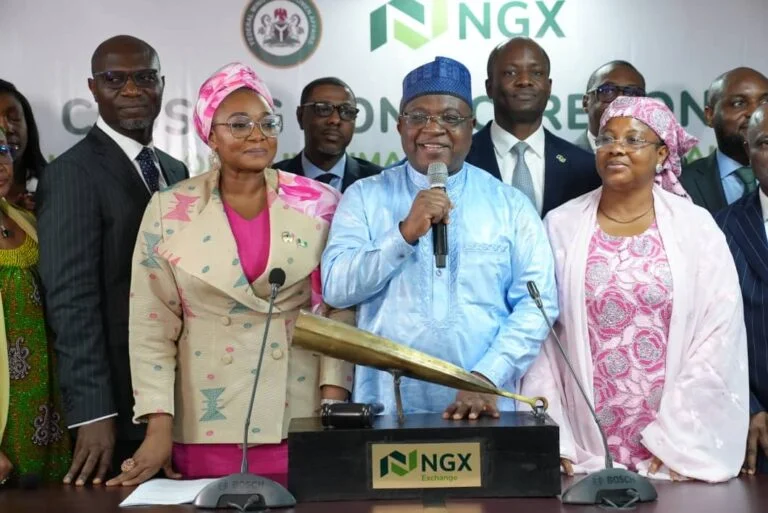

The Nigerian Exchange (NGX) and the Federal Ministry of Women Affairs have entered into a strategic partnership aimed at expanding women’s participation in the capital market, addressing a persistent gender gap in investment and wealth creation. The collaboration seeks to develop financial literacy programmes, facilitate access to investment products, and create pathways for women entrepreneurs to raise capital through the exchange. With women accounting for a growing share of economic activity yet remaining underrepresented in formal investment channels, the initiative aligns with broader efforts to harness demographic dividends and promote inclusive economic growth.
The partnership’s framework focuses on removing barriers that have historically limited women’s engagement with the capital market. These include lower levels of financial literacy, limited awareness of investment products, and structural constraints such as lower average incomes and informal sector employment that make traditional brokerage relationships less accessible. By designing targeted outreach programmes and simplified investment vehicles, the NGX and the ministry aim to create an enabling environment where women can participate as retail investors, bondholders, and eventually as issuers of capital market instruments.
From an economic development perspective, increasing women’s participation in formal financial markets carries multiplier effects. Research across emerging economies has shown that when women invest, they tend to allocate resources toward education, health, and household welfare, creating positive intergenerational impacts. Moreover, women entrepreneurs who access capital through formal channels can scale businesses that create employment and contribute to economic diversification. For Nigeria’s economy, where small and medium enterprises account for a substantial share of employment, unlocking capital for women-led businesses represents a significant growth opportunity.
The capital market’s role in financing women-owned businesses has been limited by structural factors. Many women entrepreneurs operate in the informal sector, where access to credit is constrained and investment readiness is difficult to demonstrate. The NGX partnership includes capacity-building components designed to help women-led enterprises understand listing requirements, improve corporate governance, and prepare for equity or debt issuance. By creating a pipeline of investment-ready women-owned businesses, the exchange expands its potential issuer base while contributing to the formalisation of female entrepreneurship.
The initiative also addresses the retail investment gap among Nigerian women. Savings and investment habits often differ by gender, with women more likely to hold cash or informal savings rather than equities, bonds, or mutual funds. The partnership’s financial literacy programmes aim to build confidence in navigating capital market products, emphasising the long-term wealth-building potential of diversified investment. For the NGX, broadening the investor base enhances market liquidity and deepens the pool of domestic capital available to fund businesses and infrastructure.
The Ministry of Women Affairs brings to the partnership its networks of women’s organisations, market associations, and community-based groups that can serve as channels for reaching potential investors and entrepreneurs. Its involvement signals government recognition that capital market inclusion is not merely a financial sector objective but a development priority with implications for poverty reduction, economic empowerment, and gender equality. The ministry’s convening power can help overcome trust barriers that sometimes limit women’s engagement with formal financial institutions.
For Nigeria’s capital market, the partnership represents a strategic investment in long-term growth. A more diverse investor base reduces concentration risk and enhances market stability, while a pipeline of women-led issuers expands opportunities for listings and capital raising. As the NGX seeks to position itself as a gateway for African investment, demonstrating commitment to inclusive growth strengthens its appeal to international investors who increasingly consider environmental, social, and governance (ESG) factors in allocation decisions.
The success of the initiative will depend on sustained implementation and measurable outcomes. Concrete indicators such as the number of women opening brokerage accounts, the volume of women-led businesses accessing capital market financing, and the share of women among new retail investors will determine whether the partnership achieves its stated objectives. The collaboration between the NGX and the ministry provides the institutional framework; the challenge lies in translating ambition into action that reaches women across Nigeria’s diverse economic landscape.