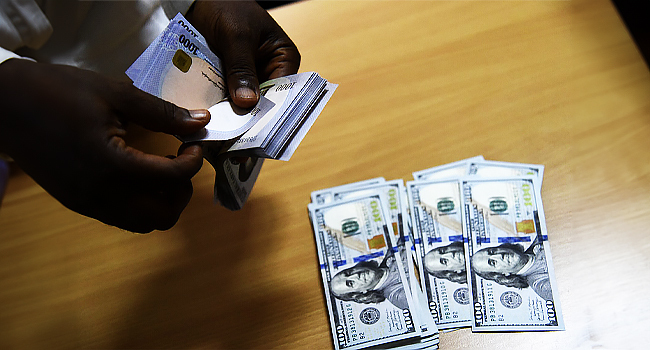

The naira came under renewed pressure on Monday, weakening sharply across foreign exchange markets as declining external reserves and rising dollar demand triggered broad-based sell-offs. Data from the Central Bank of Nigeria showed the local currency depreciated by N35 at the Nigerian Foreign Exchange Market (NFEM) window, closing at N1,388 per dollar, a 2.48 per cent drop. The parallel market mirrored the bearish trend, with the naira falling by 2.33 per cent to N1,388/$, underscoring sustained pressure across both official and informal segments.
The latest decline reverses recent gains that had pushed the exchange rate to around N1,344/$ last week, supported by foreign portfolio inflows, exporters’ proceeds, and targeted FX interventions by the apex bank. However, the resurgence of dollar demand, driven by global risk aversion and increased appetite for safe-haven assets, has eroded those gains, exposing underlying vulnerabilities in Nigeria’s external sector. The reversal highlights the fragility of recent stability and the sensitivity of the naira to shifts in global investor sentiment.
A key pressure point remains the country’s external reserves, which recorded a fifth consecutive outflow amid ongoing international payments. Gross reserves declined to $49.79 billion from $50.03 billion, slipping below the $50 billion threshold and signalling reduced FX buffers. The persistent drawdown comes despite elevated global oil prices, which would typically support reserve accretion. Analysts attribute the disconnect to weak oil production, high import demand, and sustained capital outflows—structural factors that continue to constrain Nigeria’s ability to build resilience against external shocks.
From a macro stability perspective, the simultaneous decline in reserves and the exchange rate raises questions about the sustainability of the Central Bank’s intervention strategy. The apex bank had earlier moderated its FX interventions following a period of relative stability, but renewed market pressure in the latter part of last week shifted sentiment, accelerating the naira’s depreciation. Market expectations had pointed to a gradual appreciation towards N1,300/$ in the first half of 2026, but the current trajectory suggests that exchange rate stability remains contingent on sustained policy coordination and improved supply-side fundamentals.
The implications for inflation and household purchasing power are significant. A weaker naira increases the cost of imported goods, including fuel, machinery, pharmaceuticals, and food products that are not sufficiently produced domestically. With inflation already elevated, further currency depreciation risks compounding cost pressures for businesses and consumers. For manufacturers who rely on imported raw materials or intermediate goods, the exchange rate movement adds to operating costs at a time when access to foreign exchange remains a persistent challenge.
The investment climate implications are equally concerning. Foreign portfolio investors, who had been drawn by high yields in the fixed income market and relative exchange rate stability, may reconsider their positions if volatility returns. The reversal of recent gains suggests that the investor confidence built over the past year remains fragile and easily disrupted by global risk aversion. For the Central Bank, maintaining stability will require a careful balance between using reserves to defend the currency and conserving buffers for essential obligations.
Industry experts believe the near-term outlook for the naira will depend on the central bank’s intervention strategy, the pace of FX inflows, and the trajectory of external reserves. With pressures mounting across both supply and demand dynamics, the latest depreciation reinforces concerns over currency volatility, even as policymakers continue efforts to stabilise the market and restore investor confidence. The disconnect between elevated global oil prices and reserve depletion underscores the urgency of addressing production shortfalls and diversifying foreign exchange sources away from oil dependency.
As the naira settles at N1,388/$, the path forward will test the resilience of Nigeria’s external sector and the effectiveness of the Central Bank’s policy framework. Without sustained improvements in oil production, non-oil export earnings, and capital inflows, the currency may remain vulnerable to periodic sell-offs that undermine the stability needed for long-term investment planning.