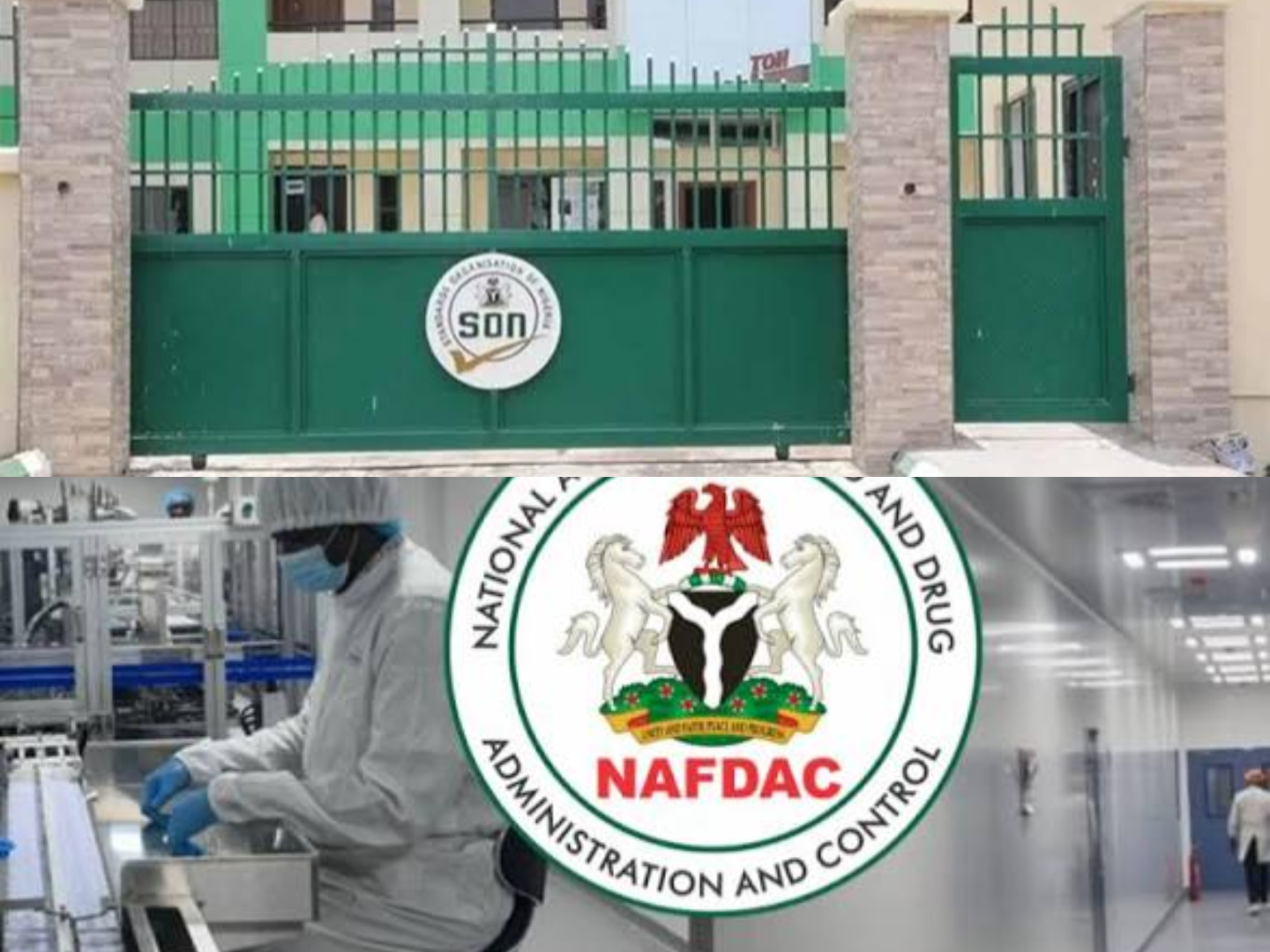

When Nigerians buy body cream, take medication, drink bottled water, purchase electrical appliances or use building materials, they are relying on a regulatory system designed to ensure that the products meet safety and quality requirements. Two government agencies play important roles in this system: the National Agency for Food and Drug Administration and Control (NAFDAC) and the Standards Organisation of Nigeria (SON).
Although both agencies are responsible for protecting consumers and ensuring product quality, their functions are different. NAFDAC regulates specific categories of products, including food, drugs, cosmetics, medical devices and packaged water, while SON develops and enforces standards covering a much wider range of goods, including electrical appliances, building materials, industrial products and manufactured goods.
Their responsibilities can sometimes intersect, but their approvals are not interchangeable. Understanding what each agency does, the products under its control and the difference between their registration and certification processes can help consumers make informed purchasing decisions and businesses comply with Nigerian regulations.
The distinction has become particularly relevant following NAFDAC’s recent enforcement operations at the Lagos Trade Fair Complex, where officials uncovered large quantities of banned and unregistered cosmetics.
In February 2026, the agency discovered a warehouse containing cosmetic products valued at more than ₦3 billion. In August, it also sealed several shops at the complex over suspected dealings in unregistered cosmetics.
The operations provide an opportunity to examine a bigger question: why does Nigeria have both NAFDAC and SON, what exactly does each agency regulate, and how do their responsibilities affect the products Nigerians buy every day?
NAFDAC was established in October 1992 and operates under the National Agency for Food and Drug Administration and Control Act, Cap N1, Laws of the Federation of Nigeria 2004.
Its primary responsibility is to regulate and control the manufacture, importation, exportation, distribution, advertisement, sale and use of food, drugs, cosmetics, medical devices, packaged water, chemicals and detergents.
In simple terms, NAFDAC focuses on products that people eat, drink, take as medicines or apply to their bodies, alongside other products within its statutory mandate.
For example, a company intending to introduce a new body cream, toothpaste, packaged drinking water or medicine into the Nigerian market must comply with the applicable NAFDAC registration and regulatory requirements.
The agency evaluates product information, inspects relevant facilities, conducts laboratory analysis where required and monitors products after they enter the market. It can also seize products, seal premises and take enforcement action against businesses that violate its regulations.
This explains why cosmetics fall under its authority despite the agency’s name. Nigeria’s NAFDAC Act expressly includes cosmetics among regulated products. Its Cosmetic Products Registration Regulations 2023 also establish registration requirements for cosmetics manufactured, imported, advertised, distributed or sold in Nigeria.
The Standards Organisation of Nigeria was established in 1970 and operates under the Standards Organisation of Nigeria Act 2015.
Unlike NAFDAC, whose mandate covers specified categories of regulated products, SON has a broader standardisation and quality-assurance responsibility across Nigerian industry and commerce.
Its functions include developing and approving standards for products, materials, measurements and industrial processes, testing products, investigating quality and enforcing applicable standards.
Its work covers electrical appliances, electronics, cement, steel, textiles, building materials, machinery and other manufactured products.
For locally manufactured goods covered by its requirements, SON operates the Mandatory Conformity Assessment Programme (MANCAP). The programme assesses whether locally manufactured products comply with relevant Nigerian Industrial Standards.
For imported products covered by its requirements, SON operates the Standards Organisation of Nigeria Conformity Assessment Programme (SONCAP), which involves conformity assessment and verification procedures designed to ensure that regulated imports meet applicable standards before entering Nigeria.
The distinction between the agencies becomes clearer when their responsibilities are considered together.
For instance, a manufacturer producing a cosmetic product must comply with NAFDAC’s requirements for cosmetic registration and safety. SON’s standards and conformity-assessment responsibilities may also apply where the product falls within the scope of relevant SON requirements.
However, this does not mean every product automatically requires separate approvals from both agencies. The applicable requirements depend on the product category, relevant standards and regulatory rules.
SON also exempts certain products, including food and medicines, from its offshore SONCAP certification scheme. This does not mean SON has no regulatory responsibilities concerning those products.
It is equally important to distinguish between registration and certification. A NAFDAC registration number relates to the agency’s regulatory approval of a product, while MANCAP and SONCAP demonstrate conformity with applicable standards under SON’s programmes. They are not interchangeable.
For consumers, the practical lesson is that checking a NAFDAC number alone is not sufficient for every type of product. Buyers should also pay attention to applicable certification marks, product labels, expiry dates, packaging and manufacturer information.
Ultimately, NAFDAC and SON serve different but complementary purposes in Nigeria’s consumer protection system. One focuses on regulating specific products with important public health implications, while the other establishes and enforces standards across a broad range of products and industrial activities.
Together, their responsibilities help protect consumers, discourage the circulation of substandard goods and promote confidence in products manufactured locally or imported into the country.