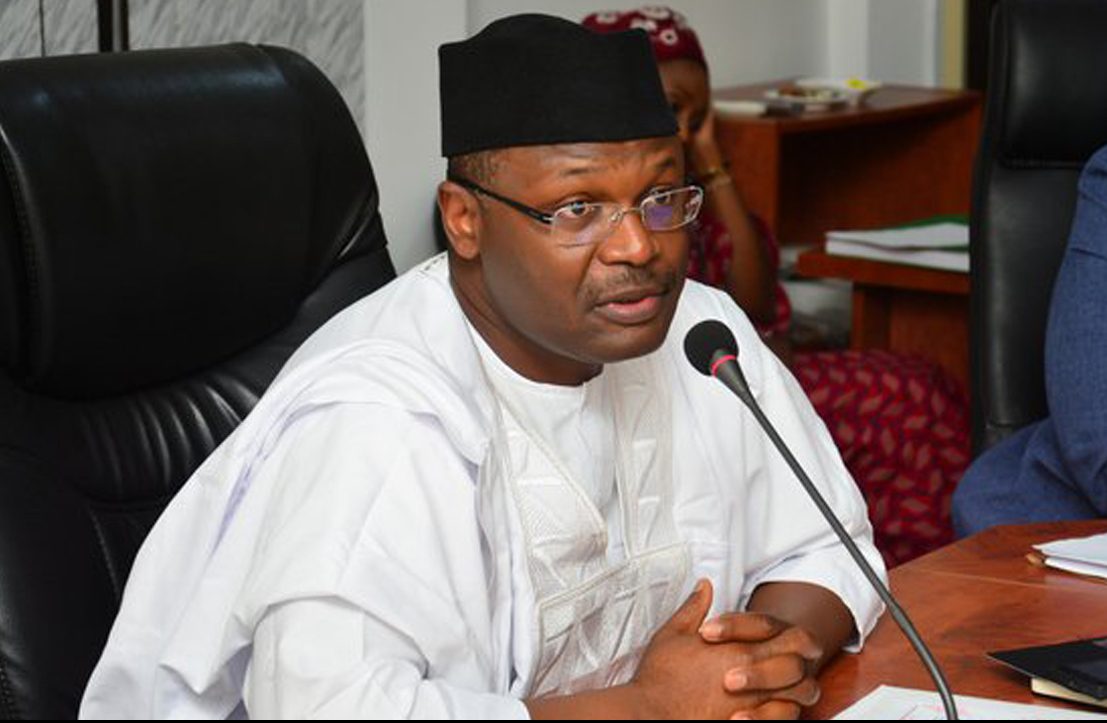

Professor Mahmood Yakubu has officially ended his tenure as Chairman of the Independent National Electoral Commission (INEC), drawing to a close a decade-long stewardship that shaped the trajectory of Nigeria’s electoral process. His exit on Tuesday marks the conclusion of his second and final five-year term, in line with constitutional provisions.
At a meeting with Resident Electoral Commissioners (RECs) held at INEC headquarters in Abuja, Yakubu formally announced his departure and handed over to Mrs May Agbamuche-Mbu, a serving National Commissioner, who now assumes office as Acting Chairman pending the appointment of a substantive successor by President Bola Tinubu.
Mrs Agbamuche-Mbu, a seasoned lawyer and publisher, has been part of the INEC leadership since 2016, representing the South-South geopolitical zone. Her assumption of the acting role is seen as a move to ensure continuity within the Commission during the transitional period. She will oversee INEC’s administrative and operational activities, including ongoing preparations for off-season governorship elections and continuous voter registration exercises.
Yakubu’s tenure — the longest of any INEC chairman in Nigeria’s history — was marked by ambitious reforms, technological innovation, and a persistent drive to strengthen the credibility of Nigeria’s electoral system. Under his watch, INEC introduced the Bimodal Voter Accreditation System (BVAS) and the INEC Result Viewing (IReV) portal, tools that significantly changed how elections were conducted and results transmitted. These measures, intended to enhance transparency and public trust, have since become central to Nigeria’s electoral discourse.
However, his leadership was not without controversy. While Yakubu earned plaudits for institutionalising technology and improving the independence of the Commission, he also faced criticism over logistical lapses and allegations of electoral irregularities, particularly during the 2023 general elections. Critics pointed to delays in result transmission and communication failures that undermined public confidence. Supporters, however, argue that many of these issues reflected broader systemic challenges beyond the Commission’s control, including political pressure, funding constraints, and security threats in several parts of the country.
Attention now turns to Mrs Agbamuche-Mbu, whose interim leadership comes at a delicate time for the Commission. With preparations underway for governorship elections in Anambra in November 2025, and in Ekiti and Osun States in 2026, her immediate challenge will be to maintain operational stability and public trust while the process of appointing a new substantive chairman unfolds.
Her legal background and previous involvement in INEC’s policy and legal advisory work could prove valuable in navigating potential disputes and ensuring that upcoming elections adhere to both constitutional and procedural standards.
As Nigeria’s democratic experiment continues to evolve, the transition at INEC signals both continuity and uncertainty. The choice of Yakubu’s successor, and how that individual builds on his legacy, will determine the pace and credibility of future electoral reforms. For now, the Commission stands at another defining moment in its 27-year history as the guardian of Nigeria’s democracy.