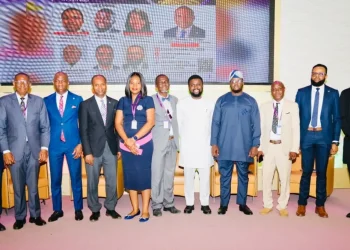

The Lagos State Government has successfully concluded EcoNexus 3.0, a high-level strategic engagement aimed at transforming climate and circular economy initiatives into measurable financial assets. Convened by the Office of the Special Adviser on Climate Change and Circular Economy, the event established a unified framework for industries to capture, verify, and monetise sustainability data, further solidifying Lagos’s position as a regional hub for green finance and ESG (Environmental, Social, and Governance) investment.
The structural and economic consequence of this initiative addresses a critical market gap: the “invisibility” of sustainability efforts. Titilayo Oshodi, Special Adviser to the Governor on Climate Change and Circular Economy, noted that while many organizations are already implementing green practices, they often struggle to convert these actions into economic value. By aligning local data with international standards such as the Greenhouse Gas Protocol, IFRS S2, and the Task Force on Climate-related Financial Disclosures (TCFD) Lagos is creating an auditable system that makes sustainability efforts globally competitive and investable.
Analytically, the impact on “Capital Allocation and Revenue Potential” marks a shift from mere regulatory compliance to strategic advantage. Funke Shobanjo, COO of FBNQuest Merchant Bank, observed that sustainability has evolved from a reporting requirement into a tool for capital allocation and revenue generation. However, she cautioned that many Nigerian firms have yet to harness these opportunities because their initiatives lack the rigorous structure and measurement required by global investors who prioritize documented environmental impact.
The impact on “State Planning and Enabling Environments” was reinforced by the Commissioner for Economic Planning and Budget, Ope George. He revealed that the state is currently restructuring its budgeting frameworks to ensure that sustainability opportunities are transparent and accountable. This government-led approach allows businesses to transform emission reductions and resource optimization into new revenue streams, effectively turning environmental responsibility into a core business strategy rather than an operational cost.
The impact on “Cross-Sectoral Governance and Systems Alignment” was echoed by global development strategist Oshunniyi Abiola, who argued that ESG value is created only when data and decisions align across different sectors. EcoNexus 3.0 successfully drew a diverse cohort of participants—including leaders from telecommunications, construction, FMCG, and academia reflecting the reality that climate action is now a central pillar of national economic planning rather than a niche environmental concern.
Furthermore, the state’s drive to position Lagos as a “green hub” comes at a time when Nigeria faces the dual pressure of managing environmental risks while maintaining growth. By integrating international verification standards into local operations, Lagos is building a model that could redefine how climate action is implemented across West Africa. The focus remains on making the state not just a participant in the global green shift, but a leader in circular innovation.
The long-term outlook for the Lagos economy depends on the speed at which the private sector adopts these auditable data systems. As global finance increasingly flows toward regions with credible sustainability performance, the frameworks established at EcoNexus 3.0 will serve as the essential bridge between local environmental action and international green capital.