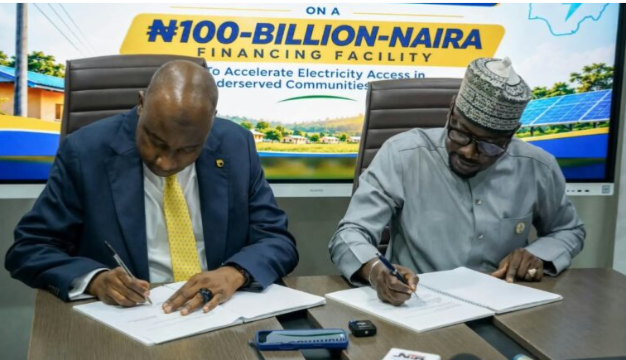

The Rural Electrification Agency (REA) and Jaiz Bank have signed a N100 billion financing agreement to expand electricity access in communities across Nigeria that have limited or no access to reliable power.
The agreement is expected to strengthen funding for renewable energy projects and support developers working to improve electricity supply in underserved areas. With the latest deal, local financing commitments for renewable energy projects in Nigeria have increased to N450 billion, according to a statement issued by the REA on Wednesday.
The agreement was signed on Tuesday at the agency’s headquarters, with Abba Aliyu, managing director of the REA, describing the partnership as an important step towards attracting more domestic investment into the renewable energy sector.
Aliyu said access to local funding was necessary to sustain the industry’s growth and support efforts to close the country’s electricity access gap.
“I would like to say that you joined at the right time, even though we already have local financing arrangements with Lotus Bank, FCMB, Stanbic IBTC and Alpha Morgan,” he said.
“We are happy to have Jaiz Bank on board, as access to financing is key to reaching this N450 billion milestone.”
The REA chief also highlighted the growing importance of renewable energy as countries increase investments in cleaner sources of electricity to reduce carbon emissions. He referenced global climate commitments, including the Paris Agreement and COP30, noting that solar power was increasingly becoming one of the cheapest sources of electricity.
According to Aliyu, electricity is no longer just a basic necessity but an important foundation for technological advancement and economic development. He pointed to rising electricity demand in countries such as the United States, China, India and South Africa, adding that global demand could reach 18 petawatt-hours (PWh) by 2050.
Aliyu said the agency had identified seven major areas requiring attention to improve electricity access across Nigeria. He also highlighted the Federal Government’s commitment to expanding reliable power supply through the Distributed Access through Renewable Energy Scale-up (DARES) project, which is supported by the World Bank.
The REA managing director stressed that the agency’s work goes beyond securing funding, noting that it was also supporting the delivery of electricity infrastructure in different communities. He cited recently commissioned projects, including a 1.6-megawatt interconnected mini-grid at the Federal University of Lafia, a 581-kilowatt-peak installation at Oke-Oyi, and a 265-kilowatt-peak project serving Ballagaza and Marayar Rogo communities in Warawa Local Government Area of Kano State.
Meanwhile, Haruna Musa, managing director of Jaiz Bank, said the partnership would contribute to Nigeria’s ambition of building a $1 trillion economy. Musa noted that the availability of local financing for Renewable Energy Service Companies (RESCOs) within two years showed progress in attracting domestic capital to the sector. He added that the partnership was not simply about providing money but also creating opportunities for millions of Nigerians through improved electricity access.
Under the agreement, Jaiz Bank will provide financing support to renewable energy project developers, while the REA will facilitate the necessary grant agreements. The combination of bank financing and government supported grants is expected to reduce funding challenges facing developers and help move more renewable energy projects from planning to implementation.
The partnership is expected to strengthen Nigeria’s domestic renewable energy financing capacity while supporting efforts to extend electricity access to communities that remain underserved.