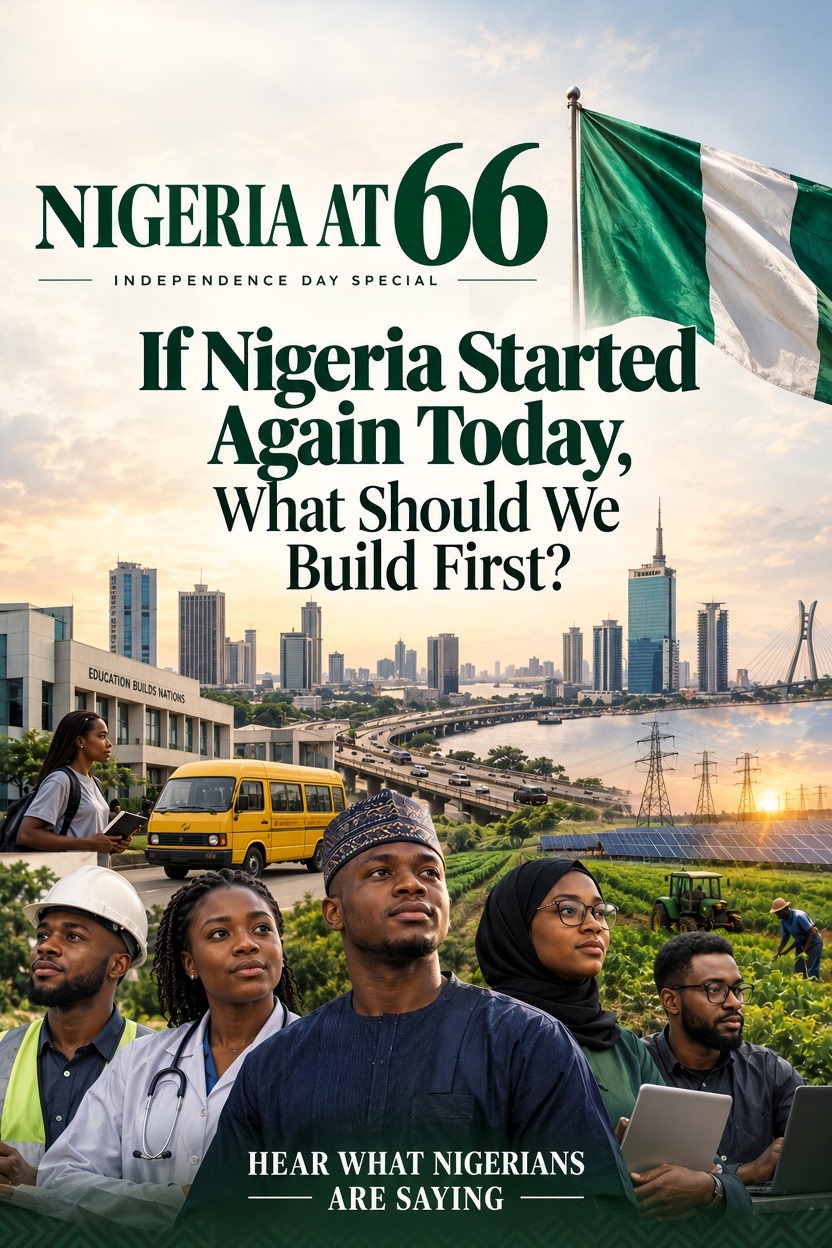

Sixty six years after independence, Nigeria has built a large and complex economy. But if the country had the chance to start again today, what should it build first? Should the priority be food, electricity, education, jobs or something deeper?
As Nigeria marks 66 years of independence, Business Times asked professionals from different backgrounds one question: If Nigeria started again today, what should we build first, and why?
For Val Okafor, a human capital development expert, the answer begins with something that cannot be measured in kilometres of roads or megawatts of electricity: unity.
“Unity across every line, tribal, ethnic and religious. These are the foundations of nation building,” Okafor said.
His response points to a foundation that cuts across every other part of the economy. Roads, schools, factories and power infrastructure still depend on people and institutions capable of building, managing and maintaining them.
For entrepreneur Chukwuemeka Nnabugwu, the starting point should be education and human capital.
“This would make up for every other thing on the list. This should also cover culture shaping, which would promote a sense of responsibility and unity,” he said.
Nnabugwu argued that proper education would provide the knowledge and skills needed to establish and manage other sectors of the economy. For him, starting again would require sufficient investment in knowledge building, skill acquisition and mindset development. He also believes this would create a stronger foundation for ideas, accountable institutions, efficient infrastructure and innovation.
The economic case for investing in people is significant. A 2026 World Bank human capital report, titled, Building Human Capital Where It Matters: Homes, Neighborhoods and Workplaces, released in February 2026 found that Nigeria’s deficits in health, education and workforce skills are associated with a loss equivalent to 111% of future labour earnings. The report also found that increasing effective years of schooling to 12 years could raise labour earnings by about 20% over the long term.
Isaac Lawal, a leadership expert and media professional, reached a similar conclusion. “If I have to pick just one, I’d go with education and human capital,” Lawal said. “This is because the success and fruition of every other thing is dependent on the human factor.”
For Lawal, the logic is straightforward: whatever Nigeria chooses to build will ultimately depend on the people responsible for designing, operating and sustaining it.
Queen Esther Anakor, an educator and AI and automation specialist, also placed education at the centre of her answer, but focused more closely on mindset.
“Definitely education and human capital for me,” she said. “I believe so many of our problems come from a mindset and mentality point of view.”
Anakor said Nigeria needs both formal and informal education that expands what citizens believe is possible and encourages people to work towards better outcomes together.
“I think we have almost everything on your list to some extent. The systems are just somewhat flawed,” she said.
She pointed to healthcare as an example, arguing that some problems are not simply about the absence of facilities or equipment but also about a lack of knowledge and awareness among citizens. Her argument becomes particularly relevant when considering Nigeria’s large and growing population. The World Bank estimates that about 3.5 million people enter Nigeria’s labour force every year, while weak job creation and limited entrepreneurial opportunities remain challenges to translating economic growth into better living standards.
For Awoko Emmanuel, a graphic and product designer, jobs and opportunities for young people are the priority. He argued that a system that creates room for businesses, organisations and entrepreneurship would have wider economic benefits.
“For me, I would opt for jobs and opportunities for young people,” Emmanuel said. “Nigeria, as a largely populated country, would be much better if opportunities were provided for individuals to thrive. If a country as a whole provides sufficient jobs, that implies there is already an existing structure that needs to be managed,” he said.
Emmanuel believes job creation would also pull other sectors along because a functioning labour market would require agriculture, energy, healthcare, technology and other industries to grow. He also pointed to investment in young Nigerians through graduate training, funding programmes and other opportunities that allow them to learn, build and scale. But before people can build businesses or fill jobs, they need one of the most basic things required for survival: food.
For Manawa Joan, an HSE intern, agriculture should be the starting point for rebuilding Nigeria.
“I think agriculture is a better way to enable a stable economy if we’re to start again,” Joan said. “Focusing on food production in quantity, not necessarily in price, will increase our production rate and our country’s GDP,” she said.
Joan also sees agriculture as a way to reduce Nigeria’s dependence on imports and create opportunities to export locally produced food.
“We are naturally blessed. If we can go with our natural local produce, it will make people see the benefits of agriculture instead of the little attention people pay to it,” she said.
The scale of Nigeria’s agricultural sector supports her argument. According to the Food and Agriculture Organisation, agriculture contributed about 28% of Nigeria’s GDP between 2021 and 2024 and employed about 40% of the labour force. Yet Nigeria imported about ₦16 trillion worth of food during that period, compared with about ₦7 trillion in food exports.
Ifeoluwa Joshua, a software engineer, also chose agriculture and food production, but approached it from the perspective of basic needs. For Joshua, building a stronger food system would not only feed Nigerians but could also create opportunities for the country to earn more from agricultural exports. “If the first thing that will always come to a common man’s mind is food, then other things follow.” But agriculture itself depends on another foundation: energy.
Deborah Utuvahwe, an educator, believes reliable electricity should come first because of its effect across the economy, particularly on technology.
“If there is electricity and energy, it will improve the technology world. There is a lot to achieve when electricity is stable,” she said.
The data shows why electricity remains central to the discussion. World Bank data puts electricity access in Nigeria at 62.5% in 2024, meaning a substantial share of the population still lacked access. Reliable electricity affects far more than technology. Manufacturers need it to produce, farmers need it for irrigation and processing, businesses need it to operate and households need it for basic services.
The different answers therefore begin to connect. Food production requires energy, infrastructure, financing and skilled workers. Businesses need electricity, transport and human capital to operate. Young people need education and skills before they can fill productive jobs. And all these systems require institutions and citizens capable of maintaining them. Nigeria does not have the luxury of literally starting over. But the question offers a useful way to examine the foundations of the economy it wants to build next.
At 66, the debate may therefore be less about choosing one sector over another and more about understanding how those foundations connect. A country that can educate its people, feed its population, power its businesses, create productive jobs and maintain the social trust needed to hold its diverse population together would be building more than infrastructure. It would be building the conditions for a stronger economy.
And perhaps that is the more useful Independence Day question: if Nigeria started again today, what should it build first?