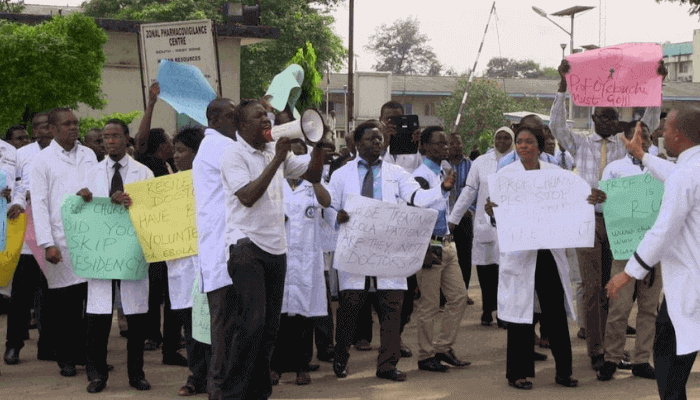

Public healthcare services across Nigeria have been brought to a standstill following the commencement of an indefinite nationwide strike by the Joint Health Sector Unions (JOHESU). The industrial action, which began after the expiration of a 15-day ultimatum issued to the Federal Government, has left thousands of patients stranded and hospitals functioning at skeletal capacity.
The dispute hinges on the government’s failure to implement the upward adjustment of the Consolidated Health Salary Structure (CONHESS). JOHESU contends that this adjustment has been long overdue, citing the disparity with the Consolidated Medical Salary Structure (CONMESS) enjoyed by doctors, which has seen multiple reviews since 2014. Despite a Memorandum of Understanding signed in October 2024 and assurances from President Bola Tinubu during a meeting in June 2023, the union states that the government has stalled on issuing the necessary circulars to activate the new salary table.
On Monday, December 22, 2025, the impact of the strike was visible across major health institutions in Lagos and Abuja. At the Lagos State University Teaching Hospital (LASUTH), the usually bustling corridors were marked by frustration and confusion. Essential units such as the pharmacy and records departments were locked, effectively barring new patients from registration and existing ones from accessing prescribed medications.
Paul Igbede, a physically challenged outpatient, was found waiting in a corridor while his wife scrambled to find a private pharmacy outside the hospital premises. “I can’t get drugs,” Igbede lamented. “When we came in, the records were locked. That was the only missing point. Every other unit was active, but without records, you are stuck.” A retired nurse at the same facility managed to see a doctor only after filling out a manual form but was ultimately turned away at the pharmacy by security personnel who confirmed the unit was shut.
In the Federal Capital Territory, the situation was equally dire. Maitama District Hospital, typically a hive of activity, was described as “largely quiet” by midday. The General Outpatient Department (GOPD) was devoid of queues, and the records office gathered dust behind locked doors. Staff on the ground confirmed that while some doctors were present, they could not attend to patients because JOHESU members—who handle critical entry-point services like card retrieval and registration—were absent. “Without record officers, patients cannot be registered or cleared to see doctors,” a hospital staff member explained.
The situation appeared even more severe at Wuse District Hospital, where the premises were described as deserted and dimly lit due to a power outage. Consultation rooms remained locked, and patients were turned away en masse. A young man accompanying an elderly relative noted that they only received limited attention because they required specific eye treatment; virtually all other departments were non-functional. At the National Hospital in Abuja, a rowdy atmosphere pervaded the GOPD as patients begged the few available staff for attention. Many were referred to private facilities or told to return to their referring hospitals, despite the logistical impossibilities.
Martin Egbanubi, the National Secretary of JOHESU, maintained that the strike would continue until the government meets their demands. He argued that health workers are not immune to the system’s failures and suffer alongside the general populace. “We have shown maturity and patriotism, but it seems our maturity has been taken for granted,” Egbanubi stated, emphasizing that only those who can afford medical tourism are shielded from the crisis.
The recurring paralysis of Nigeria’s health sector exposes a deeper economic and structural rot, succinctly captured in the 2025 Health Preparedness Index by SBM Intelligence. The report reveals a catastrophic lack of readiness, with no single Nigerian state scoring up to 30 percent in health emergency preparedness. This fragility is exacerbated by a massive brain drain—the “Japa syndrome”—which has left the nation with a pitiful doctor-to-patient ratio of 1:15,361, far below the WHO recommendation of 1:1,000. The economic implications are severe: as public hospitals shut down, the productivity of the workforce plummets due to untreated illnesses, and the country bleeds foreign exchange through medical tourism, which remains the only option for the wealthy elite while the poor are left to languish.
Reactions to the latest shutdown have been sharp and despairing. Adetokunbo Fabamwo, the Chief Medical Director of LASUTH, lamented the human cost, stating, “It is the patients they are punishing. They are the ones that suffer the most.” His sentiments were echoed by Ayuba Ibrahim Tanko, President of the Pharmaceutical Society of Nigeria (PSN), who described the strike as a “national emergency” that has paralyzed over 73 Federal Health Institutions. For the average Nigerian, however, the strike is a death sentence. A distressed patient at LASUTH summed up the hopelessness of the situation: “They told me there was nothing they could do and that I should try a private hospital, but I cannot afford private care. I don’t even know where to start.” Meanwhile, JOHESU leadership insists their hand was forced, with National Secretary Martin Egbanubi noting that their previous “maturity and patriotism” had been exploited by a government that failed to honor signed agreements.