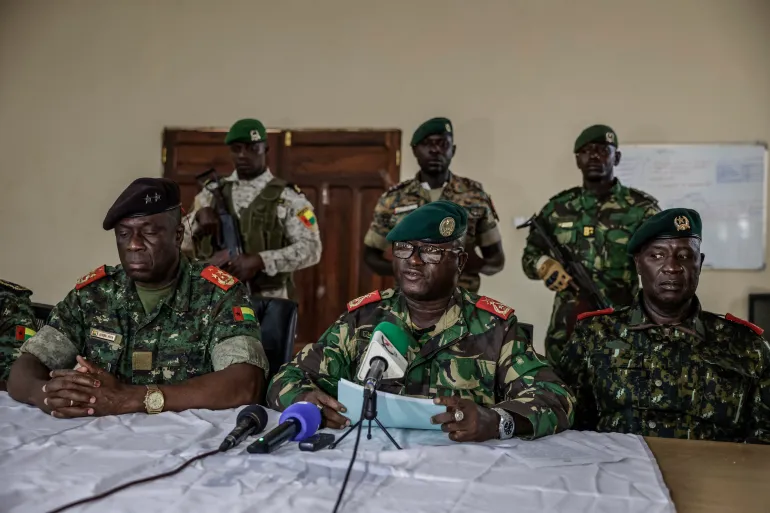

Army officers in Guinea-Bissau declared on Wednesday that they had taken control of the country, abruptly suspending the release of results from a contentious presidential election and plunging the West African nation into its gravest political crisis in years. The announcement, delivered on state television by military spokesperson Diniz N’Tchama, said the officers had removed President Umaro Sissoco Embaló from power, suspended the electoral process, sealed all borders and imposed a nationwide curfew.
Calling themselves the High Military Command for the Restoration of Order, the officers did not provide details about the fate or location of the president. Hours later, Embaló told France 24: “I have been deposed,” confirming that he was no longer in control of the state. Security sources in Bissau said he was being held at the office of the army chief of staff, though this has not been independently verified.
The military’s declaration halted the tallying of election results in a vote already marred by allegations of interference, delayed counts and political tensions between rival factions. Embaló, who came to power in 2020 after a fraught contest, had faced strong opposition in the latest election from Fernando Dias, a former minister who campaigned on promises of reform and curbing elite influence.
Shortly after the takeover, armed men attempted to detain Dias at a residence in the capital, according to his campaign team. Speaking later, Dias said he was safe and accused authorities of orchestrating a “false coup,” claiming he had already won the vote and that the military move was a ploy to block his victory. His comments stoked further confusion over whether the military acted independently or in alignment with elements loyal to the outgoing administration.
Gunfire was reported near key government buildings as military checkpoints appeared across central Bissau. Residents described a tense and rapidly evolving situation, with businesses shuttering early, roads closing, and families rushing to gather supplies before the newly imposed curfew took effect. State institutions, including the electoral commission, remained under heavy guard.
The African Union and the Economic Community of West African States issued separate statements expressing deep concern about the unfolding crisis. Both organisations said they had received reports that electoral officials were being arrested and called for their immediate release. ECOWAS, which has frequently intervened in political crises in Guinea-Bissau, urged the military to restore constitutional order and warned that it was monitoring the situation closely.
Guinea-Bissau has a long history of instability, with multiple coups, mutinies and political assassinations since independence from Portugal in 1974. Although Embaló’s presidency brought a period of relative calm, tensions between the executive and parliament persisted, and analysts had warned that the country’s fragile institutions remained vulnerable to disputes over electoral legitimacy.
The timing of the military takeover, coinciding with the partial release of election results, suggests the vote may have been a key trigger. Preliminary figures were expected to show a tight race, with opposition supporters alleging irregularities even before polls closed. Diplomatic sources said disagreements between security chiefs and political actors in the days leading up to the announcement contributed to an atmosphere of mistrust.
The crisis also raises fears of broader regional instability at a moment when West Africa is grappling with a series of military takeovers in Mali, Burkina Faso, Niger and Guinea. ECOWAS has struggled to reverse those coups, and analysts say its leverage in Guinea-Bissau may also be limited unless the military shows willingness to negotiate.
For now, uncertainty looms over the political future of the small coastal nation. With borders shut, institutions suspended, and the status of both the president and his main challenger in question, residents face the prospect of prolonged volatility. International partners are calling for restraint, but much will depend on whether the military consolidates its position or faces pushback from political groups, civil society and regional organisations seeking to restore civilian rule.