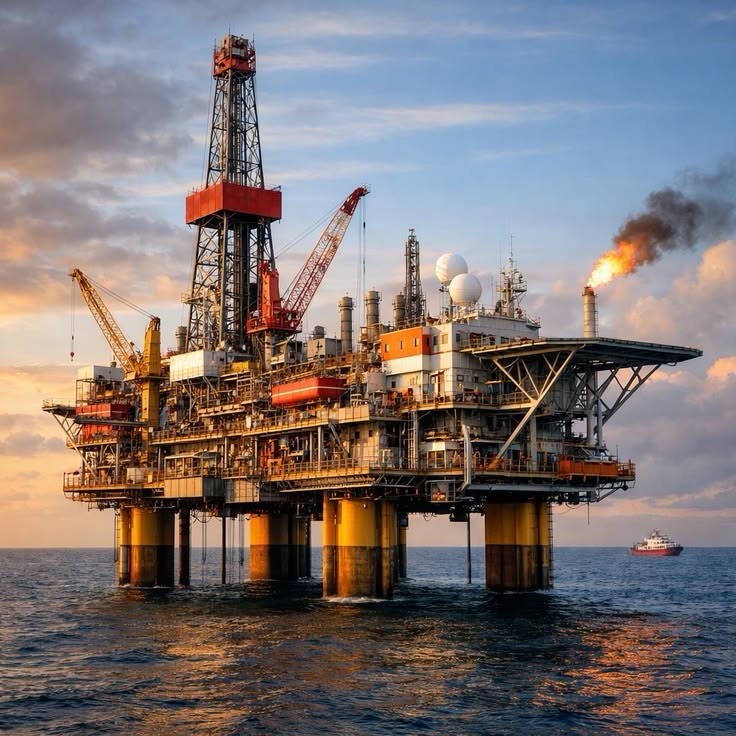

Fears are rising across the global energy industry as new projections show a sharp decline in offshore oil and gas investment in 2026. According to recent analysis, total capital expenditure (CAPEX) in the sector is expected to fall significantly, signaling a slowdown in major project developments.
A report by maritime research firm Clarkson Research Services estimates that global offshore oil and gas CAPEX will drop to about $85 billion in 2026. This represents a steep 24 percent decrease from the $111.9 billion recorded in 2025 through final investment decisions. If this forecast holds, it would mark the lowest level of offshore investment since 2020.
So far, only around $34 billion has been committed to offshore projects this year, suggesting that companies are becoming more cautious with spending. This slowdown is raising concerns about the future of large-scale offshore exploration and production activities.
Despite the drop in new investments, some parts of the offshore sector are still showing strength. For example, the backlog for subsea engineering, procurement, and construction projects has reached a record high of $52 billion. This indicates that while fewer new projects are being approved, previously planned work is still ongoing.
In addition, tightening supply in certain regions is pushing up costs. In the North Sea, subsea vessel charter rates have increased by 12 percent since the beginning of the year due to limited availability. This suggests strong demand for specialized offshore services, even as overall investment declines.
Geopolitical tensions are also playing a role in shaping the market. The ongoing conflict involving Iran has created mixed effects. On one hand, operations in the Persian Gulf have become more challenging due to security concerns. On the other hand, the situation has encouraged increased activity in other regions, as countries seek to strengthen their energy security and reduce dependence on unstable areas.
Market performance indicators show modest improvement after a weaker 2025. The Offshore Rate Index, which tracks daily rates for drilling rigs, support vessels, and subsea equipment, has risen by three percent in 2026. It now stands at 111 points, which is 11 percent higher than its previous peak in 2014 and twice its lowest level in 2018.
Demand for offshore drilling equipment is also growing. The number of jack-up rigs in use has reached 387 units, an increase from last year, with utilization rates at 89 percent. Premium jack-up rigs are now earning around $103,000 per day, reflecting an 11 percent increase so far this year.
Similarly, floating rigs are seeing steady demand, with 130 units in operation. Ultra-deepwater drilling rates have risen by five percent to about $373,000 per day, recovering slightly after a decline in 2025.
Support vessel markets are also improving. In West Africa, platform support vessel rates have increased by five percent this year, while rates in the North Sea have also seen growth.