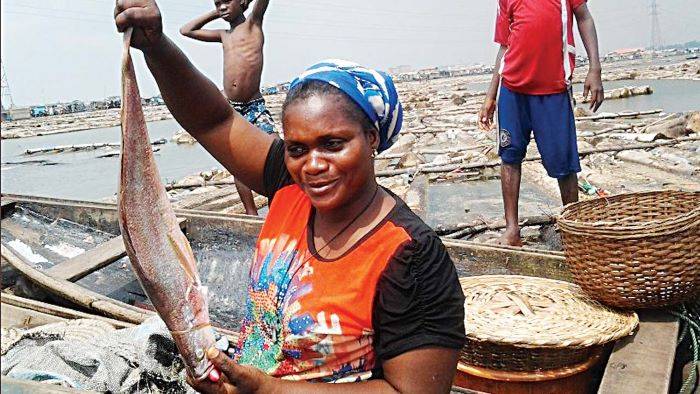

Fish sellers in Ibafo, Ogun State, are facing rising business costs as weak customer purchasing power, expensive storage and the need to keep unsold fish frozen squeeze their earnings.
For Bose, a fish seller and hawker in Ibafo, the problem is particularly noticeable when she returns from selling with only a few fish left.
“If I am left with two or three, I eat them,” she said.
Rather than allow the remaining fish to go to waste, Bose sometimes takes them home for consumption. But the unsold stock also represents money that has not been recovered from her day’s sales.
Another fish seller, Ajoke, said she keeps unsold fish in storage when necessary.
“I store them, but I pay,” she said.
The storage charge adds to her cost of doing business, meaning that the longer fish remains unsold, the more money she has to spend before eventually recovering the value of the stock.
For traders in Ibafo, the challenge is therefore not simply the price at which they buy fish. They must also factor in transportation, preservation and storage while dealing with customers who may not have enough money to buy as much as they previously did.
The pressure is also being felt in other parts of Nigeria. Eze Lucy, a fish trader at Dei-Dei Market in Abuja, told the News Agency of Nigeria (NAN) on August 11, 2026, that prices had more than doubled in many cases, with a carton of Original Titus selling for about ₦140,000.
Lucy said Kampala Titus sold for ₦78,000, Shawa for ₦80,000 and Kpanla for about ₦47,000. She also told NAN that government financial support would help traders buy stock outright.
At Kubwa Market in Abuja, Sani Ibrahim told NAN that transportation, ice blocks and storage had increased the cost of selling fish, forcing traders to pass the additional expenses on to customers.
The pressure on traders comes amid a significant gap between Nigeria’s fish demand and domestic production. WorldFish reported on November 21, 2025, that Nigeria’s annual fish demand was nearly four million metric tonnes, compared with domestic production of about 1.2 million tonnes.
WorldFish said the shortfall had contributed to Nigeria’s dependence on fish imports, with the country spending more than $1.2 billion annually on imported fish.
That dependence makes cold storage important to traders handling frozen fish. But Nigeria’s cold-chain infrastructure remains inadequate.
BusinessDay reported on April 30, 2025, citing a United States International Trade Administration report, that Nigeria had fewer than 1,000 cold trucks compared with about 25,000 needed to transport more than 11 million metric tonnes of perishable goods annually.
The cost of preserving fish therefore becomes another pressure on small traders. In Ibafo, when customers buy less and fish remains unsold, sellers like Ajoke have to pay to keep it frozen, while Bose sometimes takes a few leftovers home.
For traders operating on small margins, the difference between selling quickly and paying to preserve stock can determine how much money is left at the end of the day.