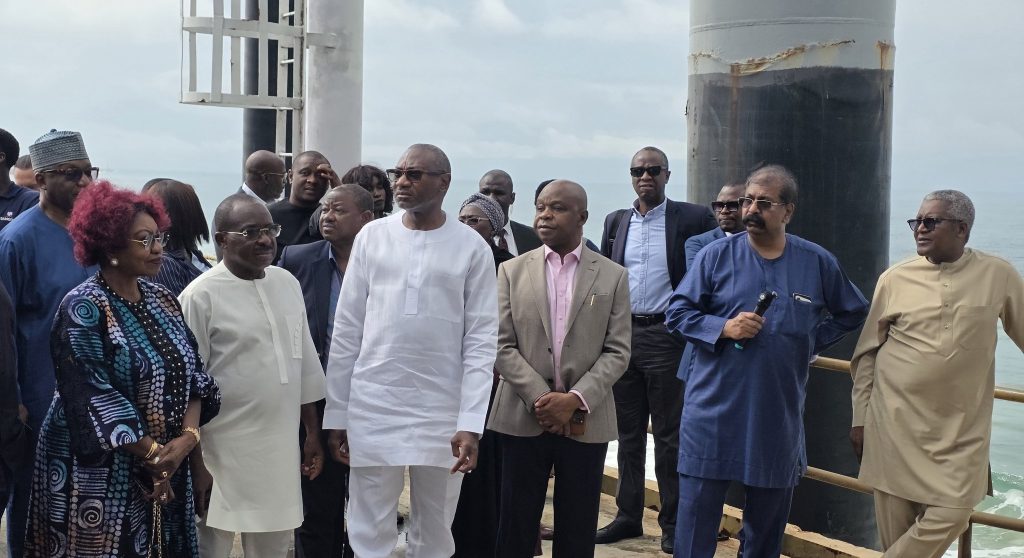

Senior executives and board members from First HoldCo Group companies have visited the $20bn Dangote Petroleum Refinery in Lagos, underscoring growing collaboration between Nigeria’s banking sector and large-scale industrial projects shaping the country’s economic future.
The delegation, comprising directors and senior management from subsidiaries within First HoldCo, toured the sprawling refinery complex located in the Lekki Free Trade Zone. The visit provided executives with a closer assessment of operations at what is widely regarded as Africa’s largest single-train refinery.
The refinery, developed by billionaire industrialist Aliko Dangote, has become central to Nigeria’s push to reduce dependence on imported refined petroleum products, conserve foreign exchange, and strengthen domestic manufacturing capacity.
Executives during the visit highlighted the strategic importance of stronger engagement between financial institutions and industrial operators, particularly as Nigeria seeks to diversify its economy beyond crude oil exports.
Industry analysts say the engagement reflects increasing interest from financial institutions in supporting infrastructure-backed industrial expansion, especially projects capable of generating long-term economic multipliers across logistics, manufacturing, energy, and exports.
The Dangote Refinery, with a projected refining capacity of 650,000 barrels per day, is expected to significantly alter fuel supply dynamics in Nigeria and across West Africa. Economists believe the facility could help ease persistent pressure on Nigeria’s foreign exchange reserves by reducing fuel import bills, which have historically consumed substantial dollar inflows.
The refinery has already commenced phased production of refined products including diesel, aviation fuel, and petrol, with market participants closely monitoring its impact on domestic fuel pricing, supply stability, and regional exports.
For First HoldCo, the visit also signals the growing role financial institutions are expected to play in financing industrialisation and infrastructure development in Africa’s largest economy. Nigerian banks have increasingly positioned themselves as critical enablers of large-scale projects amid tighter global financing conditions and rising domestic capital requirements.
Stakeholders at the visit reiterated the need for stronger public-private collaboration to unlock industrial growth, improve energy security, and enhance investor confidence in Nigeria’s economy.
The engagement comes at a time when policymakers are intensifying efforts to attract long-term capital into strategic sectors including refining, gas processing, agriculture, manufacturing, and transportation infrastructure.
Analysts say sustained collaboration between banks, institutional investors, and industrial conglomerates will be crucial to achieving Nigeria’s ambitions for economic transformation, job creation, and export-led growth over the coming decade.