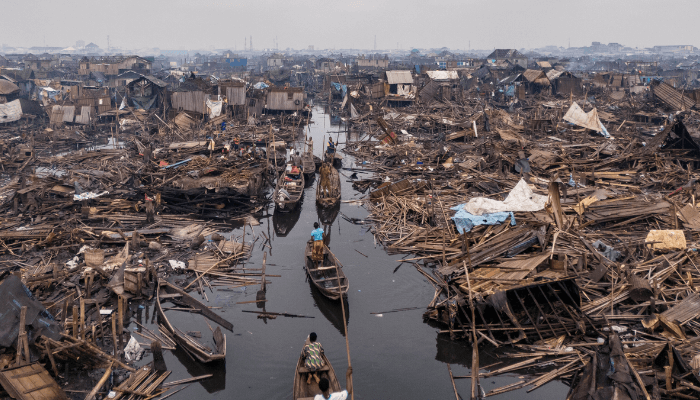

A coalition of civil society organizations has sounded the alarm over a series of mass demolitions executed by the Lagos State Government, actions that have reportedly left at least 12 people dead and thousands displaced. The operation, which targeted waterfront and informal settlements including Makoko, Oworonshoki, Owode Onirin, Otumara, and Baba-Ijora, has drawn fierce condemnation for its perceived cruelty and lack of procedural safeguards.
At a press conference held at the International Press Centre in Ogba on Thursday, January 22, 2026, coalition leaders described the government’s approach as a systemic attack on the urban poor. Speakers shared harrowing accounts of security personnel using tear gas and setting homes on fire while residents were still inside. One heartbreaking testimony revealed that a newborn died from tear gas inhalation, while a woman in labor bled to death because a bulldozer blocked her access to medical care.
Ms. Zikora Ibeh of Corporate Accountability and Public Participation Africa (CAPPA) highlighted the irony of these demolitions occurring against the backdrop of a past $200 million World Bank initiative intended to upgrade, rather than destroy, these very communities. Despite these funds, the infrastructure in places like Makoko remains virtually non-existent, with the government now seemingly intent on clearing the land for what critics allege are “elite interests and private mega-developments.”
SBM Intelligence Report: A Broken Social Contract
Corroborating the outrage on the streets, an SBM Intelligence report sighted by Business Times reveals that the demolitions have precipitated a “severe crisis of public trust” between the state and its citizens. The report, titled A Report on the Sentiment Following the Makoko Demolitions (January 2026), synthesizes data from a structured ground survey of residents and a digital sentiment analysis of public discourse.
According to the SBM findings, the public mood is “overwhelmingly hostile,” with 82% of analysed discourse categorised as negative. The report notes that this hostility is not driven by generic anti-government sentiment but by a specific sense of “Breach of Contract.” The central grievance identified is the discrepancy in setback distances. While residents claim they agreed to a 30-meter clearance from high-tension wires, SBM’s survey found that 91% of respondents in Makoko reported the government enforced a 100-meter boundary, destroying homes deep inside the community that residents believed were safe.
The report describes this “shifting goalpost” not merely as an administrative error, but as a “calculated deception” that has destroyed the government’s credibility. Furthermore, the report highlights that 94% of surveyed residents view the “Mega City” vision as an exclusionary project designed to displace the poor for the benefit of elite real estate interests, fueling a dominant narrative of “Wealth over Welfare.”
Government Narratives Fail to Resonate
Governor Babajide Sanwo-Olu has defended the actions as necessary safety measures to prevent disasters near high-tension power lines. In recent days, he has also accused NGOs of “profiteering” from the crisis. However, the SBM Intelligence report suggests this counter-narrative has largely failed to penetrate public consciousness. The data shows that the government’s defense resonates with only 13% of the populace, primarily government loyalists. Meanwhile, 85% of survey respondents defended NGOs as their “only voice,” rejecting the Governor’s claims as an attempt to deflect from the humanitarian disaster.
Economic and Security Implications
The aggressive displacement of thousands of residents carries profound economic and security risks for Lagos State. Economically, the destruction of homes and businesses in informal settlements obliterates the livelihoods of the urban poor. Markets like the Owode Motor Spare Parts Market have been bulldozed, and goods seized, stripping traders of their capital and pushing countless families deeper into poverty.
From a security perspective, the SBM report offers a chilling warning: the “social contract in these communities has effectively snapped.” The survey revealed that 80% of residents have expressed a total loss of faith in secular justice, invoking divine intervention as their only recourse. When a population feels that the law is weaponized against them rather than used to protect them, the risk of social unrest escalates. The perceived injustice creates a fertile ground for instability, as desperate, disenfranchised youth may become vulnerable to recruitment by criminal gangs, threatening the peace of the commercial nerve center of Nigeria.