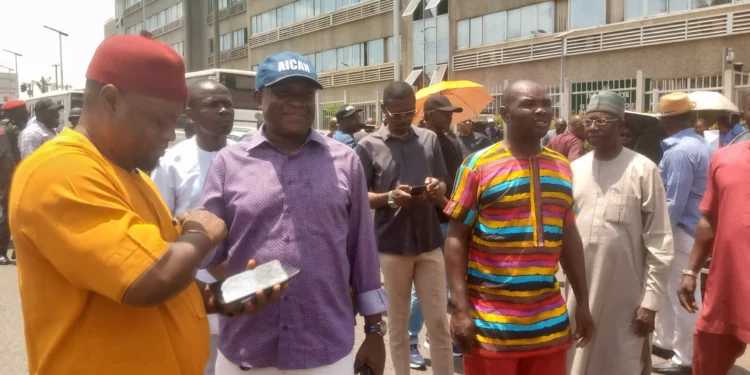

The Federal Government has agreed to release 35 percent of the N150 billion owed to indigenous contractors upfront, a targeted move to address a persistent backlog of unpaid liabilities owed to local firms. The advance was confirmed by Mr. Jackson Nwosu, President of the All Indigenous Contractors Association of Nigeria (AICAN), after constructive discussions with the Minister of Finance.
The outstanding N150 billion is part of a broader N1.15 trillion in verified payments owed to contractors who completed federal projects across multiple states and the Federal Capital Territory in 2024. Delays in settling these obligations have strained financial capacity within the domestic contracting sector, hampering operations and investment decisions.
The payment arrangement was reached amid renewed protests by AICAN members demanding immediate settlement of overdue fees, and marks a tactical partial payment ahead of a phased release of the remainder in the coming weeks.
This upfront disbursement is designed to provide liquidity relief to indigenous contractors who have faced prolonged cash‑flow challenges. It acknowledges that timely settlement of verified debts supports business continuity, safeguards jobs, and reinforces confidence in public project financing. Analysts view this as a fiscal adjustment within existing budgetary ceilings rather than new spending beyond approved appropriations.
“Nwosu described the outcome of the meeting as encouraging, expressing optimism that the government would fulfil its commitments,” according to the News Agency of Nigeria report. “The Federal Government had proposed to pay 35% of the N150 billion being demanded immediately, with the balance to be paid in phases in the coming weeks.”
Contractors have been instructed to secure valid batch numbers from relevant Ministries, Departments, and Agencies (MDAs) to qualify for payments. Those without current batch numbers must obtain new warrants, as previous numbers have been updated for the new fiscal year. This procedural step may affect how quickly funds are disbursed to individual firms.
While the partial payment represents progress, it leaves 65 percent of the N150 billion to be settled in due course. The government’s approach reflects an effort to balance payment commitments with broader fiscal constraints and competing budgetary priorities.
Separately, AICAN had threatened to escalate protests and even disrupt major political events if more substantive progress on payments was not made. Mr. Nwosu and other association officials have highlighted that only a fraction of owed funds had been paid before the recent agreement, with contractors citing serious financial hardship due to prolonged delays.
The 2026 appropriation bill made provisions of N1.7 trillion for verified contractor liabilities from 2024 and an additional N100 billion for other local contractor debts, but actual cash disbursements have lagged due to administrative verification and compliance checks. Government officials argue these checks are necessary to ensure accountability in public spending.
In economic terms, the government’s strategy to release a portion of overdue funds now and schedule the balance later reflects a pragmatic response to liquidity shortages while signalling willingness to meet its contractual obligations. How effectively this strategy restores contractor confidence and accelerates full settlement depends on execution and consistency in forthcoming payments.
Overall, the partial advance represents a step toward resolving a chronic financing issue in Nigeria’s public project ecosystem. However, administrative hurdles and the pace of follow‑through payments will be key determinants of long‑term stability and the health of the indigenous contracting sector.