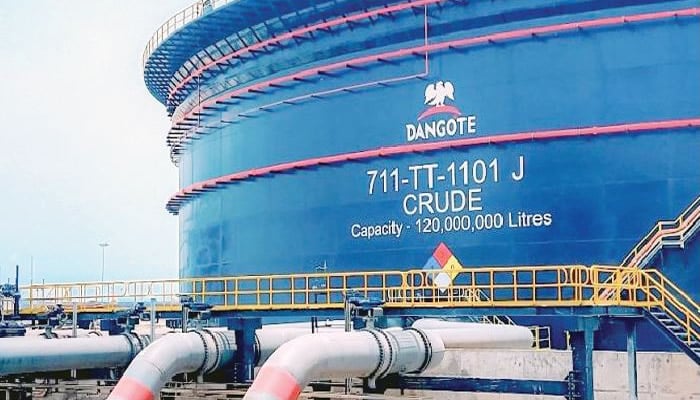

The Dangote Refinery has carved out a distinct role in Nigeria’s downstream petroleum sector, describing itself not as a conventional crude-processing plant but as a globally integrated merchant refinery.
Speaking during a media engagement, Chief Executive Officer David Bird said the $20 billion facility was intentionally designed to function like major international refining centres such as Rotterdam and Singapore, where maritime access, flexible sourcing and export capability drive operations.
“What we are is not a refinery sitting at the end of a crude pipeline processing one crude,” Bird said. “We are a fully flexible trading-led merchant refinery. All of our feedstocks are brought in by sea, and our products can be evacuated domestically or exported into the global market.”
Moving Away from the ‘Tramline’ Model
Unlike vertically integrated oil firms that refine crude from their own upstream assets, Dangote Refinery buys its feedstock on commercial terms. The refinery sources crude from Nigerian producers and supplements supplies from international markets when necessary.
In many oil-producing countries, refineries are built to process specific local crude grades delivered via dedicated pipelines — a structure Bird referred to as a “tramline refinery.” Dangote’s facility, however, processes a wide range of crude types and intermediate materials depending on market conditions and operational needs.
“Every day we are processing a different crude,” Bird said. “We’ve processed more than 25 different crudes and probably another 10 different intermediate feedstocks. We are agnostic about whether that molecule comes from crude or from an intermediate product. It’s about maximising utilisation and margin.”
He disclosed that about 30 percent of feedstock is Nigerian crude acquired under the naira-for-crude framework, another 30 percent is sourced opportunistically within Nigeria, while the remaining 40 percent comes from international suppliers.
Exposure to Market Forces
Operating as a merchant refinery exposes the plant directly to fluctuations in crude prices, exchange rates and refining margins — often measured by the crack spread, which reflects the gap between crude costs and refined product prices.
Bird acknowledged that this model links the refinery’s pricing behaviour to global oil dynamics, especially in Nigeria’s deregulated fuel market.
“Utilisation is everything in our business,” he said. “If one of our downstream units is underutilised because the crude mix doesn’t produce enough of a particular fraction, we will import intermediate feedstock to load that unit up. It’s no different from an airline wanting every seat filled.”
Quality Standards and Competition
Addressing concerns over imported blending materials, Bird clarified that any high-sulfur components brought into the refinery are upgraded before sale.
“What we may import are intermediate products such as high-sulfur blendstocks,” he said. “But they are not sold directly. They are upgraded inside the refinery. The only gasoline leaving this refinery is Euro 5, 50 parts-per-million sulfur gasoline.”
He added that while the refinery is ready to compete at import parity pricing, regulators must ensure consistent product standards to prevent lower-quality fuels from distorting the market.
“We are willing to compete on import parity pricing,” Bird said. “But there must be a level playing field on product quality. Inferior products are cheaper, and that distorts the market.”