
The Nigerian Electricity Regulatory Commission (NERC) has published its Second Quarter 2025 report, revealing a marginal yet significant increase in the revenue collection efficiency of the nation’s Electricity Distribution Companies (DisCos). The figures show that the DisCos collected ₦564.71 billion during the three-month period, recovering over three-quarters of the ₦742.34 billion they had billed to their customers. This translated to a collection efficiency of 76.07 per cent, a modest 1.68 percentage point improvement on the previous quarter’s 74.39 per cent.
While this upward trend provides a small measure of good news for the financially struggling firms, the sheer size of the uncollected debt underscores the profound liquidity crisis gripping Nigeria’s power sector. This financial shortfall, which prevents the sector from operating effectively, cannot be separated from the nation’s wider, decades-long energy crisis. Despite holding vast natural resources, the country is consistently failing to provide adequate electricity. An estimated 45 per cent of the population remains unconnected to the grid, and even those with a connection often suffer from supply that averages as little as four hours a day.
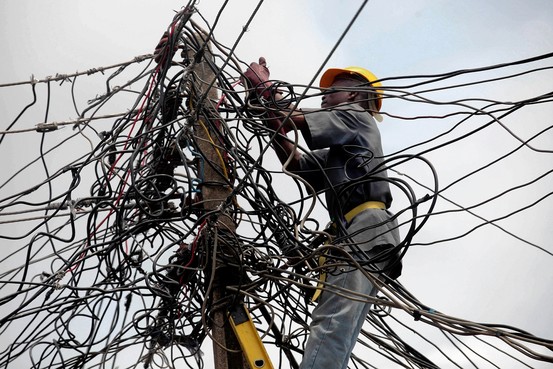
The systemic challenges are manifold and deep-seated. The entire value chain is hampered by inadequate infrastructure, with the government-owned Transmission Company of Nigeria (TCN) being a widely acknowledged weak link. Its outdated, fragile network frequently results in system collapses and is incapable of transmitting the total power generated. Furthermore, the DisCos themselves suffer from massive financial losses—known as Aggregate Technical, Commercial and Collection (ATC&C) losses—which are reported to be around 50 per cent, far above the international benchmark. These losses are driven by dilapidated equipment, widespread energy theft, poor customer metering, and, crucially, the persistent failure of government Ministries, Departments, and Agencies (MDAs) to settle their outstanding electricity bills.
This profound unreliability carries a crippling economic cost. With the grid unable to cope, businesses and households are forced to rely heavily on expensive, polluting diesel and petrol generators. The World Bank estimates that these supplementary power arrangements cost the Nigerian economy between 5 and 7 per cent of its Gross Domestic Product (GDP) annually. Moreover, financial considerations often dictate supply; under certain tariff regimes, DisCos are known to prioritise electricity delivery to areas deemed more likely to pay, meaning that poorer districts frequently experience fewer hours of supply, exacerbating societal inequality.
Within the latest results, the performance across the 11 DisCos was highly varied. Eko DisCo emerged as the top performer, achieving an 87.80 per cent collection rate, while Jos DisCo registered the lowest efficiency at a dismal 43.82 per cent. Although six DisCos—including Port Harcourt, Benin, Ikeja, and Eko—recorded an improvement on the previous quarter, five companies saw their efficiency decline, with Abuja and Jos registering the most significant drops.