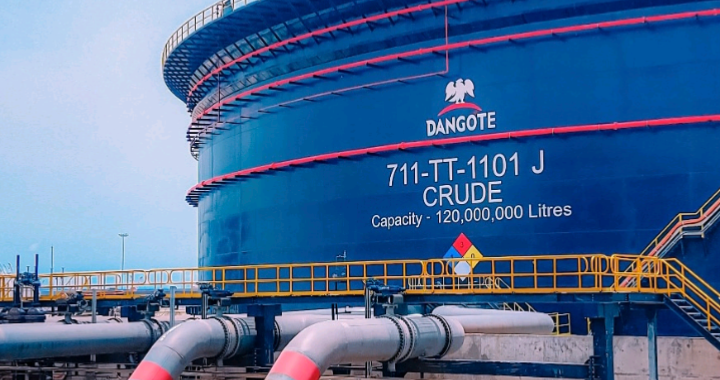

According to official data, the Dangote Petroleum Refinery delivered an average of 40.1 million litres of Premium Motor Spirit per day during the month. This level of output marks an increase of roughly 8 million litres from December 2025’s 32 million litres, reflecting a deliberate expansion in refining activity and output.
Nigeria’s benchmark for domestic PMS supply stands at 75 million litres per day, of which the Dangote refinery now accounts for more than half. Total supply into the market during January was about 64.9 million litres per day, with imports from the Nigerian National Petroleum Company Limited and private marketers averaging 24.8 million litres. Daily consumption averaged 60.2 million litres.
This increase is meaningful. It shows the refinery trending toward ending Nigeria’s dependence on imported petrol. Previously, Nigeria sent billions of dollars overseas for refined fuel. The ramped-up output reduces that import gap and strengthens the country’s energy security.
The regulator measures effective fuel distribution based on volumes trucked into the domestic market. This is a strict metric. It reflects actual availability and distribution rather than installed capacity. The latest figures confirm that more refined petrol is reaching stations and users across the nation.
The refinery in the Lekki Free Zone, Lagos, is a single-train facility with a nameplate capacity of 650,000 barrels per day. Company sources describe it as the largest of its kind anywhere. It has been under phased ramp-up since commissioning, with a clear mandate to lessen Nigeria’s reliance on foreign fuel.
Historical targets set by the refinery projected that it might supply up to 50 million litres of petrol daily between late 2025 and early 2026. To support that goal, management optimized key units such as the crude distillation and motor spirit production units, stabilizing steady state operations. A performance test with technology partners is validating efficiency and compliance with global standards.
The latest output has broader implications for Nigeria’s macroeconomy. Lower dependence on costly imports can reduce pressure on the naira and preserve foreign exchange reserves. Prominent investors have projected that such developments could strengthen the currency.
In practical terms, meeting local demand with local refining diminishes volatility in supply and price at service stations nationwide. Increased local output also translates into fewer supply interruptions and less exposure to global shipping delays and price shocks.
Overall, the data underscore a clear shift in Nigeria’s fuel sector toward domestic production. For decades, the nation struggled with chronic fuel shortages and long queues at petrol stations. The recent performance of the Dangote refinery signals progress toward stability and self-reliance in refined products.
In summary, Nigeria’s largest refinery has boosted its contribution to the petrol market sharply. Production benchmarks are up, import reliance is down, and fuel distribution appears steadier. These outcomes support broader national goals of energy security, economic resilience, and reduced external dependency.