
Two separate but simultaneous fire incidents in Lagos’s densely packed Mile 2 industrial corridor have once again exposed the acute vulnerability of Nigeria’s economic heartland to infrastructural and safety failures. The Lagos State Fire and Rescue Service battled a major warehouse blaze in the Amuwo-Odofin Industrial Layout while also responding to an outbreak at Alaba Suru, underscoring a persistent pattern of emergencies that threaten supply chains, inflate operational costs for businesses, and jeopardize critical assets in the nation’s premier commercial hub.
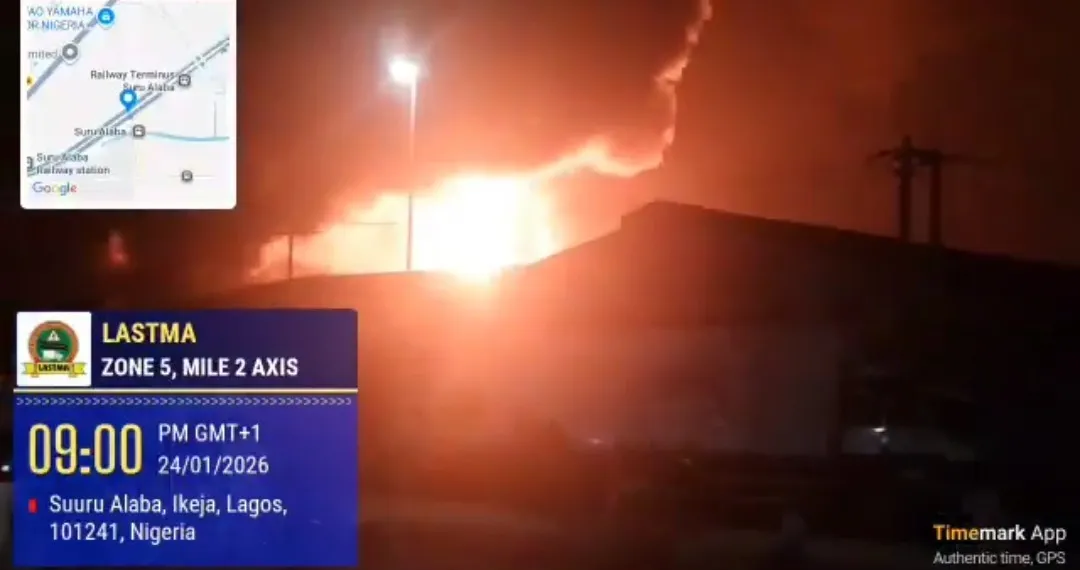
The more severe incident occurred at a large warehouse along Coker Market Road, which stored highly flammable materials in hundreds of 200-litre drums. According to Controller-General Margaret Adeseye, the fire service received a distress call at 8:29 p.m. and deployed crews from four stations—Ajegunle, Sari Iganmu, Okota, and Alausa—by 8:40 p.m. Firefighters worked through the night to contain the intense blaze, bringing it under control by 5:55 a.m. on Sunday and preventing it from spreading to adjacent facilities. No casualties were reported, though the cause remains under investigation. Concurrently, just kilometers away, a fire broke out in a building at Alaba Suru around 9:05 p.m., prompting an immediate response from the Lagos State Traffic Management Authority (LASTMA) to manage traffic and assess safety risks while fire services were mobilized.
These incidents are not isolated but part of a distressing trend within a critical economic zone. The Mile 2 corridor, a nexus for manufacturing, warehousing, and wholesale trade, has suffered multiple major fires in recent months. In December 2025, a fire at the Berger Trailer Park destroyed several trailers and containerized stalls. Just two months prior, in October 2025, parts of the vast Alaba International Market were gutted, destroying multiple shops and disrupting commerce for weeks. This pattern signals a chronic systemic failure in fire safety compliance and emergency preparedness in one of Lagos’s most valuable economic districts.
The economic ramifications are immediate and severe. Each fire disrupts intricate supply chains, destroying inventory, paralyzing logistics operations, and causing significant financial losses for small and medium-sized enterprises that form the backbone of the local economy. For larger businesses and manufacturers, these recurrent risks lead to skyrocketing insurance premiums, making operations in Lagos increasingly costly. The constant threat also discourages long-term investment in industrial capacity and modern warehousing, as asset security cannot be guaranteed. The heavy traffic congestion caused by such emergencies, as noted by LASTMA, further compounds economic losses by stalling the movement of goods and personnel across the metropolis.
The response from emergency services, while swift in these instances, highlights a reactive rather than preventive approach to a clear and present danger. The Lagos State Fire Service’s commendable containment efforts are consistently deployed against a backdrop of preventable hazards—overcrowded markets, substandard electrical wiring, improper storage of flammable materials, and inadequate safety protocols in industrial layouts. The state’s plea for strict compliance with fire safety regulations, reiterated by Adeseye, underscores the gap between official policy and on-the-ground reality.
For Nigeria’s economy, the fragility of Lagos’s industrial infrastructure represents a critical point of failure. The city is the nation’s primary gateway for imports and exports, a major manufacturing center, and home to countless billions in assets. Continuous operational disruptions in its key industrial corridors have a multiplier effect, creating shortages, inflating prices, and eroding competitiveness. To secure the country’s economic stability, a concerted, enforceable, and systematic overhaul of fire safety standards and urban planning in Lagos’s commercial districts is not just a regulatory issue—it is an urgent economic imperative.