
The United States’ Christmas Day 2025 airstrikes in Nigeria’s Sokoto state represent far more than a single counter-terrorism operation. They are a microcosm of a profound shift in global power dynamics, a case study in the perils of external intervention built on contested justifications, and a source of deep domestic tension for Africa’s most populous nation. By weaving together the strategic doctrine outlined by analysts, the ground-level testimony from affected communities, and the precarious position of the Nigerian government, a complex picture emerges—one where geopolitical maneuvering collides with local reality, leaving a trail of physical damage, societal anxiety, and troubling questions about sovereignty and the future of international order.
A New Strategic Doctrine: From Multilateralism to Unilateral Enforcement
The strikes must first be understood within a broader strategic recalibration by the United States. According to analysis by SBM Intelligence, the operations in Nigeria, followed swiftly by the January 2026 intervention in Venezuela, signal a decisive turn away from post-Cold War multilateralism. This new age is characterized by a foreign policy of unilateral enforcement, where military force is deployed based on a nation’s own assessment of its interests and moral imperatives, often sidelining established international institutions like the UN Security Council.
Under this emerging framework, concepts like sovereignty and humanitarian protection become fluid. They are less inviolable principles of a shared system and more tools of political messaging and justification. Nigeria, as a major state in the Global South, finds itself on the frontline of this experiment. The SBM report argues that such actions force nations to recalibrate their strategies around “pragmatic calculations of legal interpretation, survival, and bloc alignment” rather than universal norms. For Nigeria, this creates an immediate dilemma: how to manage a powerful partner whose actions are justified by a logic that may not align with its own domestic complexities or its desire for strategic autonomy.
The Disconnect: Washington’s Narrative vs. Sokoto’s Reality
This strategic shift manifested in Sokoto through a stark and problematic narrative disconnect. The Trump administration framed the strikes as a defense of religious minorities, specifically Christians, against “ISIS Terrorist scum.” President Trump explicitly linked the action to halting the “mass slaughter” of Christians, threatening further strikes if the violence continued.
This framing unravels upon contact with Nigeria’s intricate conflict geography and the experiences of Sokoto residents. First, security data contradicts the premise of a religiously driven genocide. While tragic sectarian violence occurs, groups like the Armed Conflict Location & Event Data Project note that violence specifically targeting Christians due to their faith accounts for only about 5% of reported civilian targeting events in Nigeria. The epicenters of both the Islamist insurgency (the Northeast) and the most severe farmer-herder violence affecting Christian communities (the Middle Belt) are hundreds of miles from Sokoto.
On the ground, the narrative was met with confusion and fear. “There is no ISIS here,” stated Abdulmalik Abubakar, a resident of Jabo village in Sokoto. Local residents, living in a predominantly Muslim state with relatively lower levels of violence, resented the implication that their home was a hotbed of anti-Christian terrorism. For some, the U.S. justification translated into a terrifying threat. “Some of my neighbors ran away from home because they believed Donald Trump wants to kill all Muslims in Sokoto,” Abubakar told reporters. The intervention, meant to “protect,” instead sowed panic and alienated the local population it occurred within.
Collateral Damage and Operational Questions
The tangible consequences of the strikes further eroded their legitimacy. An investigation by local media and eyewitness accounts from the targeted Bauni forest area found “no sign that any terrorist was hit.” Residents like Kasimu Hassan reported that members of the shadowy Lakurawa group—designated a terrorist organization by Nigeria but of disputed international affiliation—remained present in the area after the attack.
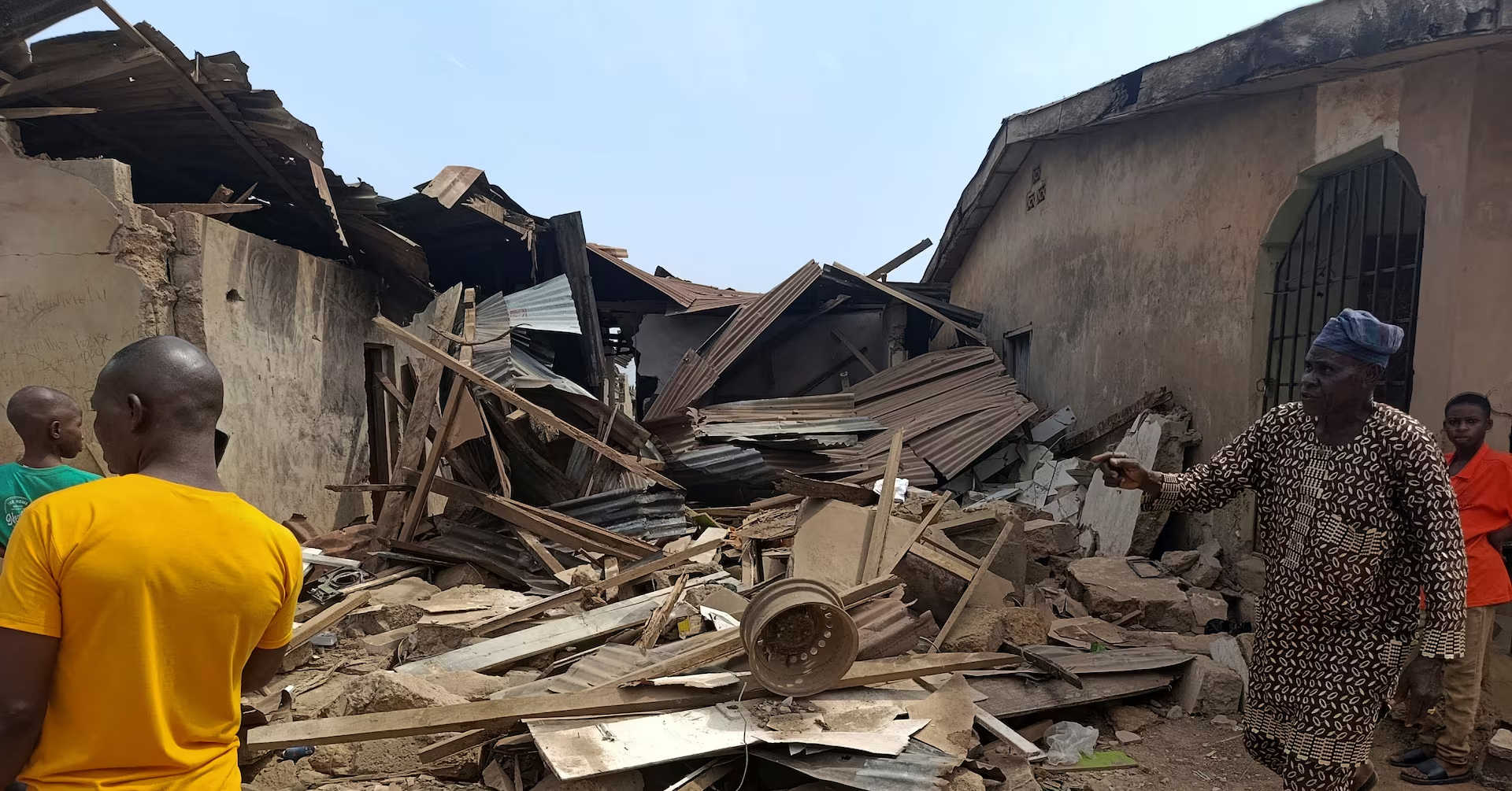
More disturbingly, the operation caused direct civilian harm far from the target zone. An unexploded munition traveled nearly 600 miles to land in Offa, Kwara State, destroying part of the Solid Worth Hotel and injuring three staff members. Hotel director Bello Adewale lamented the lack of compensation from U.S. or Nigerian authorities and the devastating secondary impact: a collapse in patronage from customers who feared the hotel was “complicit in terrorism.” This incident starkly illustrates how the “precision” of remote warfare can have wildly imprecise and devastating human consequences, for which accountability appears elusive.
The Nigerian Government’s Precarious Tightrope
Caught between a unilateral ally and a skeptical citizenry, the Nigerian government’s response has been one of careful, and at times contradictory, navigation. Officially, Abuja coordinated the operation and described it as routine counter-terrorism cooperation, framing the Bauni forest as a strategic corridor used by terrorists planning large-scale attacks. This technical, security-focused narrative was a deliberate attempt to downplay the inflammatory religious framing from Washington and maintain a veneer of sovereign consent.
Analysts like Confidence MacHarry of SBM Intelligence suggest a pragmatic, tactical logic may have been at play: Sokoto represented a “gap” in Nigerian Air Force operations, making it a candidate for a show of disruptive force against a group with a local base. However, by acquiescing to an operation justified on grounds it publicly disputes, the government risks being seen as subordinating its own complex reality to Washington’s political agenda. This damages its credibility domestically, particularly with the Muslim population in the North, and internationally, as it appears to validate a new norm of transactional sovereignty where external powers can act with tailored justifications.
Broader Implications: Risk, Realignment, and a Fractured Order
The long-term implications extend beyond immediate security and political fallout. The SBM Intelligence report warns of a fundamental repricing of risk for countries like Nigeria. By targeting two major energy exporters (Nigeria and Venezuela), the U.S. has signaled that geopolitical alignment and governance profiles are now direct factors in assessing investment risk. For Nigeria, already grappling with economic challenges, this could mean a higher cost of capital and a future where vital long-term investment becomes contingent on securing explicit security guarantees from major powers, effectively trading economic development for geopolitical allegiance.
Ultimately, the Sokoto strikes exemplify the fragmenting international order. They reveal a world where powerful states enforce their own interpretations of justice and security, where narratives are weaponized, and where the populations most affected have the least say. For Nigeria, the path forward is fraught. It must manage an essential but overbearing security partnership, address the legitimate grievances of its citizens who bear the brunt of both insecurity and intervention, and navigate a global stage where the rules are being rewritten in real-time—often, as in the forests of Sokoto, with explosive consequences. The legacy of the Christmas Day strikes will not be measured in terrorists eliminated, but in the deepening of distrust, the recalibration of risk, and the precarious position of a nation striving to assert its sovereignty in an age of renewed unilateralism.