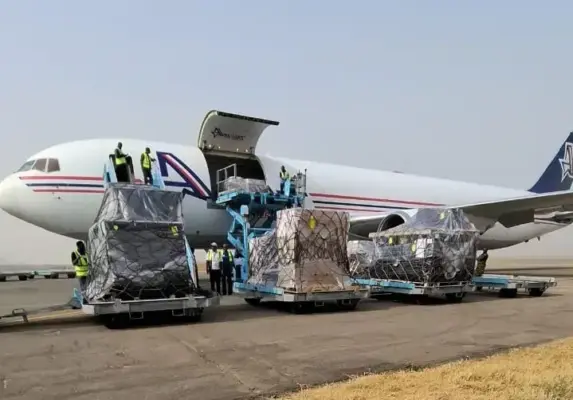

The United States has delivered an unspecified package of military supplies to Nigeria in a move aimed at strengthening the country’s counterterrorism and security operations, U.S. Africa Command (AFRICOM) announced on Tuesday. The delivery, directed to Abuja, underscores the growing defence partnership between the two nations and signals Washington’s continued commitment to supporting Nigeria’s efforts against Islamist insurgencies and organised crime.
AFRICOM stated that the military aid is intended to support ongoing operations against extremist groups, including Boko Haram and the Islamic State in West Africa Province (ISWAP), which have long destabilised Nigeria’s northeastern regions. The announcement comes in the wake of a U.S.-coordinated airstrike in Sokoto State last month, which reportedly killed multiple ISWAP militants. Nigerian authorities described the strike as part of a broader framework of strategic cooperation with the United States, encompassing intelligence sharing, tactical coordination, and capacity-building in counterinsurgency operations.
Nigeria has battled Islamist insurgencies for more than fifteen years, with the northeast particularly affected by sustained attacks on civilians, government installations, and economic infrastructure. In addition to insurgent activity, the country faces ongoing security challenges in the northwest, where kidnapping gangs and criminal networks disrupt local commerce, agriculture, and trade routes. The security situation continues to hamper economic growth, as investors weigh the risks of operating in areas prone to violence and businesses face elevated costs for security and insurance.
Reuters reported that U.S. intelligence-gathering flights have been operating over parts of Nigeria since late November, highlighting a persistent American role in monitoring security threats. Such collaboration allows Nigerian forces to access advanced surveillance capabilities and real-time intelligence, enhancing operational effectiveness. Analysts say that while the support does not constitute a full-scale deployment of U.S. forces, it represents a strategic deepening of military cooperation aimed at stabilising regions critical to Nigeria’s economy.
The economic implications of sustained insecurity in Nigeria are significant. Frequent attacks on oil installations, supply routes, and agricultural zones in the northeast and northwest continue to disrupt domestic production and raise operational costs for local businesses. By strengthening Nigeria’s security apparatus, U.S. military support indirectly aims to stabilise economic activity in affected regions, protect infrastructure, and restore investor confidence. Moreover, the partnership may encourage foreign direct investment by signalling that Nigeria is taking concrete steps to mitigate security risks, a factor often cited by multinational corporations as a precondition for operations in fragile environments.
Nigeria’s government has consistently sought international assistance to counter violent extremism while maintaining sovereignty over domestic security operations. The partnership with the United States reflects this balance, providing critical technological and logistical support without direct foreign command of operations. Defence analysts note that such collaboration can also have broader regional impacts, as stabilising Nigeria contributes to security across West Africa, safeguarding trade corridors, and mitigating cross-border militant activity that could threaten neighbouring countries.
However, reliance on foreign military support carries its own challenges. Critics caution that while U.S. equipment and intelligence enhance immediate operational capacity, long-term security solutions require sustained investment in local forces, governance reforms, and socioeconomic development. Persistent poverty, unemployment, and lack of educational opportunities in affected regions continue to create environments in which extremist groups and criminal networks thrive. Economists argue that without parallel investment in development and state-building, security gains risk being temporary.
For the United States, the support package represents a strategic interest in maintaining stability in Africa’s most populous nation, a hub for regional trade, and a critical partner in global counterterrorism efforts. By enhancing Nigeria’s operational capacity, Washington strengthens a security partnership that aligns with broader geopolitical objectives, including countering violent extremism, protecting economic interests, and reinforcing U.S. influence in West Africa amid increasing engagement from other global powers.
The delivery of military supplies to Nigeria underscores a deepening bilateral security relationship while addressing immediate operational needs against insurgents and criminal networks. Beyond the battlefield, the cooperation carries significant economic and geopolitical implications, as stabilising Nigeria’s security environment is central to protecting infrastructure, sustaining investment, and fostering regional economic resilience. While the partnership offers short-term operational benefits, experts emphasise that long-term stability will require a combination of military, political, and economic strategies to address the root causes of insecurity.