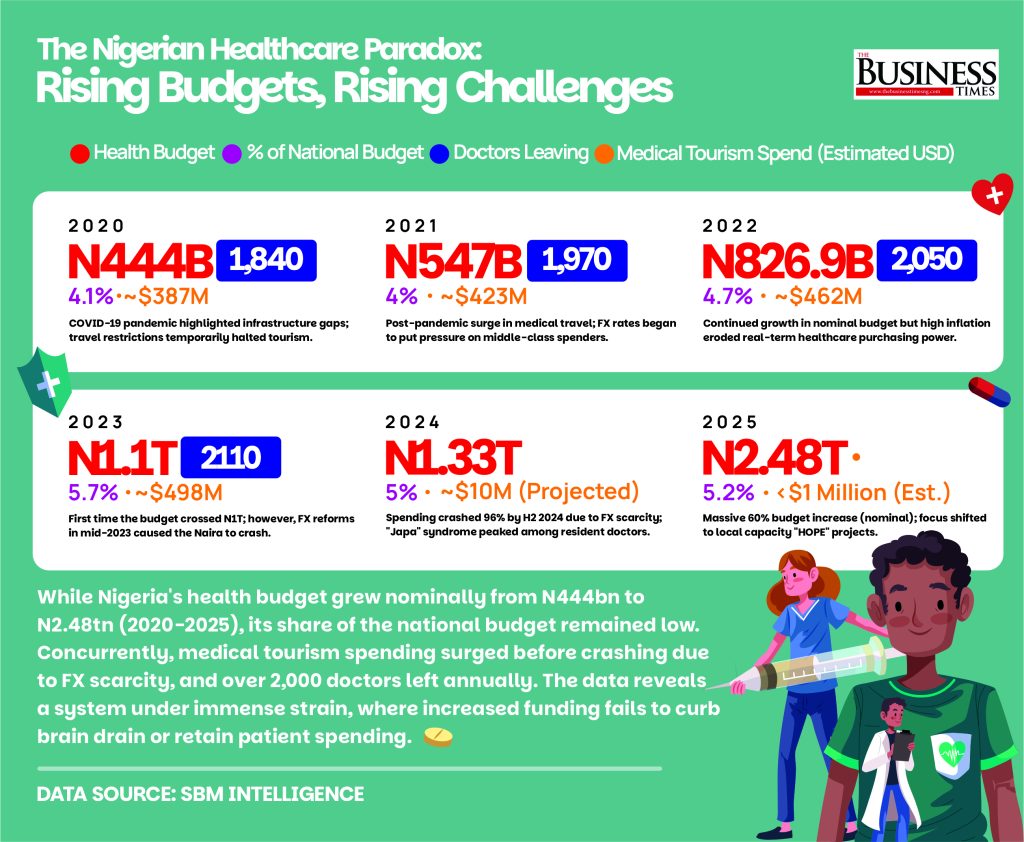
A single statistic threatens to tell a dangerously misleading story about Nigeria’s healthcare sector. In 2024, the nation’s dollar spending on medical tourism crashed by 96%, a figure that could be misinterpreted as a sign of robust domestic capacity. Yet, this drastic economic indicator cannot be disentangled from another harrowing scene: that of a world champion boxer, injured on the Lagos Ibadan Expressway in late 2025, being transported to a hospital in a police vehicle because no ambulance arrived. This juxtaposition reveals the true narrative. The decline in medical tourism is not a victory for local healthcare but a symptom of severe economic constraints and a failing domestic system, creating a perfect storm that threatens both human capital and national productivity.
For a business audience, this represents a critical market and systemic failure. The massive outflow of health spending, previously a reliable leakage of foreign exchange, has been forcibly plugged not by competitive local alternatives, but by devaluation and policy. This has created a captive domestic demand with no corresponding upgrade in supply, elevating systemic risk. As Victor Ejechi, head of insights at SBM Intelligence, frames it, “Nigeria’s health tourism rate is coming down not because confidence in the health system is improving, but because fewer Nigerians can afford to leave the country for care.” The demand has been localized by compulsion, not by choice, placing immense strain on an infrastructure already in critical condition.
The Economic Mechanics of a Tourism Decline
The 96% reduction in medical tourism spending is primarily a story of foreign exchange and purchasing power. Data shows monthly spending falling from an average of $17.3 million in 2023 to a fraction of that in 2024, part of a 76.7% aggregate drop in overseas spending on tourism, health, and education. This cliff edge drop correlates directly with the naira’s sharp depreciation and tighter currency access. Procedures in India, Turkey, or the United Kingdom that were once feasible for upper middle class Nigerians have become prohibitively expensive, representing multiples of an average annual income.
This is not an organic shift in consumer preference but a brutal market correction. Tighter visa regimes in destination countries have acted as a further non tariff barrier. As observed by clinical nurse Adedipe T. from Lagos, “Economic factors have played a major role. The increased cost of international travel, visa difficulties, and overall economic hardship have made medical travel abroad inaccessible for many.” The result is a forced internalization of demand. Patients are now fungible consumers in a local market they deliberately sought to avoid, not because of improved quality, but due to evaporated purchasing power for international health services. This creates a dangerous economic illusion, mistaking a balance of payments symptom for a sectoral improvement.
The Cost of a Failing Domestic Healthcare Infrastructure
The system that must now absorb this pent up demand is economically and operationally fragile. The 2025 SBM Health Preparedness Index provides a stark audit, concluding that no Nigerian state reached even a 30% score for health crisis readiness. This systemic risk is underpinned by chronic underinvestment. The 2026 national health budget allocates less than 5% of total spending to the sector, a figure that signals profound misallocation of resources given the sector’s role in human capital development.
The economic impact of this underinvestment is quantifiable. The doctor to patient ratio has widened to approximately 1:15,000 nationally, degrading to 1:43,000 in northern states like Bauchi. This represents a catastrophic human capital deficit. The “Japa” syndrome of medical professional emigration is a direct market response to poor remuneration, inadequate facilities, and security concerns, turning Nigeria into a net exporter of highly subsidized medical talent. Each departed professional represents a significant loss of public investment in education and a direct increase in future healthcare costs due to scarcity.
The incident involving boxer Anthony Joshua, as reported by Austyn Ogannah, publisher of The Will, tragically illustrates the infrastructure deficit’s cost. With an estimated national ambulance availability of 0.4 per 100,000 people and only 5% of trauma victims transported via professional ambulance, economic productivity is literally left dying on the roads. The loss of skilled workers, entrepreneurs, and breadwinners in preventable incidents constitutes a recurrent drain on GDP that is rarely calculated in national accounts.
Market Led Improvements and Persistent Gaps
Amidst the systemic decay, targeted, market aware investments have created islands of efficiency, primarily in urban private practice and certain public private partnerships. These developments offer a blueprint for what focused capital can achieve. Nurse Adedipe notes tangible progress in specific service lines: “Renal care has seen substantial improvement in Lagos… Improved access to hemodialysis, better trained renal nurses, and more consistent service delivery have reduced the need for patients to travel abroad for routine dialysis.”
Furthermore, specialist Francis Ukpe points to institutional investments that have altered referral patterns. “In my institution, investments in modern diagnostic imaging, cath labs, dialysis expansion, and continuous specialist training have directly reduced overseas referrals. For example, we now manage complex cardiac cases and cancer diagnostics locally.” Advances in orthopedics and minimally invasive surgery have also localised care for a range of procedures, retaining spending within the domestic economy.
However, these advancements are selective and expose the remaining market gaps. As Ukpe clarifies, “advanced organ transplants, some neurosurgical procedures, and highly specialised oncology treatments remain gaps.” The economic implication is clear: the high value, high complexity end of the healthcare market remains unserved by local capacity. Nigeria retains the costly, mid complexity cases while losing the most profitable specialty segments to overseas providers, an inefficient economic outcome for the health sector.
The Macroeconomic Implications of a Health System Under Stress
The confluence of forced demand localization and systemic decay presents severe macroeconomic risks. First, it represents a hidden tax on productivity. Ailing workers receive delayed or suboptimal care, prolonging recovery and reducing output. The frequent strikes by resident doctors, including one scheduled for January 2026, create recurring disruptions that paralyze public health delivery and spill over into private sector absenteeism.
Second, it discourages foreign direct investment. A robust healthcare system is a key infrastructure consideration for multinational corporations deciding where to locate skilled expatriate staff. The current environment, where even basic emergency response is unreliable, significantly raises the risk premium of operating in Nigeria.
Third, and most critically, the situation creates a vicious cycle of human capital depletion. The inability to access quality care, either abroad or at home, leads to the premature death or disability of productive citizens. It also accelerates the emigration of the skilled middle class, who cite healthcare insecurity as a primary push factor. This erosion of the tax base and consumer class further constrains the fiscal space needed to fund healthcare improvements, cementing the cycle of decline.
Reframing the Investment Imperative
The narrative must shift from misleading celebration of a tourism decline to urgent recognition of a sector in economic crisis. The goal should not be to trap spending within a broken system through currency manipulation, but to make Nigeria a competitive destination for health spending by choice. This requires reconceptualizing healthcare not as a social cost, but as fundamental economic infrastructure.
Sustainable solutions, as echoed by practitioners, require economic logic: deliberate investment in specialist retention through competitive wages, long term PPP models for tertiary center funding, insurance reform to create patient driven demand for quality, and critical enablers like consistent power supply. The public economic return on investment in functional ambulances, diagnostic equipment, and hospital infrastructure would be measured in saved productivity, increased investor confidence, and a healthier, more stable workforce.
The 96% drop in medical tourism is not a metric of success. It is a leading indicator of a larger economic problem where constrained consumption meets failed supply. For the business community, the lesson is clear: a healthy economy requires a healthy population, and achieving that demands smart, sustained investment rather than relying on economic barriers to create a captive, and suffering, market.