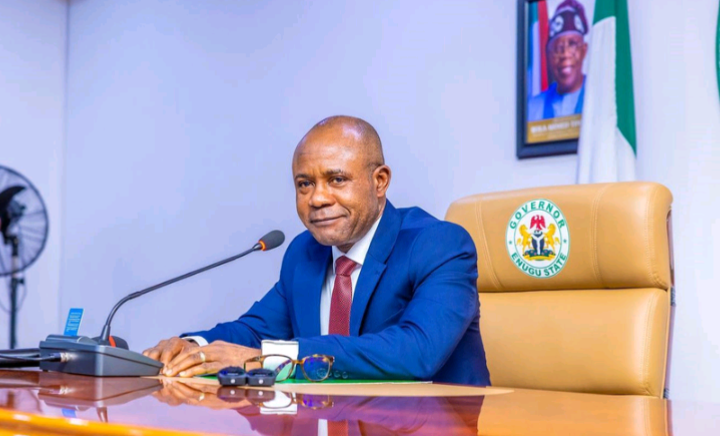

The governor of Enugu State, Peter Mbah has just laid before the State Assembly a sweeping ₦1.62 trillion appropriation for 2026, launching what he calls the “Budget of Renewed Momentum.”
Under the plan, an ambitious ₦1.296 trillion about 80% of the total budget is set aside for capital investments, with the remaining ₦321.3 billion (20%) covering recurrent expenditure. The boost from the 2025 budget’s ₦971 billion, a 66.5% increase signals a major expansion in spending aimed at accelerating growth.
A core ambition of the budget is to transform Enugu’s economic landscape. The plan proposes large-scale investment in roads, housing, education, healthcare, agriculture, transport and other infrastructure.
Education remains a top priority: the sector receives 32.27% of the total budget consistent with previous years. Meanwhile, the economic sector (agriculture, infrastructure, commerce, transport) is allocated ₦825.9 billion (51%), followed closely by the social sector at ₦644.7 billion (40.1%).
Key infrastructure plans include building or rehabilitating over 1,200 urban roads and many rural roads; completing major dual carriageways and expressways; expanding the state-owned airline with acquisition of 14 aircraft; constructing five new bus terminals; and delivering 15,000 mass-housing units, part of a broader drive to build a New Enugu Smart City. Agriculture and agro-processing are also slated for expansion, with farm estates, irrigation, warehouses and mechanised farming, intended to boost food production, create rural jobs and strengthen the state’s agrarian economy.
On healthcare, the budget supports completion of 260 primary-healthcare centres, upgrading 51 secondary hospitals, and delivering a 300-bed specialist hospital, showing a commitment to improve health access across the state.
In presenting the estimates, the governor explained that funding would come from a mix: ₦870 billion projected Internally Generated Revenue (IGR), ₦387 billion from federal allocations, and ₦329 billion from capital receipts.
He argued that the heavy investment under the economic sector is strategic and deliberate, aimed at generating jobs, reducing poverty, and strengthening the state’s long-term revenue base.
“Allocating N825.9 billion to the Economic Sector is strategic and deliberate. When we invest in agriculture, industry, and trade, we create jobs, reduce poverty, and generate revenue that strengthens the entire economy.”
If implemented well, this budget could propel the state toward the governor’s long-term vision of dramatically expanding Enugu’s GDP and lifting many residents out of poverty.
By projecting ₦870 billion from IGR and channeling over half of the budget into economic and infrastructure development, Enugu is aiming to reduce reliance on federal transfers. If successful, this could spur local investment, generate jobs and accelerate state GDP growth, potentially positioning Enugu as a major subnational economic engine in Nigeria.