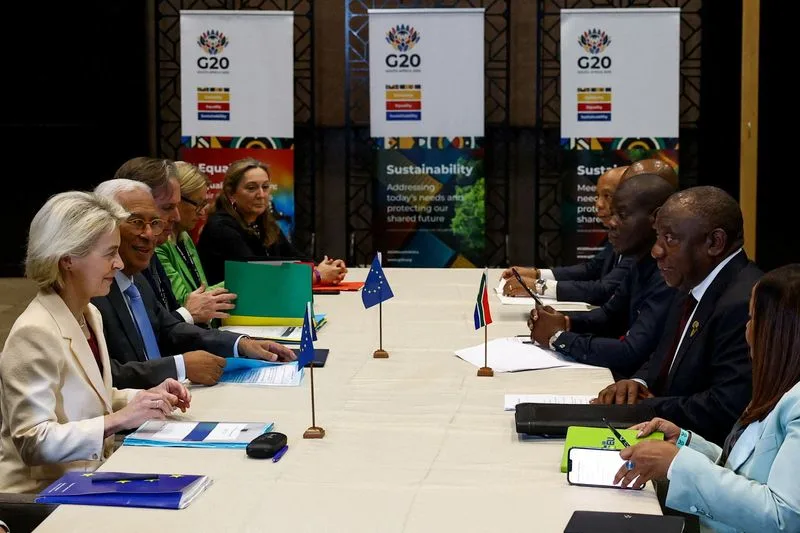

South Africa and the European Union have signed a landmark partnership on critical minerals, reaffirming their commitment to multilateralism and supply chain security ahead of the G20 summit hosted in Pretoria. The agreement, formalised on Thursday by South Africa’s Mines Minister Gwede Mantashe, aims to bolster the country’s position in the global minerals market by promoting domestic processing of key resources rather than relying solely on raw material exports.
President Cyril Ramaphosa emphasised that the deal is part of a broader strategy to move South Africa up the value chain in the mining sector, capturing greater economic benefits from mineral resources while creating skilled employment opportunities within the country. By processing minerals domestically, South Africa can increase its share of global value creation, reduce vulnerability to price volatility, and strengthen its industrial base.
European Union leaders, including Commission President Ursula von der Leyen and Portuguese Prime Minister António Costa, highlighted the strategic importance of securing metals essential for renewable energy, computing technologies, and defence applications. Von der Leyen specifically pointed to the ongoing war in Ukraine as a catalyst for reconsidering global energy and mineral supply chains, noting that Europe’s dependence on concentrated sources, particularly in China, exposes the continent to geopolitical and market risks. The partnership is therefore designed to diversify supply and ensure access to critical resources stably and sustainably.
Economic analysts suggest that the agreement could have far-reaching implications for South Africa’s industrialisation. Traditionally, much of the country’s mineral wealth has been exported in unprocessed form, limiting the domestic economic impact. By investing in local refining and processing infrastructure, the government and private sector could capture higher margins, stimulate related manufacturing industries, and create thousands of direct and indirect jobs. This approach also aligns with global trends promoting sustainable sourcing, circular economy practices, and reducing carbon footprints associated with long-distance transport of raw materials.
The timing of the agreement, just before the G20 summit, the first ever hosted on African soil, is significant. President Ramaphosa described the event as an opportunity to showcase the continent’s economic potential while reinforcing commitments to democracy, human rights, and multilateral diplomacy. The summit is expected to draw attention to Africa’s growing role in the global economy, highlighting opportunities for investment, trade partnerships, and collaboration on strategic sectors such as energy, technology, and critical minerals.
While the U.S. is reportedly considering limited participation in the summit, South Africa and the EU stressed the importance of multilateral engagement, cooperation, and open dialogue. The critical minerals partnership exemplifies how countries can work together to address global supply chain vulnerabilities while advancing economic development goals.
From a strategic perspective, the agreement also signals a broader shift in the global minerals landscape. As demand for battery metals, rare earths, and other critical minerals accelerates, driven by the energy transition, digitalisation, and defence requirements, countries rich in these resources are seeking to capture greater value and reduce reliance on external processors. South Africa’s move to retain more of the processing chain domestically could serve as a model for other resource-rich nations in Africa and beyond.
The deal also aligns with regional industrial development initiatives, such as the African Continental Free Trade Area (AfCFTA), by supporting regional value addition and integration of supply chains. Local processing hubs could supply both domestic and continental markets, strengthening Africa’s competitiveness and reducing dependence on imports of processed minerals from abroad.
Experts note that the success of the partnership will depend on effective investment in technology, infrastructure, regulatory frameworks, and workforce development. Strategic collaboration between the public and private sectors will be essential to ensure that South Africa’s minerals sector can meet both domestic and global demand sustainably, while contributing to long-term economic growth.
By signing the partnership, South Africa and the EU have signalled their shared commitment to sustainable industrial development, resilient supply chains, and the principles of multilateralism, a message that will resonate strongly during the upcoming G20 summit.