
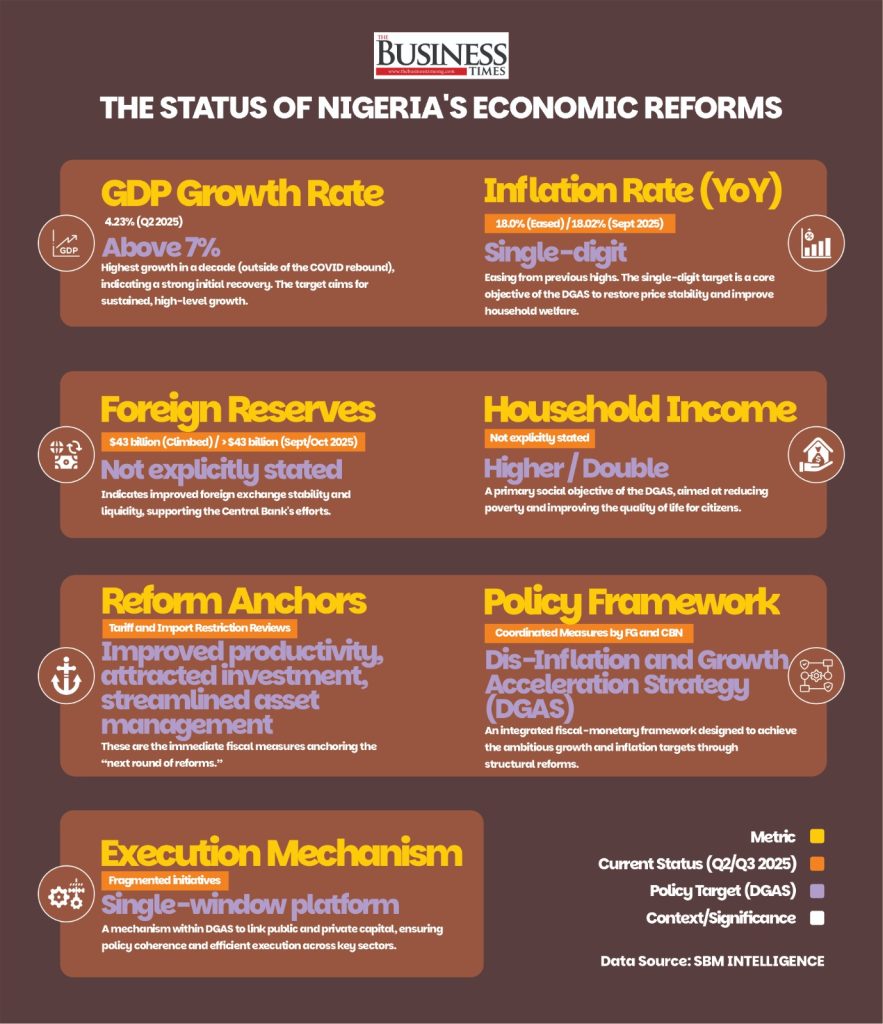
Nigeria stands at a pivotal moment, having launched a comprehensive and highly ambitious economic blueprint known as the Dis-Inflation and Growth Acceleration Strategy (DGAS). This strategy, an integrated fiscal and monetary framework, promises a transformative future: a nation where money buys more, jobs abound, and markets thrive. The goals are monumental—to drive annual economic growth above a sustained 7% and, simultaneously, to wrestle headline inflation, currently at 18.0% (as of September 2025), down to a single-digit rate. Achieving both objectives at the same time is a historical challenge that will test the government’s resolve and implementation capacity to its limit.
The foundation for this bold strategy has been laid by early signs of recovery. An unprecedented level of coordination between the Federal Government (FG) and the Central Bank of Nigeria (CBN) has yielded promising initial results. The economy grew by an encouraging 4.23% in Q2 2025, marking its highest quarterly rate in a decade outside the post-COVID rebound. This early momentum, coupled with a foreign reserve base that has climbed to over $43 billion, provides a crucial buffer for exchange rate stability and instills a modicum of confidence in the market. This reserve level is particularly significant, representing over eight months of import cover, well above the global three-month standard. According to financial experts, this robust foundation supports the naira, secures debt payments, and enables open trade.
The Tightrope Walk: Taming Inflation to Fuel Growth
At the heart of the DGAS lies the complex balancing act of achieving accelerated growth while crushing inflation. Inflation, currently driving up costs for essentials like food, fuel, and school fees, is the first hurdle. Economist Ariyo Onadeji articulates the immediate approach: “We must cool prices first. That means raising interest rates to slow spending and stabilize costs.”
However, this tight monetary discipline is a double-edged sword. Higher interest rates, while essential for taming prices, can easily choke businesses, limiting their ability to hire or expand. “It’s a tightrope,” Onadeji cautions. The strategic solution is a sequence: “Start with tight monetary policies to tame inflation, while simultaneously fixing fundamental supply issues.” These supply-side challenges, such as decrepit roads that inflate food transportation costs and persistent power cuts that stall factory production, are structural barriers that must be addressed concurrently. Once the foundation of price stability is set, the government can then invest heavily in job creation and major infrastructure projects without the risk of reigniting inflationary pressures.
CBN Governor Olayemi Cardoso’s commitment to tighter monetary discipline is seen as a complementary framework to the fiscal strategy. The overarching goal is to build long-term investor confidence and deepen industrial competitiveness, ultimately driving sustainable export diversification—a critical step to fortify the economy against external shocks.
A Focus on the Populace: Making Essentials Affordable
Beyond macro stability, the DGAS has a profound core social objective: to significantly increase, and ultimately double, household income, directly addressing widespread poverty and aiming for more inclusive growth.
The immediate operational anchors for this “next round of reforms” are comprehensive reviews of tariffs and import restrictions. This signals a strategic pivot away from the protectionist measures that have dominated policy for decades. A review of these regimes is a welcome step, as over the years, these policies have imposed undue costs on the Nigerian people for essential goods across the board—food, housing, transport, healthcare, and clothing. This situation has largely been driven by the influence of a protectionist business lobby seeking profit, combined with a persistent, but misguided, belief that blanket import bans and restrictions will somehow spontaneously stimulate domestic production.
For a nation where the average percentage of income spent on food by the majority is above 60%—and in certain economically strained areas, even exceeds 100%—the guiding principle for every policy must be simple and unwavering: Will this make things cheaper for the majority of the populace? This consideration, as noted by observers, must form the primary objective of the tariff and restriction reviews, with every other factor remaining secondary. By cutting tariffs and reducing import restrictions, the government aims to bring in cheaper goods and, paradoxically, spur domestic productivity through competition.
However, this move is not without risks. Economic analyst Viola Dominic warns that local industries, such as rice farmers, poultry businesses, and textile mills, could be immediately overwhelmed by a sudden flood of cheap imports. “That could close farms, shut factories, and cost jobs,” she says. To mitigate this, Dominic proposes a careful, supportive approach: “Offer farmers subsidies and manufacturers low-cost loans. Train workers for better skills. Enforce rules against unfairly cheap imports and provide tax breaks for diversification.” These steps, she argues, are necessary to “shield local industries while unlocking the immense benefits of open trade and higher domestic efficiency.”
Funding the Vision: Attracting Private Capital
The expansive vision of the DGAS—which includes massive investments in energy, roads, and advanced youth training—requires substantial, sustained financing. The government cannot carry this burden alone; public-private partnerships (PPPs) are essential.
However, Nigeria’s past reputation for unpredictable policy and systemic delays scares off international investors. Onadeji is direct: “Investors want predictability. We need clear rules, fast approvals, and guarantees against government delays.” To attract the private capital necessary to power the DGAS, he suggests concrete incentives: “Tax breaks, loan protections, or government support for early project costs, such as feasibility studies for large-scale power plants.” For youth training, “subsidies can encourage companies to teach skills for tech or factory jobs,” he adds, noting that these are high-value fields. If the government can keep these structural promises, Onadeji believes, “private capital will flow, powering DGAS’s goals of 7%+ growth.”
Streamlining Trade: The Power of a Single Window
A key innovation in the DGAS execution mechanism is the plan to implement a single-window platform to link public and private capital and to revolutionize Nigeria’s chaotic trade environment. Tayo Adeola describes the current system as a “mess,” characterized by “outdated tech, agency rivalries, and corruption that necessitate delays and bribes for importers.”
The single-window would create one digital hub for all trade approvals, slashing red tape and acting as a crucial element for policy coherence and efficient execution. However, challenges are significant. “Old computers and poor internet are big hurdles,” Adeola says, noting the technical debt. More critically, there is political resistance. “Some officials benefit from the chaos, and they’ll resist change,” he warns. The fix requires top-down enforcement: “Get presidential backing to enforce cooperation and punish delays. Invest heavily in modern tech and staff training. Pass laws to protect importers.” If this platform is successfully implemented, Adeola predicts that “trade costs could drop 30 to 50%, immediately boosting businesses, jobs, and overall productivity.”
Building an Economic Fortress
Nigeria’s $43 billion foreign reserve provides a strong buffer, but analysts caution against complacency due to the inherent volatility of oil dependence. Adeola highlights the weak spot: “If global oil prices crash, reserves could shrink fast.” His advice is clear: to build a fortress against future economic shocks, the government must aggressively diversify its export base—into areas like cocoa, agricultural processing, or tech services—while strictly cutting wasteful spending and saving more from non-oil revenue sources.
The Job Boom and Prosperity Goal
Ultimately, the success of the Dis-Inflation and Growth Acceleration Strategy (DGAS) will be measured not in boardrooms, but on the streets and in the homes of average Nigerians, judged by its ability to achieve its core social objective: doubling household incomes. According to Viola Dominic, this path to prosperity is paved with a historic job boom. She projects that the potent combination of focused investment and sustained policy stability could generate an estimated 40 to 50 million new jobs by 2030. This massive employment drive will be anchored in key sectors: transforming agriculture by improving value chains for staples like rice and cassava to employ millions more productively; revitalizing manufacturing with a focus on textiles, chemicals, and light assembly to create high-volume factory work; and turbocharging the services sector through trade, logistics, and the nation’s rapidly expanding tech ecosystem.
Dominic further argues that higher wages, essential for lifting incomes, must be driven by a dedicated focus on training and technology. She explains that “skills programs and tools can lift pay three to five times in informal jobs alone.” For the most vulnerable, targeted social safety nets are a vital complement; she notes that “cash transfers to 10 million households could cut national poverty by as much as 40%.” These collective steps, she asserts, are what “turn national economic dreams into tangible prosperity for families across the nation.”
In essence, the DGAS is an intricate tapestry, woven with threads of ambitious growth, price stability, investor confidence, streamlined trade, and secure reserves. But its most crucial thread is the promise of higher incomes for the populace. Each piece is interdependent and vital; a single misstep or a failure in implementation could unravel the entire ambitious plan. Yet, a emerging consensus suggests that with disciplined execution, strong leadership, and the critical public support that comes from delivering immediate benefits—like lower food prices—Nigeria possesses both the resources and the blueprint to achieve lasting, transformative change. The journey has definitively begun, and the nation’s collective resolve, more than any single statistic, will ultimately determine its success.