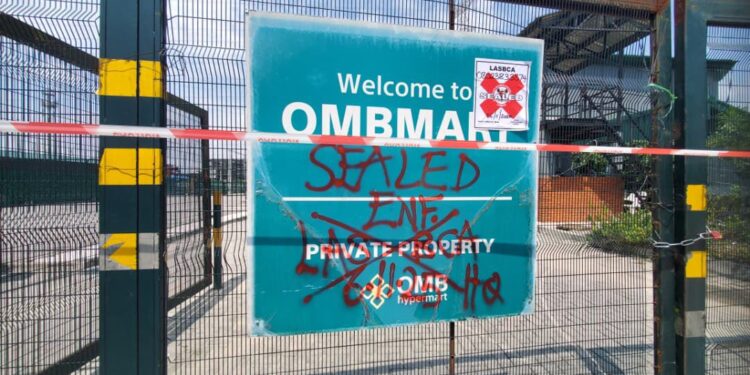

The Lagos State Government has issued a strict 72-hour ultimatum to QMB Mart, a popular commercial centre, demanding the immediate removal of all illegal structures erected on the coastal road and beneath high-tension power lines. This action marks an intensification of the state’s enforcement efforts against unauthorised property developments, particularly in high-value areas like Lekki.
The Lagos State Building Control Agency (LASBCA) initiated the directive, targeting structures that have been built without the necessary government authorisation or which violate the original purpose of the land.
Dr. Olajide Babatunde Abiodun, Special Adviser to the Governor on E-GIS and Urban Development, explained the core reason for the action, stating that the space currently occupied by QMB Mart was originally designated “strictly for use as a parking lot.”
“Development in Lagos must follow due process,” Dr. Abiodun stressed. “Any structure built without approval or any change of use of Government-Allocated spaces without authorisation is illegal. We are committed to ensuring that the master plan of the state is respected.”
He highlighted that the occupants had illegally converted the area into a full commercial hub, illegally operating a laundromat, a clubhouse, and an eatery without official approval.
During the enforcement operation, LASBCA officials also sealed several other buildings across the Lekki and Ikoyi areas found to have commenced construction without the required building authorisation. Builder Gbaye Florence, the General Manager of LASBCA, reaffirmed the agency’s commitment to maintaining safety standards.
“Our job is to ensure that buildings across Lagos are safe and comply with global standards,” she stated. “Anyone who puts up structures without approval will be tracked, marked, and appropriate enforcement actions taken.”
This aggressive enforcement drive, which is part of a larger campaign that detected infractions by 8,663 building owners in the past year, carries significant economic implications for Lagos.
First, the enforcement seeks to protect the long-term viability of the state’s urban planning and infrastructure. Illegal structures, especially those encroaching on coastal roads or utility corridors like power lines, can compromise public safety and undermine critical infrastructure projects, which in turn discourages both local and foreign investment. The government’s firmness signals a commitment to the rule of law regarding property, which is a major factor for investors.
Secondly, the crackdown aims to safeguard the integrity of the real estate market. When developers bypass approval processes, they often use substandard materials, leading to the collapse of buildings—a persistent issue in Lagos. By ensuring that all construction meets global safety standards and obtains certificates of completion and fitness for habitation, the state is attempting to professionalise the sector, ultimately boosting consumer confidence and property values in the long run.
The state noted that in the previous year, it brought down 349 distressed properties and temporarily took over 39 collapsed buildings as a sanction, demonstrating the high cost of non-compliance to both developers and the wider economy. This current ultimatum to QMB Mart serves as a prominent warning that commercial gain cannot override public safety and regulatory compliance.