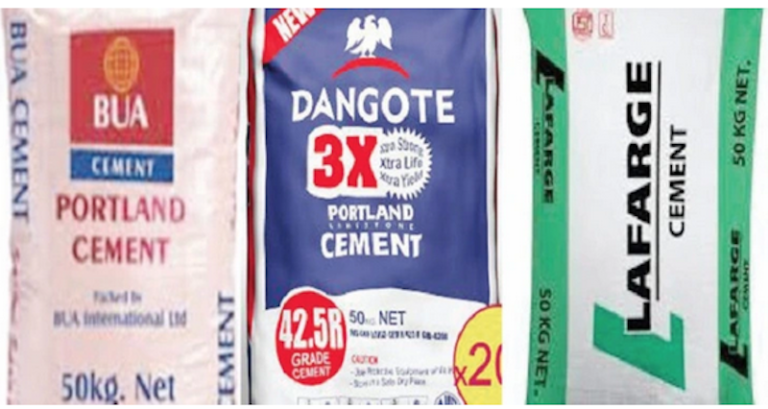

Nigeria’s three largest cement manufacturers, Dangote Cement Plc, BUA Cement Plc and HBM Nigeria Plc, formerly Lafarge Africa, generated a combined revenue of ₦5.8 trillion in the first nine months of 2026, supported by higher cement prices and increased demand.
The figure represents a 21 per cent increase from the ₦4.8 trillion recorded during the corresponding period of 2025, according to their unaudited financial statements for the nine months ended September 30, 2026. Dangote Cement accounted for the largest share, generating ₦3.8 trillion in revenue, representing a 19.6 per cent increase from ₦3.15 trillion recorded a year earlier.
The company also increased its production capacity by nine per cent to 22.1 million metric tonnes from 20.2 million tonnes in 2025. Its cement sales rose by 6.4 per cent to 14.1 million tonnes, while its average selling price increased by 9.4 per cent to ₦170,493 per tonne. BUA Cement recorded revenue of ₦1.09 trillion, representing a 26.5 per cent increase from ₦858.72 billion in the previous year. HBM Nigeria also reported ₦928.25 billion in revenue, up from ₦780.5 billion, representing growth of nearly 19 per cent.
The revenue growth comes amid rising cement prices across the country. A 50kg bag sold for between ₦12,000 and ₦15,000 in Lagos and Ogun States between July and September 2026, compared with approximately ₦10,000 in September 2025.The improved earnings were partly supported by increased construction activities, including government infrastructure projects, housing developments and private sector investments.
Nigeria’s construction sector expanded by 6.38 per cent year on year in the second quarter of 2026, following growth of 6.4 per cent in the first quarter. The sector contributed to the country’s overall economic growth of 4.5 per cent during the second quarter.
Government infrastructure projects, including the Lagos Calabar Coastal Highway, Sokoto Badagry Superhighway and Abuja Kaduna Zaria Kano corridor, have also supported demand for construction materials. In addition, about 10,000 housing units are being developed across 14 states. Despite the revenue increase, the manufacturers recorded higher production expenses. Their combined cost of sales rose to ₦2.23 trillion in the nine months of 2026, compared with approximately ₦2.04 trillion in the corresponding period of 2025.
Their combined profit before tax also increased by 21.4 per cent to ₦2.01 trillion from ₦1.66 trillion a year earlier.
Dangote Cement contributed the largest share, recording profit before tax of approximately ₦1.04 trillion, while BUA Cement posted ₦556.7 billion, representing a 64.4 per cent increase from the previous year. HBM Nigeria recorded ₦414.43 billion, up 32.3 per cent from ₦313.29 billion. BUA Cement’s Managing Director and Chief Executive Officer, Yusuf Binji, attributed the company’s performance to improved sales and changes in its distribution operations.
He said: “I am delighted with our performance, which demonstrates resilience despite challenging conditions, particularly on account of the heavy rainfall and its impact on road infrastructure. We surpassed our quarterly performances of 2025 through the addition of bulk customers, the acquisition of LNG trucks, and the further restructuring of our logistics operations.”
Binji added that investments in liquefied natural gas trucks would improve distribution efficiency and reduce the company’s environmental impact. HBM Nigeria’s Chief Executive Officer, Lolu Alade-Akinyemi, said the company’s performance reflected stronger sales volumes, improved distribution and cost management.
He explained that planned maintenance at existing plants affected its third quarter performance but would improve operational efficiency and production capacity ahead of the final quarter. The company expects stronger demand during the fourth quarter, traditionally an active period for construction and building activities.
The results highlight the growing financial strength of Nigeria’s major cement manufacturers, even as rising building material prices continue to increase construction costs for households, contractors and property developers.