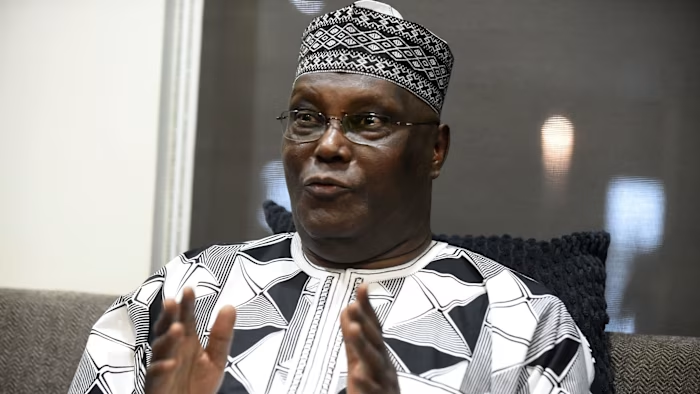

Former Vice President Atiku Abubakar has questioned the Federal Government’s borrowing strategy as Nigeria’s public debt rose to ₦166.79 trillion by June 30, 2026, demanding an account of how the country’s obligations have grown alongside higher government revenues.
Atiku said the Tinubu administration must explain why Nigerians are still facing higher living costs while government borrowing continues to increase.
His position was contained in a statement issued on Saturday, September 26, 2026, by Phrank Shaibu, Director of Strategic Communications of the African Democratic Congress Presidential Campaign Council.
The intervention followed the latest public debt figures released by the Debt Management Office, which showed that Nigeria’s total public debt increased by ₦7.44 trillion from ₦159.35 trillion at the end of March 2026 to ₦166.79 trillion by June 30, 2026. The increase represents about 4.7% in three months.
The DMO said domestic debt accounted for ₦91.59 trillion, or 54.91% of the total, while external debt stood at ₦75.20 trillion, representing 45.09%.
Federal Government debt stood at ₦152.77 trillion, while the 36 states and the Federal Capital Territory accounted for ₦14.01 trillion.
Atiku said the administration should provide a detailed reconciliation of its borrowing, including Treasury Bills, new debt and debt-service transactions.
He specifically questioned the ₦19.48 trillion in outstanding Federal Government Treasury Bills as of June 30, 2026, asking the government to explain which instruments had matured, which had been redeemed or rolled over, and which represented fresh borrowing.
The former vice president also raised questions over $39.25 million classified as “other charges” in the DMO’s second-quarter 2026 external debt-service report.
According to The PUNCH’s report on September 27, 2026, the amount included $22.5 million linked to a First Abu Dhabi Bank Total Return Swap and about $8.97 million against Deutsche Bank AG. Atiku called for greater transparency around the transactions.
He also linked the rising debt burden to the hardship Nigerians have experienced since the removal of the petrol subsidy and other economic reforms introduced by the Tinubu administration in 2023.
Atiku argued that Nigerians had been asked to make sacrifices while the government continued to borrow, questioning whether the increased revenue being reported by the administration was translating into better living conditions and public services.
However, the increase in the naira value of Nigeria’s debt should not automatically be treated as equivalent to fresh borrowing. The debt stock is affected by exchange-rate movements, particularly when foreign-currency obligations are converted into naira.
The DMO’s latest figures put Nigeria’s total public debt at $120.93 billion as of June 30, 2026.
The figures have renewed scrutiny of the government’s borrowing plans as the Federal Government faces continued financing needs for its budget and development programmes.