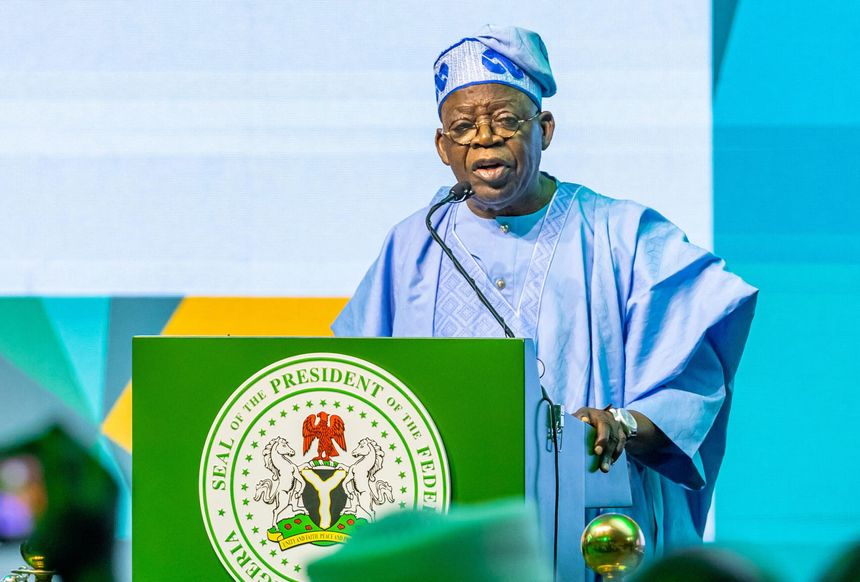

President Bola Tinubu has declared that Nigeria has moved beyond the difficult phase of economic reforms and entered what he described as an “age of prosperity”.
Tinubu made the declaration in his Independence Day address to Nigerians on Thursday as the country marked its 66th anniversary. The President said the reforms introduced by his administration were necessary to address longstanding economic problems and create the foundation for sustainable growth.
“The age of reform has done its work. Now begins the age of prosperity,” Tinubu said.
He acknowledged that the reforms had brought significant difficulties for millions of Nigerians, particularly through higher living costs, but argued that the challenges were the result of economic problems that had accumulated over several decades. According to him, successive governments had postponed difficult decisions, allowing economic distortions to deepen.
Tinubu compared the situation to a patient undergoing painful treatment for a serious illness, arguing that the government had chosen to address the underlying problems rather than temporarily ease their effects. He also rejected calls for a return to petrol subsidies, describing such proposals as a return to arrangements that, in his view, had concealed rather than solved Nigeria’s economic weaknesses. The President said the economy had begun showing signs of improvement, citing stronger economic growth, declining inflation from its peak, improved foreign exchange stability, increased foreign reserves and higher non oil export earnings.
He said the government’s next priority was to ensure that economic improvements translated into better living conditions for Nigerians.
“When I speak of prosperity, I do not speak merely of a larger economy, abstract numbers or better statistics. I mean something much more personal,” Tinubu said.
He explained that prosperity should mean lower production and transportation costs, more affordable goods, reliable electricity for businesses, access to credit and greater opportunities for Nigerians to earn productive incomes. Tinubu said the government would focus on agriculture, industrialisation, infrastructure, skills development and digital connectivity to support economic expansion.
He said investments in roads, railways and ports would help connect farms and factories to markets, while measures to improve agricultural production would increase food supply and reduce losses between farms and consumers. The President also identified job creation as a major part of the government’s economic agenda, particularly because of Nigeria’s large young population.
“We are therefore placing jobs, enterprise, and industrial growth at the heart of our government’s policies,” he said.
Tinubu acknowledged that many Nigerians were still struggling to afford food, education, healthcare and transportation. He said the government was expanding social support programmes and improving the National Social Register to ensure assistance reached vulnerable households. He also highlighted the Nigerian Education Loan Fund and consumer credit initiatives as measures designed to widen access to education and essential assets. However, Tinubu said such interventions were not substitutes for broader economic prosperity.
“These programmes are not substitutes for prosperity. They are a bridge to aid our nation’s citizens on their path towards it,” he said.
The President maintained that the government could not reverse decades of economic challenges within four years but could change the country’s direction.
“We cannot erase in four years what accumulated over generations. But we can change its course,” he said.
Tinubu urged Nigerians to remain focused on the future, saying the country had passed through a difficult period and should now concentrate on building an economy where prosperity is broadly shared.
“Our destination is in sight. Our foundations are strong. Our direction is clear. So let us go forward. No looking back,” he said.