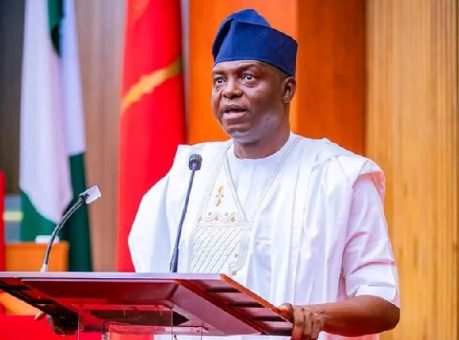

The National Chairman of the All Progressives Congress (APC), Prof. Nentawe Yilwatda, has explained why Nigerians questioning the Federal Government’s conditional cash transfer programme may rarely encounter beneficiaries discussing the payments publicly.
Yilwatda said many of the beneficiaries are poor and vulnerable Nigerians who do not have mobile phones, television sets or access to social media.
He made the remarks on Saturday, September 26, 2026, while responding to journalists after a three-day APC National Executive Council retreat in Maiduguri, Borno State.
“We have given 75,000 naira to over 10 million Nigerians across the country using the conditional cash transfer under the Ministry of Humanitarian Affairs and Poverty Reduction,” Yilwatda said.
“Mind you, these people who are poor and vulnerable don’t have telephones to make calls; they are not on social media. They don’t have a television. They cannot come and challenge and discuss as we are doing here, but they are out there,” he added. His remarks were reported by Punch and Vanguard on September 26 and 27, 2026.
The latest claim comes against a backdrop of continuing questions over the reach, beneficiary numbers and verification of the Federal Government’s cash transfer programme.
In an implementation update published on March 30, 2026, the News Agency of Nigeria reported that 9,178,837 households had received the initial ₦75,000 payment under the government’s Household Prosperity and Empowerment Cash Transfer (HOPE-CT) programme. The government said 7.2 million households had received the second tranche, while more than 6.4 million had received the third tranche at the time.
By August 2026, Humanitarian Affairs and Poverty Reduction Minister Bernard Doro said the Federal Government had disbursed more than ₦600 billion in cash transfers over three years, reaching slightly more than 10 million households. Doro made the disclosure during an interview with Channels Television on August 26, 2026.
A World Bank implementation report cited by THISDAY on September 21, 2026, put the number of poor and vulnerable households that had received economic shock-responsive cash transfers at 10.43 million as of August 2026. It said more than 7.1 million households had received all three tranches after biometric verification using their National Identification Numbers or Bank Verification Numbers.
The World Bank also reported that Nigeria’s poverty rate was estimated at 63% in 2025, with an additional seven million Nigerians estimated to have fallen into poverty that year. It said the rollout of targeted transfers to 15 million vulnerable households had been slower than planned because of the integration of the national social register with the national identity management system.
Questions over verification are not new. On January 27, 2025, Yilwatda, who was then Minister of Humanitarian Affairs and Poverty Reduction, said 19.8 million people were on the national social register but only about 1.2 million had been validated at that stage. He said the government needed to authenticate beneficiaries, confirm their locations and assess their socioeconomic conditions before payments.
The Auditor-General for the Federation also raised concerns in a 2024 annual report submitted in July 2026. The report, reviewed by TheCable in September 2026, said there was insufficient evidence to establish that ₦33.75 billion transferred to 3.29 million vulnerable households in 2023 reached genuine beneficiaries.
Former Vice-President Atiku Abubakar subsequently questioned the government’s reported beneficiary and disbursement figures. In a statement reported by Tribune on September 5, 2026, Atiku called for greater transparency over the programme and said publicly available figures should be reconciled with payment and audit records.
Yilwatda has previously defended the government’s targeting process. In May 2025, while still serving as humanitarian affairs minister, he said artificial intelligence, satellite imagery and telecommunications data were being used to identify poor people and expand the national social register. He also said research involving the World Bank and civil society organisations found that 18% of recipients were able to start nano or small-scale businesses with the funds.
His latest comments came as the APC concluded its Maiduguri retreat. Yilwatda said the party’s National Executive Council reviewed its structures from the national level down to states, local governments, wards and polling units, while also resolving to strengthen reconciliation efforts ahead of the 2027 general elections. The NEC also passed a vote of confidence in President Bola Tinubu and Vice-President Kashim Shettima.
The competing figures and audit concerns leave the cash transfer programme under continued public scrutiny, particularly over how beneficiaries are identified, how payments are reconciled and how the government can independently demonstrate that funds reached the intended households.