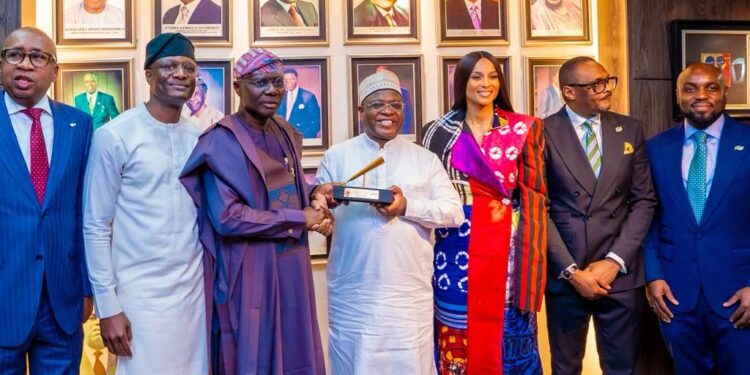

The Nigerian Exchange Group (NGX Group) headquarters in Lagos became the intersection of high finance and high fashion recently as Governor Babajide Sanwo-Olu performed the symbolic Closing Gong Ceremony to mark the end of Lagos Fashion Week. The event, which drew prominent figures including international music star and fashion icon Ciara Wilson, served to spotlight a crucial new focus: how Nigeria’s thriving creative economy can secure much-needed capital market financing to achieve sustainable, long-term growth.
The gathering emphasised a concerted effort to connect the vast potential of the creative sector spanning film, music, arts, and fashion with the structured investment resources available on the stock market. This initiative is timely, given the significant economic muscle the sector already wields, despite facing chronic funding challenges.
The creative economy in Nigeria is widely recognised as a dynamic cultural and economic engine, and is projected to reach a valuation of between $14.8 billion and $15 billion by 2025. Specifically, the nation’s fashion industry alone contributes an estimated $6.1 billion to the Gross Domestic Product (GDP). However, for too long, many small and medium-sized enterprises (SMEs) within the sector have struggled to access conventional financing, with banks often perceiving creative ventures as overly risky. The engagement with the Nigerian Exchange Group seeks to bridge this critical funding gap and transform cultural expressions into reliable economic assets.
Speaking at the ceremony, Governor Sanwo-Olu commended the NGX Group for its role in bringing this focus to the fore, noting that Lagos remains at the “forefront of Africa’s creative renaissance.” He stressed his administration’s commitment to supporting the sector through improved infrastructure, supportive policies, and, crucially, access to finance.
“Lagos is a city where innovation, culture, and enterprise intersect,” Mr Sanwo-Olu said. “Our ambition is clear: to position Lagos as a global hub for creativity and investment. By deepening linkages with the capital market through institutions like the Nigerian Exchange Group, we can unlock financing that empowers creative entrepreneurs to scale sustainably and compete on the world stage.”
Alhaji Umaru Kwairanga, the Group Chairman of NGX Group, reinforced this view, describing the ceremony as a template for how the capital market can actively support emerging sectors of the economy. He drew a parallel between the two seemingly distinct worlds, stating, “At NGX Group, we believe the creative economy and the capital market share a common purpose—transforming ideas into enduring value.” He added that across the entire fashion value chain, countless SMEs possess the potential to become industry leaders if they can access the right sustainable financing and institutional support.
This sentiment was echoed by Mr Temi Popoola, Group Managing Director/Chief Executive Officer of NGX Group, who reaffirmed the Group’s commitment to driving innovation across all economic segments. “The creative economy represents one of the most dynamic frontiers of growth in Africa,” he noted. “We see immense potential in connecting creativity with capital, enabling designers, entrepreneurs, and innovators to grow sustainably through the discipline and transparency the capital market provides.”
The global endorsement of Nigeria’s creative momentum came from American singer Ciara Wilson, who was also in attendance. She expressed her admiration, saying, “It’s amazing to see Lagos and Nigeria levelling up, not just creatively, but economically.” She emphasised that the blend of local energy, world-class talent, and innovation, when combined with the structure and investment offered by the capital market, is the formula for “building something truly global and sustainable.”
Mr Tokunbo Akerele, Chairman of Style House Files and Lagos Fashion Week, underscored the growing economic significance of Nigeria’s creative industries. “Today’s ceremony reflects the recognition of fashion as a key contributor to economic development,” he stated. He added that engaging platforms like the Exchange helps to amplify the message that the creative economy is a powerful engine for growth, social impact, and investment.
The event also highlighted that for creative businesses to attract and retain long-term capital, adherence to Environmental, Social, and Governance (ESG) standards and circular economy practices is essential. As investors increasingly prioritise sustainability, integrating these principles enhances credibility and strengthens global competitiveness, ultimately solidifying Lagos State’s position as Africa’s emerging investment gateway for the creative economy.