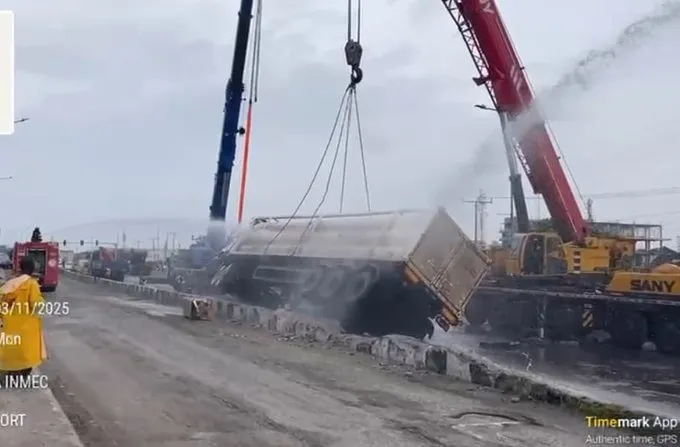

A major traffic disaster was narrowly avoided in Lagos this morning after a gas tanker overturned on a critical thoroughfare, sparking panic among motorists and residents and forcing a total closure of the road. The incident, which occurred near the Chisco axis of the busy corridor leading into Victoria Island, immediately drew a huge response from emergency services as they raced to contain the highly flammable material and prevent a catastrophic explosion.
The tanker, laden with liquefied petroleum gas, reportedly fell onto its side near the traffic light junction, instantly grinding vehicular movement to a standstill. Police officers, alongside officials from the Lagos State Traffic Management Authority and the Fire Service, quickly cordoned off the entire main carriageway, advising all road users and nearby residents to steer clear of the area. This swift, co-ordinated action, which is designed to prevent secondary incidents such as fire or explosions, was credited with averting a potential tragedy, especially given the history of fatal tanker accidents in the city. The driver of the tanker was rescued from the scene after sustaining injuries to his hand and was promptly transferred to a medical facility for treatment.
The necessary safety procedures, however, led to severe chaos across one of Africa’s most populated urban areas. The road closure choked the city’s complex network of routes, with the resulting gridlock extending for several miles and lasting for hours. Stranded commuters were forced to abandon their vehicles, choosing instead to trek long distances to their workplaces or homes.
One frustrated motorist, Jane Kenneth, told reporters she had been trapped in the congestion since eight o’clock in the morning. “Every few months, it’s the same story,” she lamented. “Whether it’s a tanker, or a large container, these breakdowns and accidents shut down the whole city. I have an important meeting that I will certainly miss now.” Her sentiment was echoed by thousands who were forced to endure hours of delay.
Beyond the immediate fear and personal inconvenience, incidents like this carry a heavy financial cost for Lagos and the national economy. As Nigeria’s primary commercial hub, Lagos relies heavily on its road network for transporting goods, including fuel and commercial cargo. When a key artery is blocked by a tanker accident, the disruption is not merely an inconvenience; it becomes a direct financial drain.
Experts estimate that the frequent occurrence of such accidents, often linked to poor vehicle maintenance and reckless driving, results in colossal losses due to lost productivity and increased business costs. For every hour that the road is closed, companies suffer from massive logistics delays, forcing them to spend more on fuel, labour, and vehicle maintenance as trucks sit idling in traffic. Businesses that depend on just-in-time delivery are forced to maintain higher inventory levels, tying up valuable capital. Furthermore, the sheer unpredictability of travel times damages Lagos’s reputation as a business-friendly environment, escalating the overall cost of doing business and, ultimately, driving up the price of goods for the average consumer.
The Director of Public Affairs for the Lagos State Traffic Management Authority, Adebayo Taofiq, appealed to the public for patience while recovery teams worked to clear the overturned tanker quickly and professionally. He emphasised that the government’s top priority was the safety of road users, promising that vehicular movement would be restored as soon as the hazardous material was safely secured and the truck removed. The recurring nature of these events, however, continues to highlight the need for stricter safety enforcement and better transport infrastructure management for heavy-duty vehicles across the state.