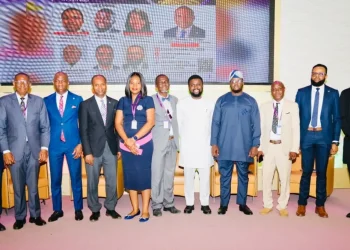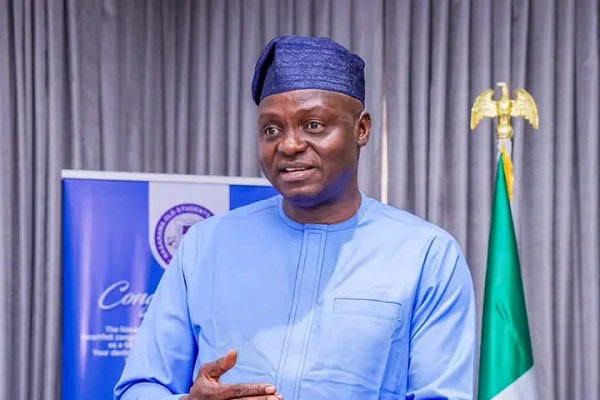

Nentawe Yilwatda, national chairman of the All Progressives Congress, APC, says President Bola Tinubu’s economic reforms and infrastructure investments are putting Nigeria on the path to becoming a $1 trillion economy by 2030. Yilwatda made the statement while representing President Tinubu at the second edition of the Asiwaju Scorecard Series and Asiwaju Policy Roundtable organised by the APC Professional Forum.
According to him, the Tinubu administration inherited an economy facing several challenges, including fuel subsidy distortions, multiple foreign exchange windows, weak revenue generation, foreign exchange shortages, rising debt servicing costs and years of inadequate investment in infrastructure. He said the decision to remove fuel subsidies and reform the foreign exchange market was difficult but necessary to change the direction of the Nigerian economy.
Yilwatda pointed to recent economic figures as signs that the reforms are beginning to produce results. He cited Nigeria’s foreign reserves, which stood at about $52.7 billion as of August 2026, stronger non oil revenue and real GDP growth of 4.43 percent in the second quarter of the year. He also noted that inflation had declined to about 15.4 percent and that Nigeria’s merchandise trade position had improved.
“These figures do not mean that our economic challenges have disappeared, but they demonstrate that the direction of travel has changed,” he said.
However, Yilwatda acknowledged that improved economic figures would only matter if they eventually translate into better conditions for ordinary Nigerians.
“The ultimate test is when stability translates into cheaper food, more jobs, affordable credit, reliable electricity and greater purchasing power for Nigerians,” he said.
He explained that the $1 trillion target should not be seen simply as a figure. Instead, he described it as part of a wider plan to increase production, exports, investment and employment. One major part of the plan is the development of an integrated transport and maritime network connecting major deep sea ports in Lagos, Ondo, Akwa Ibom, Rivers and Cross River with road and rail networks leading into the hinterland and neighbouring countries. Yilwatda said the Lagos Calabar coastal highway could become an important part of this network, while improved rail and road connections could help Nigerian businesses reach markets across West, Central and North Africa.
“This is how Nigeria can move beyond being simply a coastal trading nation to becoming the maritime gateway and logistics hub of West and Central Africa, capturing a much larger share of the continent’s trade, logistics, manufacturing and distribution value chain,” he said.
He added that the infrastructure plan could create opportunities in logistics, warehousing, freight forwarding, customs, banking, insurance, manufacturing, distribution and agro processing. Yilwatda also called for industrial parks, export processing zones, logistics parks, agro processing clusters and manufacturing centres to be developed along major transport corridors. He said infrastructure should directly support productive activities across the country.
“Where rail reaches an agricultural region, processing industries should follow. Where it reaches mineral resources, processing and manufacturing should follow. Where dry ports are established, logistics and distribution businesses should develop around them. This is how infrastructure becomes an engine of economic growth,” he said.
Energy was another key area highlighted by Yilwatda. He identified the Ajaokuta Kaduna Kano gas pipeline as important to connecting gas resources with major industrial and population centres in northern Nigeria. According to him, the pipeline could support electricity generation, fertiliser production, manufacturing, transportation and household energy supply. He also highlighted investments in education, skills development and access to credit. Yilwatda said the Nigerian Education Loan Fund, NELFUND, would help qualified young Nigerians access higher education despite financial difficulties.
“Even if you don’t like President Tinubu, your children can access the fund and access higher education,” he said.
He added that digital training, skills development and credit programmes for small and medium scale businesses could help young Nigerians gain skills, start businesses and create jobs. Yilwatda said the government’s economic plans also include investments in healthcare and solid minerals, including cancer treatment facilities, maternal healthcare and efforts to increase the local processing of Nigeria’s mineral resources.
The APC chairman’s comments come as Nigeria’s economy continues to record growth. The country’s real GDP expanded by 4.43 percent year on year in the second quarter of 2026, up from 3.89 percent in the first quarter. While the government has continued to defend its reforms, Yilwatda stressed that macroeconomic stability must eventually improve the everyday lives of Nigerians. For the $1 trillion ambition to become a reality, the proposed investments will therefore need to translate into stronger production, more jobs, better infrastructure and improved purchasing power for households.