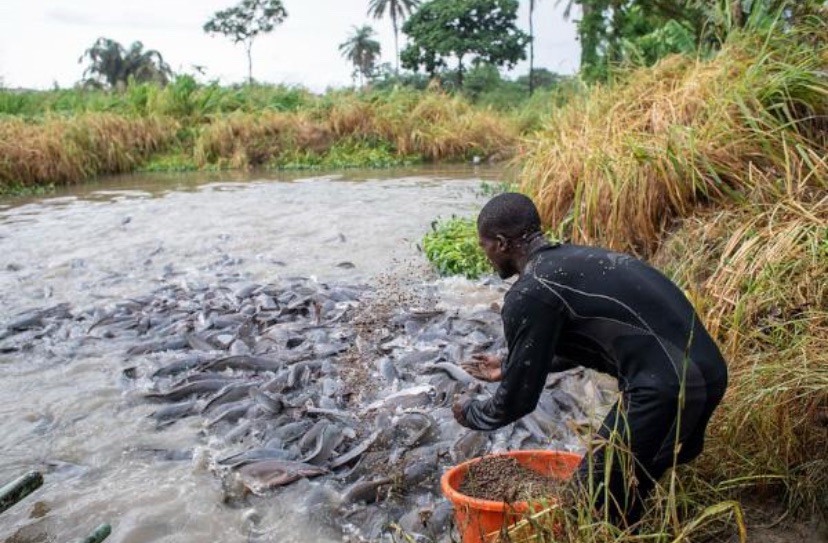

Catfish farming remains one of Nigeria’s popular agribusiness opportunities, but for many farmers, the biggest challenge is no longer finding buyers. It is keeping the fish alive and growing them without allowing feed costs to swallow the expected profit.
Feed is the largest expense in catfish production. A recent study published in the Nigerian Journal of Fisheries found that feed accounted for about 73% of total production costs among catfish farmers surveyed in Lagos and Niger states. The same study, involving 100 farmers, found that catfish farming could still be profitable, with benefit-cost ratios of 2.8 in Lagos and 2.7 in Niger.
But profitability depends heavily on how much a farmer spends before harvest.
Current market listings show how expensive feed has become. In 2026, a 15kg bag of BlueCrown extruded feed has been listed around ₦23,010 to ₦31,510, while Aqualis 15kg feed sells for about ₦31,410 to ₦40,160, depending on pellet size.
For a farmer stocking 1,000 fish, the numbers can quickly become serious. A recent 2026 estimate puts feed consumption for a well-managed 1,000-fish pond at roughly 35 to 45 bags during a five- to six-month production cycle. At current prices, that can translate into hundreds of thousands of naira spent on feed alone.
This creates one of the biggest risks in the business: feed prices can rise faster than the selling price of fish.
A farmer who starts production using one feed price may face a completely different cost by the time the fish reach market size. Rising prices of maize, soybean meal, fishmeal, transportation and other inputs can push manufacturers to increase their prices. Currency movements can also affect imported ingredients and equipment.
For farmers in Ogun State, where fish farming is common around areas such as Ifo, the pressure is particularly important because a higher feed bill means more money must be committed before the farmer receives a single naira from sales.
Mr Agbebiyi, a catfish farmer around the Ifo axis of Ogun State, represents the kind of farmer facing this pressure. In a farmer’s-eye view of the business, the major concern is simple: fish must continue eating even when feed becomes more expensive. Unlike some businesses where an operator can reduce stock immediately, fish still require adequate nutrition to reach market size.
The risk of cutting feed too aggressively is that growth can slow, production may take longer and the farmer could eventually spend even more on water, labour and other running costs.
Yet the increase in feed prices also highlights an advantage of well-managed catfish farming: efficient feeding can protect margins.
Farmers who monitor fish growth, avoid overfeeding, maintain good water quality and use the appropriate pellet size can reduce wastage. Feed conversion is crucial because every kilogram of wasted feed is money lost.
There is also growing interest in alternative feed ingredients. Research supported by the Feed the Future Innovation Lab for Fish is examining insect-based feeds as a way of reducing dependence on conventional fishmeal, which can account for a significant share of production costs.
The opportunity, therefore, has not disappeared. Catfish remains commercially attractive because Nigerians consume it through restaurants, grills, markets and households.
But today’s farmer has to treat catfish farming as a numbers business, not simply a farming activity. Before stocking a pond, the farmer needs to calculate the cost of fingerlings, feed, water, medication, labour, mortality and expected selling price.
For Mr Agbebiyi and other farmers around Ifo, the lesson is clear: the fish may be the product, but feed determines whether the business makes money.
The farmers who survive rising costs will likely be those who control feeding efficiency, buy strategically, monitor their fish closely and know their production cost before setting a selling price.