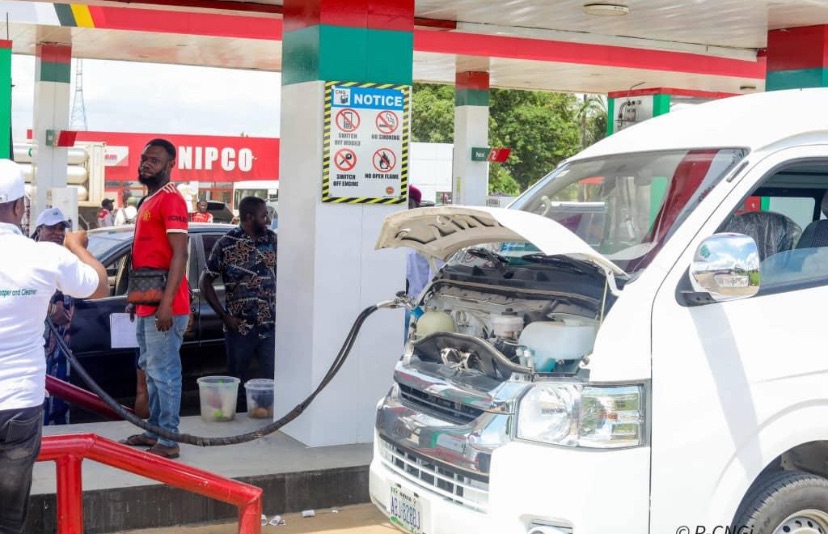

For many Nigerian businesses, fuel is no longer just an operating expense. It can determine how much a company spends on deliveries, staff transportation, logistics and daily operations. The growing use of Compressed Natural Gas (CNG) is beginning to change that calculation.
The shift is particularly important for businesses that depend heavily on vehicles. Delivery companies, transport operators, distributors, manufacturers and other businesses with large vehicle fleets are increasingly looking at CNG as a way to reduce the amount spent on petrol and diesel.
The Presidential Initiative on Compressed Natural Gas and Electric Vehicles (Pi-CNG & EV) says more than 120,000 vehicles have now been converted to CNG, while the country has more than 400 certified conversion centres and over 90 CNG refuelling stations. The programme also reports that more than 7,700 technicians have been trained.
The attraction is largely the difference in running costs.
In September 2025, CNG retail prices at major outlets in Lagos and Abuja rose from ₦230 to ₦380 per standard cubic metre (SCM). Even after that increase, CNG remained substantially cheaper than petrol and diesel for many vehicle users.
The impact becomes clearer for businesses operating vehicles every day. Pi-CNG & EV estimates that commercial drivers can save about ₦40,000 per month on average by switching to CNG. The initiative also says CNG can be 40–60% cheaper per kilometre than petrol, depending on the vehicle and operating conditions.
For a business running 20 commercial vehicles, a ₦40,000 monthly saving per vehicle would amount to about ₦800,000 in potential monthly fuel savings, or ₦9.6 million over a year, before accounting for conversion and maintenance costs.
This changes the structure of business expenses. Money that previously went almost entirely into fuel can potentially be redirected towards wages, inventory, maintenance, expansion or other operating needs.
However, switching to CNG is not free. Businesses have to consider the upfront cost of conversion, access to refuelling stations and the time vehicles may spend travelling to available CNG outlets.
The Federal Government is attempting to reduce this barrier. In April 2026, it introduced a CNG conversion financing framework under the Pi-CNG & EV programme to help motorists and transport operators spread the cost of converting their vehicles instead of paying the entire amount upfront.
Infrastructure is also expanding. In May 2026, the government commissioned four major CNG infrastructure projects across Lagos, Abuja and Owerri.
For Nigerian businesses, therefore, CNG is becoming more than an alternative fuel. It is becoming a cost-management strategy. Companies with high fuel consumption now have another option for controlling one of their largest variable expenses.
The transition will not happen overnight, especially while CNG infrastructure remains uneven across the country. But as more vehicles are converted and more refuelling stations become available, the economics of running a business could increasingly depend on which fuel companies choose to put in their tanks.