

Nigeria’s recent approval of a 15% ad valorem import duty on petrol and diesel represents a pivotal moment in the nation’s energy policy. Framed by the government as a strategic move toward energy sovereignty, this protectionist measure aims to shield multi billion dollar domestic investments, particularly the landmark Dangote Refinery. However, this well intentioned push for self sufficiency may prove to be a grave economic miscalculation that risks national stability, harms consumers, and ultimately stifles the long term competitiveness of Nigeria’s refining sector.
The Case for Protection: Shielding Domestic Investment
Proponents of the tariff argue it represents a necessary corrective measure to protect local industry from international competition. The Dangote Refinery, the policy’s primary beneficiary, has been particularly vocal in its support. Anthony Chiejina, the company’s Group Chief Branding and Communications Officer, asserts that the refinery is already “loading over 45 million litres of PMS and 25 million litres of diesel daily,” which he claims “exceeds Nigeria’s demand.” Chiejina welcomes the duty as a measure that will “protect local industries, discourage dumping of substandard products, and encourage fresh investments.” He describes the tariff as “a patriotic step” that will stabilize the naira, improve energy security, and prevent the kind of “dumping [that] destroyed our textile industry.”
This perspective finds significant support within the oil and gas marketing community. The National President of the Independent Petroleum Marketers Association of Nigeria (IPMAN), Abubakar Maigandi, has sought to “downplay public anxiety,” stating there was “no cause for alarm” and that the policy is designed to encourage local refinery investments. A more robust endorsement comes from former IPMAN National Operations Controller Mike Osatuyi, who commended the move as a “bold and patriotic step” crucial for protecting “massive private investments worth billions of dollars.” Osatuyi argues the policy ensures the “sustainability of both existing and upcoming private refineries,” and dismisses scarcity fears, stating “Dangote Refinery alone could meet national demand and still have excess for export.”
The Economic Peril: Inflation and Market Volatility
Despite these assurances, energy economists and market analysts highlight profound and immediate risks. The fundamental flaw, they argue, lies in confusing “market control” with “market competence,” assuming that excluding competition will automatically make domestic industry efficient and cost effective.
Femi Oladehin of Argentil Capital Partners expressed deep skepticism about the underlying strategy, stating bluntly: “The world has shown us that protectionism does not necessarily end with the desired results governments anticipate.” He described the decision as “hasty,” considering the nascent state of the new refinery and its potential for downstream disruptions. The most immediate impact will fall on consumers, with Oladehin warning that “higher petrol prices are a significant contributor to inflation, which could increase by 2 to 3% in headline figures due to this import duty.”
The mechanism of consumer harm is straightforward. Dr. Ayodele Oni, an energy law expert, warned unequivocally that “The imposition of a 15% duty will increase the landing cost of imported fuel, and this additional cost will be passed on to consumers.” Projections indicate the duty could add approximately ₦99.72 per litre to the landing cost of imported petrol, pushing estimated pump prices toward ₦964.72 per litre in Lagos. In a deregulated market, Oni cautions, this creates a “strong possibility of price volatility.”
Beyond inflation, the most critical vulnerability lies in supply security. True energy security must come from multiple, reliable supply chains rather than dependency on a single domestic source. The regulator, the Nigerian Midstream and Downstream Petroleum Regulatory Authority (NMDPRA), has itself stated that less than 50% of the nation’s daily consumption is met domestically. Dr. Oni warned that if local refining capacity falters, the policy could “disrupt supply, as over 60% of Nigeria’s fuel is still imported.” Halting imports prematurely, based on projected rather than proven capacity, risks market shortages and economic chaos.
The Monopoly Concern and Historical Precedents
The market structure itself poses inherent dangers. A shielded, monopolistic market allows dominant players to dictate prices, ensuring cost savings are kept as profit rather than passed to consumers, while quality stagnation becomes inevitable without competitive pressure to meet international standards.
Public policy analyst Rotimi Matthew described the petrol duty as “an attempt to legislate monopoly pricing under the guise of public interest.” He argues that genuine reform would “promote open competition, reduce inefficiencies, and create a transparent pricing system that benefits consumers rather than a few dominant players.” Dr. Oni added that the policy “could push out smaller independent marketers who may be unable to meet the new cost requirements,” leaving the market “dominated by larger players.”
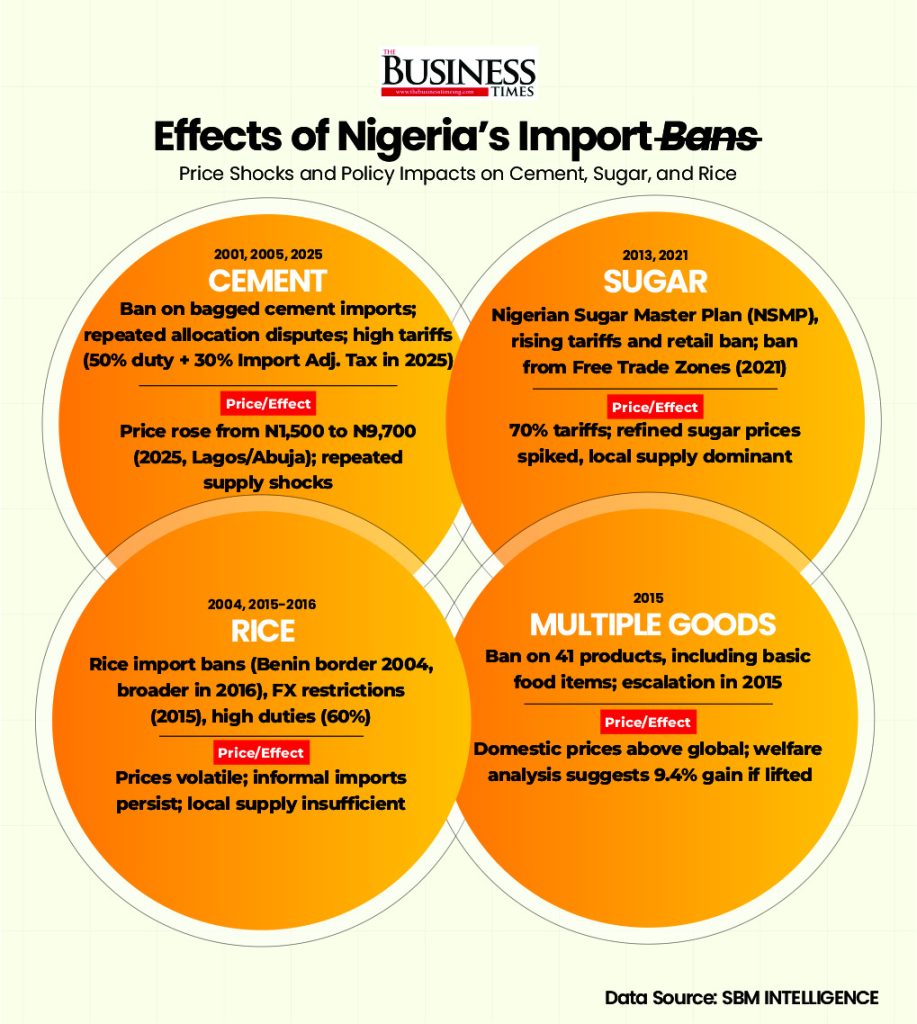
These concerns are grounded in Nigeria’s troubled history with protectionist policies. Previous import restrictions on essential commodities reveal a consistent pattern of consumer harm resulting from market dominance and restricted competition.
The cement sector provides a stark example, where bans and high tariffs saw prices skyrocket from ₦1,500 to ₦9,700 per bag, accompanied by repeated supply shocks. Similarly, the Nigerian Sugar Master Plan with its rising tariffs and retail bans led to 70% tariffs and spiked refined sugar prices, creating a market dominated by few local players. Rice import bans resulted in volatile prices and persistent informal imports due to consistently insufficient local supply. In each case, protectionism succeeded in creating fortified local champions but failed Nigerian consumers through artificial scarcity, inflated costs, and suppressed competition.
The Regulatory Framework and PIA Compliance
The Petroleum Industry Act provides a cautionary framework that should temper protectionist enthusiasm. While the PIA grants the NMDPRA authority under Section 317 to implement backward integration policies encouraging local refining, the broader spirit of the Act envisions a “transparent, competitive, and investment friendly ecosystem,” not single source dominance.
Energy economist Professor Wunmi Iledare described the tariff as a “strategic inflection point,” noting that policymakers “must balance protection with competition to avoid market concentration.” Policy analysts highlight that the PIA’s architecture envisions a “competitive environment where both large and modular refineries coexist alongside independent marketers.”
However, implementation proves crucial. Weak enforcement of competition clauses could tilt the market toward dominance by few large refiners, undermining the efficiency gains that liberalization aims to achieve. The PIA’s success depends on using its provisions to ensure open access to refining and distribution infrastructure, fair licensing, and transparent pricing mechanisms. For critics, the NMDPRA’s failure to publish sufficient empirical evidence supporting its domestic supply capacity claims highlights dangerous transparency deficiencies in a decision of such magnitude.
A Viable Path Forward: Fostering Genuine Competition
The alternative to blanket protectionism involves cultivating a genuinely competitive and resilient market. The government should focus on empowering multiple local suppliers rather than banning efficient competitors. A reform minded approach must create a sector that competes on merit rather than surviving behind protective barriers.
The path forward requires strategic support rather than market containment. First, ensuring reliable supply of local crude oil to domestic refiners at fair, naira denominated prices remains essential. Second, diligent enforcement of regulatory standards should prevent substandard product dumping without resorting to blanket import restrictions. Third, supporting multiple players including other local refineries like the upcoming BUA facility and various modular refineries, alongside efficient private importers, will create a resilient, diversified market.
As Dr. Oni advised, the government should incentivize local refining “through tax holidays, duty free importation of refining equipment, and infrastructure investment rather than imposing heavy tariffs on imports.”
The ultimate test for this policy lies not in Dangote Refinery’s profitability, but in whether Nigerian citizens benefit through stable supply and affordable prices. The government must establish clear metrics: within 18 months, can domestic refineries sustainably meet at least 80% of national demand while keeping price increases within the 15% duty level that would have applied to imports? If not, the policy will have simply shifted costs from government tariffs to higher pump prices and potential monopoly profits.
Nigeria stands at a crossroads between market control and market competence. True energy security will be built on competition, transparency, and supply diversity rather than domestic monopoly that risks holding the nation’s economy hostage. The stakes for Nigeria’s economic stability and citizen welfare have never been higher.